






 Unsupervised ML
Anomaly Detection With Mathematical Precision
When traditional threshold-based monitoring generates noise, consensus-based machine learning delivers clarity. Netdata trains 18 independent models per metric at the edge, achieving 99% false positive reduction in anomaly detection - all with zero configuration and included at no additional cost.


Intelligence Without Complexity
Enterprise ML for every team
99% Fewer False Positives
18-model consensus requires unanimous agreement, achieving theoretical false positive rate of 10^-36 per metric in anomaly detection.
Zero Configuration
ML trains automatically on every metric from installation. No thresholds to tune, no expertise required, no maintenance needed.
90% Cost Reduction
Sophisticated ML included with predictable per-node pricing, on every metric. No per-metric charges, no premium ML tiers, no surprises.
Mathematical Transparency
Simple k-means clustering, not black-box deep learning. Algorithm visible on GitHub, auditable by regulators, verifiable by engineers.
Edge Intelligence
ML trains where data lives - on each monitored node. Complete data sovereignty, zero egress costs, infinite scalability.
15-Minute Time to Value
First anomaly detection within 15 minutes of installation. Full confidence in 2 days as all 18 models complete training cycles.
Trusted by DevOps teams worldwide








































Transform Anomaly Detection Into Actionable Intelligence
Trust Your Anomaly Detection Results
99% false positive reduction
See the math behind consensus detection

Deploy Faster Than Competitors Can Configure
60 seconds to ML-powered monitoring
Experience zero-config deployment

Break the Monitoring Cost Spiral
90% cost reduction
See pricing details

Satisfy Regulators With Transparent ML
SOC 2 Type 2 certified
Learn about compliance-ready ML

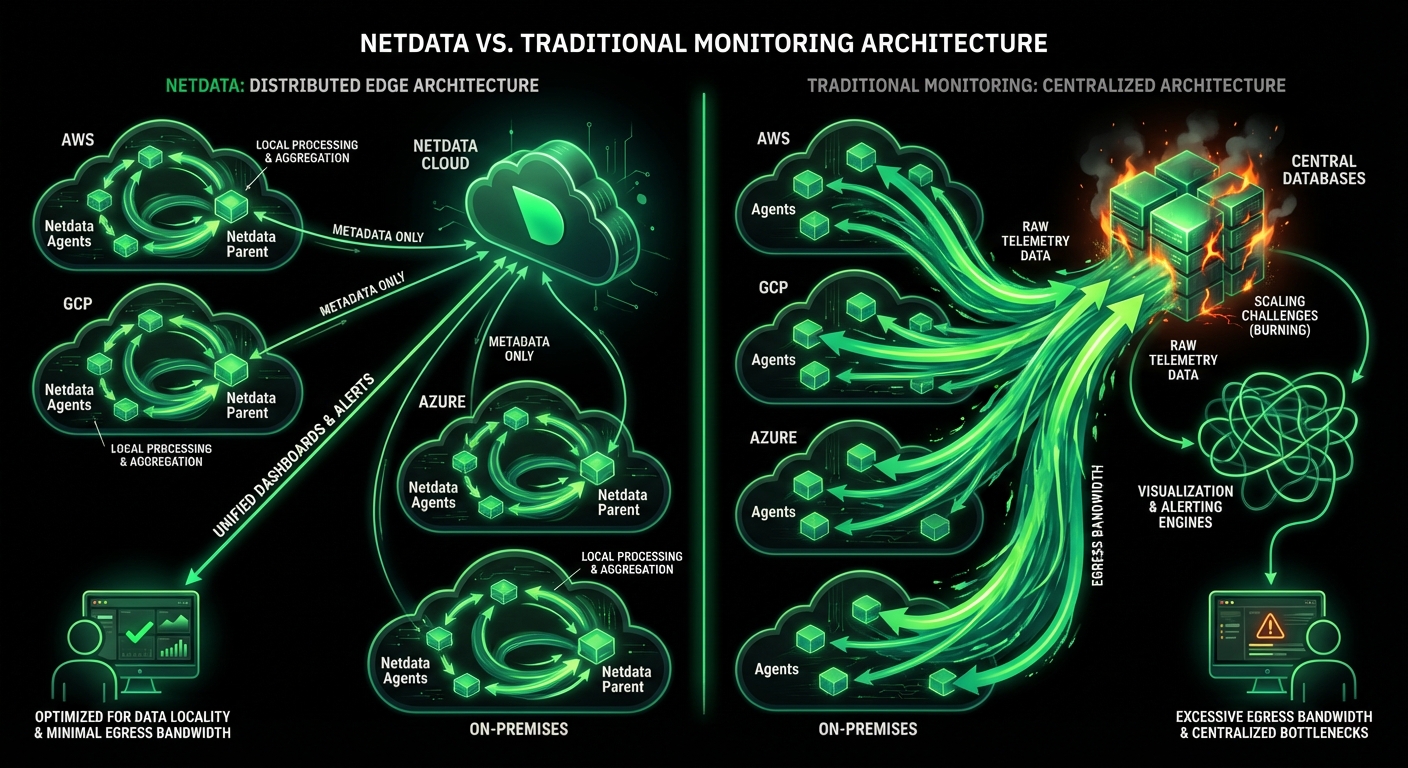
Scale Without Central Bottlenecks
Linear scalability to 100,000+ nodes
Understand edge ML architecture

Accelerate Resolution With Automatic Root Cause
80% MTTR reduction
See root cause analysis in action

How Netdata Compares
Consensus-Based ML vs Traditional Approaches
See how Netdata’s 18-model consensus architecture delivers superior results.
Capability
Netdata
Traditional Platforms
False Positive Rate
✅ 99% reduction
18-model consensus in anomaly detection
⚠️ Higher false positives
Single-model approaches typical
Configuration Required
✅ Zero configuration
Automatic on all metrics
⚠️ Extensive setup
Manual threshold tuning, metric selection
Time to First Detection
✅ 15 minutes
Immediate training on live data
⚠️ 1-3 weeks
Requires historical baseline data
Pricing Model
✅ Per-node included
ML included, no per-metric charges
❌ Volume-based add-on
ML as premium tier
Algorithm Transparency
✅ Open-source k-means
Visible on GitHub, auditable
❌ Proprietary black box
Unverifiable, closed algorithms
ML Coverage
✅ All metrics automatically
18 models per metric
⚠️ Selected metrics only
Limited by cost
Data Sovereignty
✅ Complete edge training
Data never leaves infrastructure
❌ Cloud processing required
Data transmitted for ML
Expertise Required
✅ None
Zero ML knowledge needed
⚠️ Data scientists required
ML and DevOps specialists
Scalability Model
✅ Linear edge architecture
Independent node processing
⚠️ Centralized bottleneck
Exponential complexity at scale
MTTR Reduction
✅ 80% validated
Automatic root cause analysis
⚠️ Variable results
Manual correlation required
How Consensus-Based ML Works
Unanimous Agreement for Accuracy
Each metric is monitored by 18 independent k-means models trained on different 6-hour windows staggered by 3-hour intervals. An anomaly is flagged ONLY when ALL 18 models unanimously agree, achieving theoretical false positive rate of 10^-36.
Mathematical certainty, not guesswork
Learn about anomaly detection
Key Advantages of Consensus-Based ML
Why 18-model consensus delivers superior results

99% False Positive Reduction
Unanimous agreement from 18 independent models achieves theoretical false positive rate of 10^-36 in anomaly detection.

Zero Configuration Required
ML trains automatically on every metric from installation. No thresholds to tune, no expertise needed, no maintenance burden.

90% Cost Reduction
Sophisticated ML included with predictable per-node pricing, on every metric. No per-metric charges, no premium ML tiers.

Mathematical Transparency
Simple k-means clustering, not black-box deep learning. Algorithm visible on GitHub, auditable by regulators.

Edge-Native Architecture
ML trains where data lives - on each monitored node. Complete data sovereignty, zero egress costs, infinite scalability.

15-Minute Time to Value
First anomaly detection within 15 minutes of installation. Full confidence in 2 days as all models complete training.

Skill-Independent Quality
Junior engineers get same sophisticated ML insights as senior SREs. No data scientists, no query languages required.

Built to Support Compliance
EU AI Act ready with explainable ML. Edge training supports GDPR/HIPAA programs. SOC 2 Type 2 certified.

Linear Scalability
Adding nodes doesn’t affect existing performance. Proven at 100,000+ node deployments processing 4.5+ billion metrics/second.

October 3, 2026
Who Built This Dashboard, and Are They Still Here?
Your server monitoring dashboard shouldn't be a DIY project. Netdata charts every metric automatically — no query languages, no dashboards to build, ever.
September 8, 2026
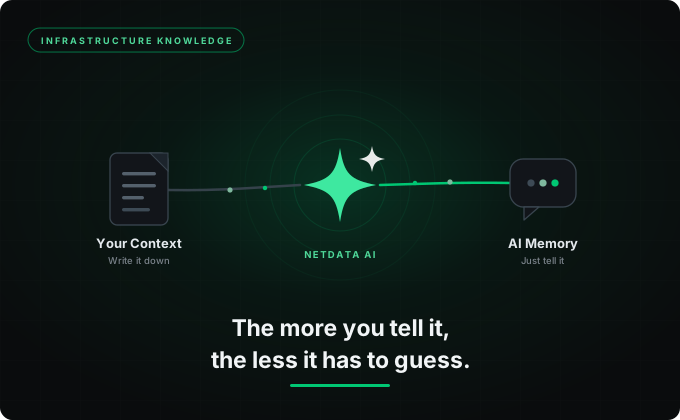
Infrastructure Knowledge For AI Root Cause Analysis
Netdata AI now learns your infrastructure the way a new SRE would: a shared context document your team writes, and a memory layer built from conversations that gets more accurate every time you use it.
August 3, 2026
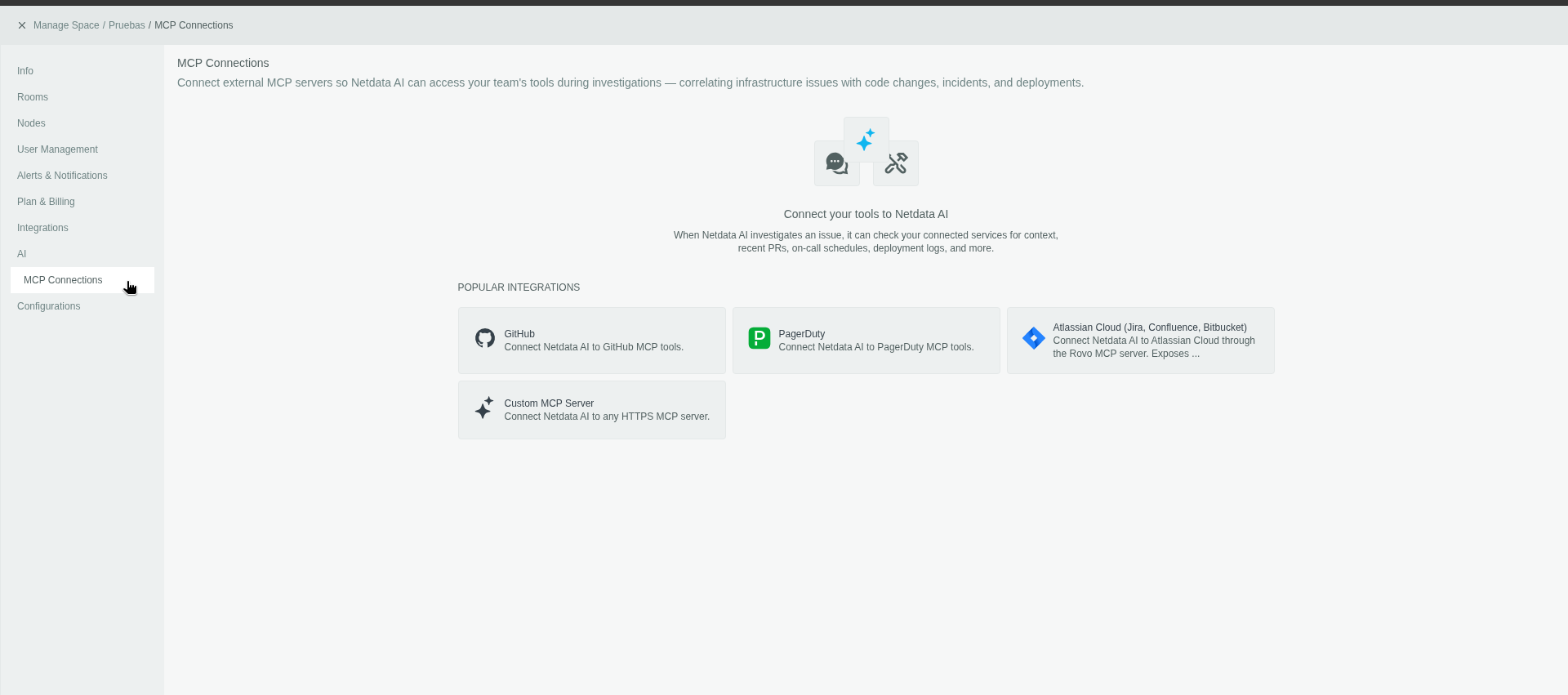
MCP Connections For Observability: AI As MCP Client
Netdata AI can now connect outward to GitHub, PagerDuty, Atlassian, and custom MCP servers via the Model Context Protocol, pulling in the context that explains why an alert fired, not just what changed.