
Managed Service for Apache Airflow Pricing
This document explains Managed Service for Apache Airflow pricing.
- To see the pricing for other products, read the Pricing documentation.
- To search for individual SKUs associated with Managed Service for Apache Airflow, see Google Cloud SKUs.
- You can use the Google Cloud Pricing Calculator to get a cost estimate for Google Cloud products, including Managed Service for Apache Airflow (Gen 3) and Managed Service for Apache Airflow (Gen 2).
Pricing models
Managed Service for Apache Airflow uses the following pricing models:
Billing interval
Managed Service for Apache Airflow environments are billed in short time intervals, for the actual time period when it was running. For example, if you create an environment, run it for 6 hours and 30 minutes, and delete it afterwards, then the total costs are for 6.5 hours.
Although some pricing is stated in hours or by the month, Managed Service for Apache Airflow is still billed for the actual usage time.
Committed use discounts (CUDs)
- Managed Service for Apache Airflow (Gen 3): Committed use discounts apply to Managed Service for Apache Airflow (Gen 3). For more information, see Committed use discounts.
- Managed Service for Apache Airflow (Gen 2): There are no committed use discounts that apply to Managed Service for Apache Airflow (Gen 2).
Managed Service for Apache Airflow (Gen 3) pricing
This section describes pricing in Managed Service for Apache Airflow (Gen 3).
Pricing table for Managed Service for Apache Airflow (Gen 3)
This section summarizes Managed Service for Apache Airflow (Gen 3) costs for different regions. Also see additional costs.
- Johannesburg (africa-south1)
- Taiwan (asia-east1)
- Hong Kong (asia-east2)
- Tokyo (asia-northeast1)
- Osaka (asia-northeast2)
- Seoul (asia-northeast3)
- Mumbai (asia-south1)
- Delhi (asia-south2)
- Singapore (asia-southeast1)
- Jakarta (asia-southeast2)
- Bangkok (asia-southeast3)
- Kuala Lumpur (asia-southeast4)
- Sydney (australia-southeast1)
- Melbourne (australia-southeast2)
- Warsaw (europe-central2)
- Finland (europe-north1)
- Stockholm (europe-north2)
- Madrid (europe-southwest1)
- Belgium (europe-west1)
- Berlin (europe-west10)
- Turin (europe-west12)
- London (europe-west2)
- Frankfurt (europe-west3)
- Netherlands (europe-west4)
- Zurich (europe-west6)
- Milan (europe-west8)
- Paris (europe-west9)
- Doha (me-central1)
- Dammam (me-central2)
- Tel Aviv (me-west1)
- Montreal (northamerica-northeast1)
- Toronto (northamerica-northeast2)
- Mexico (northamerica-south1)
- Sao Paulo (southamerica-east1)
- Santiago (southamerica-west1)
- Iowa (us-central1)
- South Carolina (us-east1)
- Northern Virginia (us-east4)
- Columbus (us-east5)
- Alabama (us-east7)
- Dallas (us-south1)
- Oregon (us-west1)
- Los Angeles (us-west2)
- Salt Lake City (us-west3)
- Las Vegas (us-west4)
If you pay in a currency other than USD, the prices listed in your currency on Cloud Platform SKUs apply.
Managed Service for Apache Airflow (Gen 3) SKUs
Managed Service for Apache Airflow (Gen 3) has the following SKUs:
- Cloud Composer 3 standard milli DCU-hours
Data Compute Unit is an abstract metering unit that represents computational resources allocated by a Managed Service for Apache Airflow environment at a point in time. Because DCU is a measure of the currently provisioned resources of an environment, costs are charged for the environment's DCU value over time, DCU-hours.
This SKU is measured in milliDCU-hours. For example, if your environment uses 1 DCU for 1 hour, this is equal to using 1000 milliDCU-hours.
DCU-hours represent the usage of the following resources:
- vCPU, Memory and Storage resources, used by the environment's components that run the workloads: Airflow workers, schedulers, DAG processors, triggerers, and the web server. Airflow workers are autoscaled, and as such the corresponding costs follow the changing number of workers in the environment.
If you deploy your own workloads in your environment's cluster, such as when you create Pods using KubernetesPodOperator or execute tasks with Kubernetes Executor, then used resources also count as DCU-hours and follow Managed Service for Apache Airflow (Gen 3) pricing model.
- Size of the environment. The environment size is the scale of the managed infrastructure of your Managed Service for Apache Airflow environment. Environment infrastructure comes in different sizes: Small, medium, and large.
The cost of environment's size in DCUs covers the cost of resources used by infrastructure components required to run Airflow. For example, by the Cloud SQL instance (with a separate SKU covering the costs of storage).
- Cloud Composer 3 database storage
This SKU covers the cost of the storage used by the Cloud SQL instance that stores the Airflow database of your environment.
The minimum disk size of the Cloud SQL instance is 10 GiB.
The disk size of Cloud SQL instances increases automatically, following the demand coming from the database storage usage and does not decrease if the size of the Airflow database is reduced later.
- Cloud Composer network data transfer
This group of SKUs covers the billable outbound traffic generated by the environment's components that run the workloads in your environment.
These SKUs cover the following types of traffic generated by workloads running in your environment:
- Intra-zone and Inter-zone data transfer
- Inter-region data transfer
- Egress to Google services: Data transfer to a different Google Cloud service within the same region using an external IP address or an internal IP address
- Internet data transfer rates with Premium Tier pricing
For more information about network egress billing and descriptions of the related SKUs, see Network Pricing.
- Your environment also has additional costs that are not a part of Managed Service for Apache Airflow pricing.
★ Note: If you create your environment from Google API Console, you can choose a predefined environment preset (small, medium, or large). The costs of environments created using these presets follow the regular pricing model for Managed Service for Apache Airflow (Gen 3). These presets only determine the starting configuration of your environment. In particular, the environment size configuration property determines DCU values for the environment size. An environment preset provides the initial value and can be changed over time.
Costs for highly resilient environments
In Managed Service for Apache Airflow (Gen 3), highly resilient environments use the same SKUs as standard environments. However, highly resilient environments run extra infrastructure components that provide resilience to zonal failures, which increases environment's costs accordingly.
The following is a description of estimated differences in SKU costs between a highly resilient environment and a standard environment. The actual increase in costs might be higher or lower, based on resource consumption in your specific usage scenario.
- Cloud Composer 3 standard milli DCU-hours
- This DCU's consumption increases to accommodate extra environment components. High resilience mode doesn't increase the SKU's rate. For example, the DCU rate for resources consumed by Airflow components of an environment that runs two schedulers, two DAG processors, and two workers is the same for a standard and for a highly resilient environments.
- This DCU's consumption increases to cover extra managed infrastructure of your environment that is required to maintain the environment across several zones. This increase in consumption is relative to the environment's size.
- Cloud Composer 3 database storage
- Highly resilient environments use a regional Cloud SQL instance, which has a primary and a standby instance. The approximate costs generated by this SKU are doubled compared to a standard environment.
Additional Costs for Managed Service for Apache Airflow (Gen 3)
Costs for the following services are billed in addition to costs for Managed Service for Apache Airflow (Gen 3) environments:
- The Cloud Storage bucket of an environment, which is used for managing DAGs and holding task logs. This bucket persists unless manually deleted. Managed Service for Apache Airflow interacts with the bucket through Cloud Storage API, which generates additional operation charges. The additional costs are:
- Cloud Storage data storage
- Cloud Storage operation charges
- Creating and storing environment snapshots produces additional costs related to Cloud Storage. The costs depend on the snapshot creation frequency and the size of a snapshot. Snapshot size depends on the Airflow database size and the size of the data that is included in the snapshot. The additional costs are:
- Cloud Storage operation charges
- Cloud Storage outbound data transfer
- Cloud Storage data storage
- The data that Cloud Monitoring collects to help you understand your environment's performance and health. The data is subject to separate Monitoring pricing.
- If you use Customer Managed Encryption Keys, there might be additional costs for the usage of the Cloud Key Management Service. See Cloud Key Management Service pricing for details.
Pricing example for Managed Service for Apache Airflow (Gen 3)
For example, you create a Managed Service for Apache Airflow (Gen 3) environment in Iowa (us-central1), use it for 10 days to run your workloads, and then delete it. The environment operates during the a month that has 30 days.
As an example, your environment uses the following amount of resources:
- For 5 days it uses 12 DCUs. These DCUs cover the combined costs of vCPU, memory, and storage resources used by the environment's components (schedulers, DAG processors, triggerers, workers, the web server), and the costs of operating the environment's infrastructure.
- For other 5 days your environment uses 15 DCUs because the number of workers was scaled up to address the large amount of tasks.
- Your environment's database does not go over the initial size of 10 GiB.
- The environment does not generate any billable network egress traffic because it operates within the same zone and does not send data over the internet. In this case all Cloud Composer Network Data Transfer SKUs do not generate costs.
In this case, the breakdown of costs is the following:
SKU | First period | Second period | Cost in Iowa (us-central1) | Total cost (10 days) |
|---|---|---|---|---|
DCU-hours (or 1000 milliDCU-hours) | 1440 DCU-hours (12 DCUs for 120 hours) | 1800 DCU-hours (15 DCUs for 120 hours) | $0.06 | $194.4 (3240 DCU-hours) |
Database storage | 1.67 GiBy/Mo (10 GiBy for 5 days out of 30 days) | 1.67 GiBy/Mo (10 GiBy for 5 days out of 30 days) | $0.17 | $0.5678 (10 GiBy for 10 days) |
Additional considerations:
- Your environment is auto-scaling. This means that if the actual load is lower during the described period, then the costs are also lower. For example, if you configure your environment to scale between 1 and 6 workers and your environment uses only a single worker during the whole period, then you pay for DCU-hours used by 1 worker, not by 6 workers.
- If your environment transfers data between regions or over the internet, then Cloud Composer Network Data Transfer SKUs apply.
- Your environment also has additional costs that are not a part of Managed Service for Apache Airflow (Gen 3) SKUs.
Pricing model transition for Managed Service for Apache Airflow (Gen 3)
This section describes how the pricing model changes in Managed Service for Apache Airflow (Gen 3) compared to Managed Service for Apache Airflow (Gen 2).
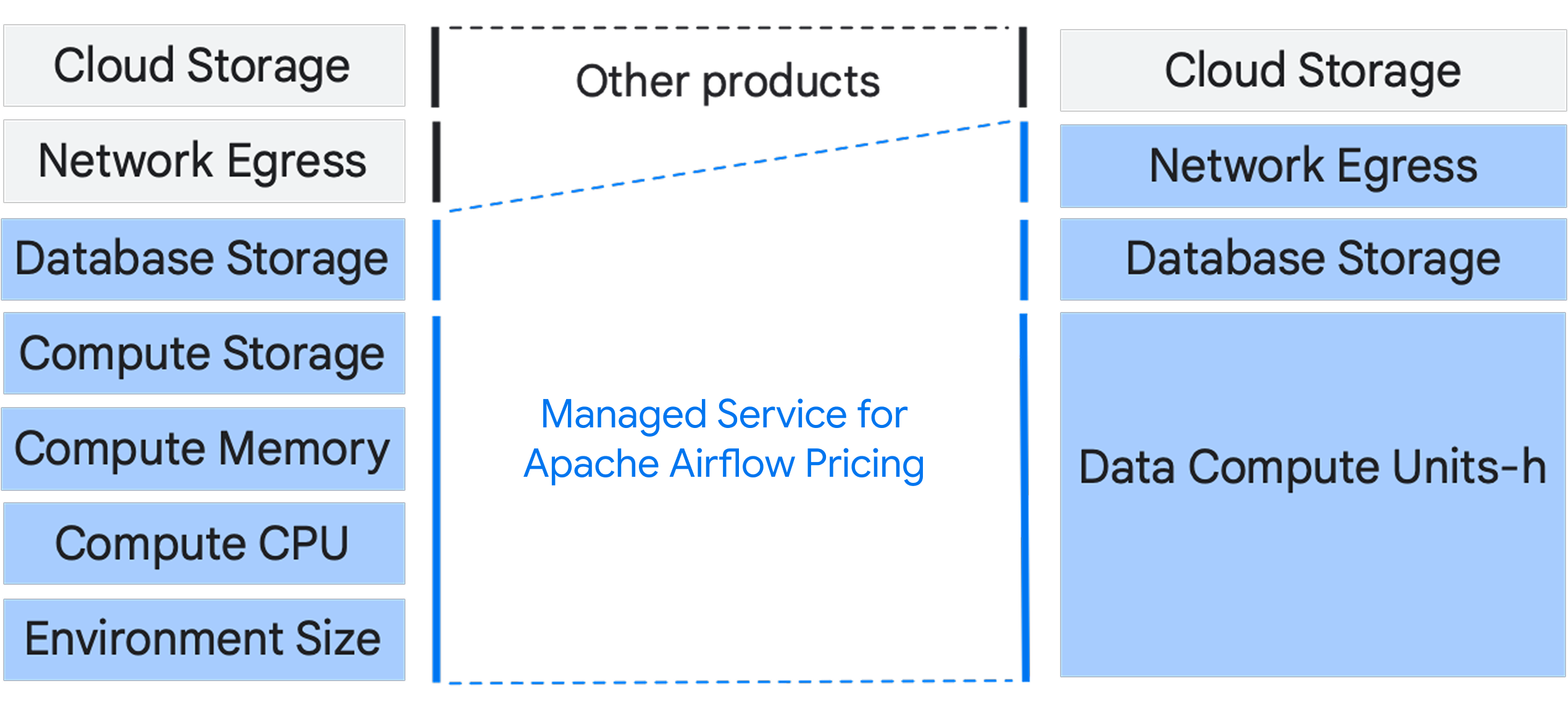
Managed Service for Apache Airflow (Gen 3) follows the path of further simplification and hides most of the remaining infrastructure components including the cluster of your environment and dependencies on other services such as Artifact Registry, Cloud Build, or Pub/Sub.
The overall costs of an Managed Service for Apache Airflow environment are now combined into a fewer number of SKUs:
- SKUs that represented Compute Engine resources used by your environment's components are combined into the DCU-hours SKU
- SKUs for the environment's size are included into the DCU-hours SKU
- Cloud Composer Network Data Transfer SKUs replace corresponding Managed Service for Apache Airflow (Gen 2) additional costs related to network traffic usage by the Airflow components that previously ran in your project
- You do not pay additional costs for Google services that were utilized in Managed Service for Apache Airflow (Gen 2) by the environment's cluster located in your project
Managed Service for Apache Airflow (Gen 2) pricing
This section describes pricing in Managed Service for Apache Airflow (Gen 2).
Pricing table for Managed Service for Apache Airflow (Gen 2)
The following table summarizes Managed Service for Apache Airflow (Gen 2) costs for different regions. Also see Additional costs.
- Johannesburg (africa-south1)
- Taiwan (asia-east1)
- Hong Kong (asia-east2)
- Tokyo (asia-northeast1)
- Osaka (asia-northeast2)
- Seoul (asia-northeast3)
- Mumbai (asia-south1)
- Delhi (asia-south2)
- Singapore (asia-southeast1)
- Jakarta (asia-southeast2)
- Bangkok (asia-southeast3)
- Kuala Lumpur (asia-southeast4)
- Sydney (australia-southeast1)
- Melbourne (australia-southeast2)
- Warsaw (europe-central2)
- Finland (europe-north1)
- Stockholm (europe-north2)
- Madrid (europe-southwest1)
- Belgium (europe-west1)
- Berlin (europe-west10)
- Turin (europe-west12)
- London (europe-west2)
- Frankfurt (europe-west3)
- Netherlands (europe-west4)
- Zurich (europe-west6)
- Milan (europe-west8)
- Paris (europe-west9)
- Doha (me-central1)
- Dammam (me-central2)
- Tel Aviv (me-west1)
- Montreal (northamerica-northeast1)
- Toronto (northamerica-northeast2)
- Mexico (northamerica-south1)
- Sao Paulo (southamerica-east1)
- Santiago (southamerica-west1)
- Iowa (us-central1)
- South Carolina (us-east1)
- Northern Virginia (us-east4)
- Columbus (us-east5)
- Dallas (us-south1)
- Oregon (us-west1)
- Los Angeles (us-west2)
- Salt Lake City (us-west3)
- Las Vegas (us-west4)
Item | Price (USD) |
|---|---|
Cloud Composer Compute CPUs | $0.045 / 1,000 hour |
Cloud Composer Compute Compute Memory | $0.005 / 1 gibibyte hour |
Cloud Composer Compute Storage | $0.0002 / 1 gibibyte hour |
Cloud Composer Database Storage | $0.000232877 / 1 gibibyte hour |
Small Cloud Composer Environment Fee | $0.35 / 1 hour |
Medium Cloud Composer Environment Fee | $0.55 / 1 hour |
Large Cloud Composer Environment Fee | $0.85 / 1 hour |
Small Highly Resilient Cloud Composer Environment Fee | $0.49 / 1 hour |
Medium Highly Resilient Cloud Composer Environment Fee | $0.77 / 1 hour |
Large Highly Resilient Cloud Composer Environment Fee | $1.19 / 1 hour |
If you pay in a currency other than USD, the prices listed in your currency on Cloud Platform SKUs apply.
Managed Service for Apache Airflow (Gen 2) SKUs
Managed Service for Apache Airflow (Gen 2) has the following SKUs:
- Cloud Composer Compute SKUs
These SKUs represent Compute Engine capacity used by Airflow schedulers, web server and workers. Airflow workers are autoscaled, and as such the corresponding costs follow the changing number of workers in the environment.
In addition, if you deploy your own workloads in your environment's cluster, then the pricing for these workloads also follows the Managed Service for Apache Airflow (Gen 2) pricing model and uses Compute Engine Compute SKUs. For example, pods started in your environment's cluster as Spot Pods follow Managed Service for Apache Airflow (Gen 2) Compute pricing model and not GKE Autopilot Spot pricing model.
- Cloud Composer Compute CPUs
Associated costs depend on the combined number of vCPUs used by all your environment's components that run on Compute Engine. This includes costs for pods and services in your environment's cluster. For example, all your environment's Airflow workers run in pods in your environment cluster.
This SKU is measured in 1000 mCPU (millicores) per hour. For example, if your environment uses 1 vCPU for 1 hour, this is equal to using 1000 mCPU for 1 hour.
- Cloud Composer Compute Memory
Associated costs depend on the combined amount of memory used by all your environment's components that run on Compute Engine.
- Cloud Composer Compute Storage
Associated costs depend on the combined amount of storage used by all your environment's components that run on Compute Engine.
- Cloud Composer Database Storage
Associated costs depend on the amount of disk space used by the Cloud SQL instance. The disk size of Cloud SQL instances increases automatically, following the demand coming from the database storage usage.
This SKU component covers the cost of Airflow database storage.
The minimum disk size of Cloud SQL instances is 10 GiB.
- Small/Medium/Large Cloud Composer Environment Fee
Associated costs depend on the size of your environment. The environment size is the scale of the managed infrastructure of your Managed Service for Apache Airflow environment.
This SKU covers the cost of infrastructure components required to run Airflow, including Cloud SQL database, task queue, connection proxies. Environment infrastructure comes in three different sizes: Small, Medium and Large.
- Small/Medium/Large Highly Resilient Cloud Composer Environment Fee
These SKUs represent the cost of infrastructure components required to run Airflow in a highly resilient Managed Service for Apache Airflow environment.
If your environment is highly resilient, these SKUs replace the Small/Medium/Large Managed Service for Apache Airflow Environment Fee SKUs.
- Your environment also has additional costs that are not a part of Managed Service for Apache Airflow pricing.
★ Note: If you create your environment from Google API Console, you can choose a predefined environment preset (small, medium, or large). The costs of environments created using these presets follow the regular pricing model for Managed Service for Apache Airflow (Gen 2). These presets only determine the starting configuration of your environment. In particular, the Small/Medium/Large Cloud Composer Environment Fee SKU is determined by the Environment size configuration property of your environment and not by an environment preset. The preset provides the initial value that can be changed over time.
Additional costs for Managed Service for Apache Airflow (Gen 2)
Costs for the following services are billed in addition to costs for Managed Service for Apache Airflow (Gen 2) environments:
- The Cloud Storage bucket of an environment, which is used for managing DAGs and holding task logs. This bucket persists unless manually deleted. Managed Service for Apache Airflow interacts with the bucket through Cloud Storage API, which generates additional operation charges. The additional costs are:
- Cloud Storage data storage
- Cloud Storage operation charges
- Creating and storing environment snapshots produces additional costs related to Cloud Storage. The costs depend on the snapshot creation frequency and the size of a snapshot. Snapshot size depends on the Airflow database size and the size of the data that is included in the snapshot. The additional costs are:
- Cloud Storage operation charges
- Cloud Storage outbound data transfer
- Cloud Storage data storage
- The data that Cloud Monitoring collects to help you understand your environment's performance and health. The data is subject to separate Monitoring pricing.
- The storage and outbound data transfer generated when using Artifact Registry. This service stores and serves Managed Service for Apache Airflow environment images. For more information, see Artifact Registry pricing pages.
- If you use Customer Managed Encryption Keys, there might be additional costs for the usage of the Cloud Key Management Service. See Cloud Key Management Service pricing for details.
- If you use Private Service Connect then the following additional charges are applied:
- Networking Private Service Connect Consumer End Point, with the use of the Using a Private Service Connect endpoint (forwarding rule) to access a published managed service rule.
- Networking Private Service Connect Consumer Data Processing.
- Billable outbound traffic generated by the environment's components. For more information about network egress billing and descriptions of the related SKUs, see Network Pricing.
Pricing example for Managed Service for Apache Airflow (Gen 2)
Assume that you create a Managed Service for Apache Airflow (Gen 2) environment in Iowa (us-central1) and use the default Small environment preset.
In this case, your environment has the following default parameters that affect Managed Service for Apache Airflow (Gen 2) SKUs:
- Your environment has one scheduler.
- Your environment scales automatically between 1 and 3 workers.
- Your environment's scheduler and web server use 0.5 vCPU each.
- Your environment's scheduler and web server use 1.875 GiB of memory each.
- Your environment's scheduler and web server use 1 GiB of disk space each.
- Your environment's workers scale automatically between 0.5 and 1.5 vCPUs, depending on the number of workers.
- Your environment's workers scale automatically between 1.875 and 5.625 GiB of memory, depending on the number of workers.
- Your environment's workers scale automatically between 1 and 3 GiB of storage, depending on the number of workers.
- Your environment's database uses 10 GiB of storage. The storage size increases automatically, following the demand coming from the database storage usage. This example assumes that the database storage does not increase.
- Your environment uses the small infrastructure size.
Assume that you run this environment for 7 days and 12 hours (180 hours total). Your environment's load is 1 worker for 50% of the time and 2 workers for the other 50% of the time. After using the environment for this period of time, you delete it. In this case, your Managed Service for Apache Airflow (Gen 2) SKUs are:
- Cloud Composer Compute CPUs is ( 90 hours * 1.5 vCPU + 90 hours * 2 vCPU ) * $0.045 per 1000 mCPU hours, for a total of $14.175
- Cloud Composer Compute Memory is ( 90 hours * 5.625 GiB + 90 hours * 7.5 GiB ) * $0.005 per GiB / hour, for a total of $5.906
- Cloud Composer Compute Storage is ( 90 hours * 3 GiB + 90 hours * 4 GiB ) * $0.0002 per GiB / hour, for a total of $0.126
- Cloud Composer Database Storage is 180 hours out of 740 hours * 10 GiB * $0.17 per GiB / month, for a total of $0.413
- Small Cloud Composer Environment Fee is 180 hours * $0.35 per hour, for a total of $63.00
- The total Managed Service for Apache Airflow (Gen 2) fees in this example are:
Managed Service for Apache Airflow (Gen 2) SKU | Fee |
|---|---|
Cloud Composer Compute CPUs | $14.175 |
Cloud Composer Compute Memory | $5.906 |
Cloud Composer Compute Storage | $0.126 |
Cloud Composer Database Storage | $0.17 per GiB / month |
Small Cloud Composer Environment Fee | $63.00 |
Total | $83.62 |
- Your environment is auto-scaling. This means that if the actual load is lower during the described period, then the costs are also lower. For example, if you configure your environment to scale between 1 and 6 workers, and your environment uses only a single worker during the whole period, you only pay for this single worker.
- Your environment also has additional costs that are not a part of Managed Service for Apache Airflow (Gen 2) SKUs.
Pricing model transition for Managed Service for Apache Airflow (Gen 2)
This section describes how the pricing model changes in Managed Service for Apache Airflow (Gen 2) compared to Managed Service for Apache Airflow (Legacy Gen 1).
Introduction of Managed Service for Apache Airflow (Gen 2) features is accompanied by a new pricing model, enabling you to fully benefit from the efficiency of autoscaling. The new model also provides a clear perspective on a Total Cost of Ownership for Managed Service for Apache Airflow environments.
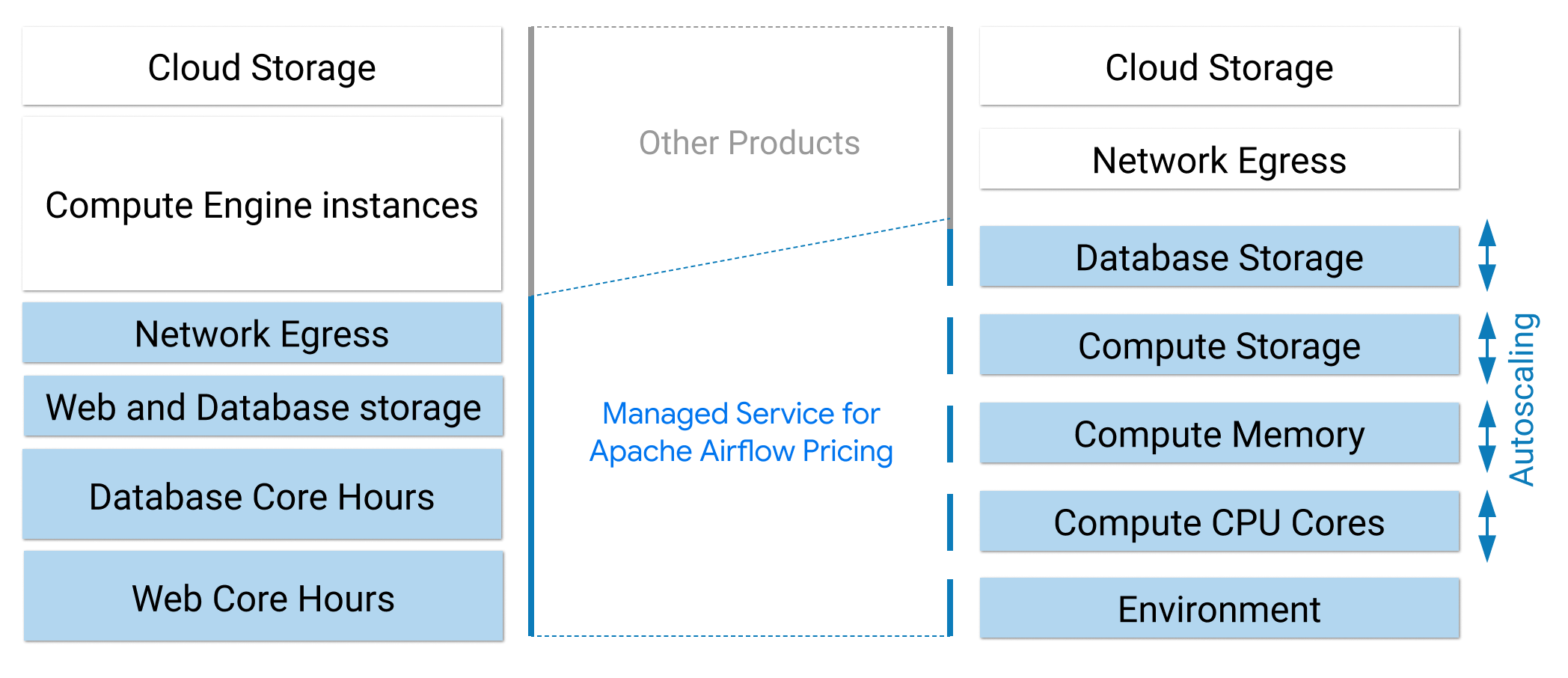
In Managed Service for Apache Airflow (Legacy Gen 1) environments, the cost of the Compute Engine layer used to run Airflow is visible as a charge for Compute Engine instances used by environment's GKE cluster.
In Managed Service for Apache Airflow (Gen 2) this cost is no longer associated with Compute Engine. Instead, it is included in Managed Service for Apache Airflow (Gen 2) SKUs for Compute Engine CPU cores, memory and storage. This approach provides a clear perspective on the overall cost of Managed Service for Apache Airflow environments.
Because the pricing model of Managed Service for Apache Airflow (Gen 2) is more encompassing than its predecessor, you might notice higher charges for Managed Service for Apache Airflow environments while at the same time seeing lower costs for Compute Engine instances.
Autoscaling introduced in Managed Service for Apache Airflow (Gen 2) brings additional efficiency in resource utilization because environments no longer need to be continuously scaled for the peak. The extent of cost savings generated by autoscaling is highly dependent on the pattern of DAG runs and environment configuration.
In Managed Service for Apache Airflow (Gen 2), compared to Managed Service for Apache Airflow (Legacy Gen 1):
- Costs for your environments might vary because of environment autoscaling. You only pay for resources that are utilized by your environment.
- You do not pay additional costs for Compute Engine components of your environment. Managed Service for Apache Airflow (Gen 2) SKUs replace these costs.
- Even though Managed Service for Apache Airflow (Gen 2) environments rely on GKE Autopilot clusters, you are not charged a cluster management fee that is present in regular GKE Autopilot clusters.
Managed Service for Apache Airflow (Legacy Gen 1) pricing
This section describes pricing in Managed Service for Apache Airflow (Legacy Gen 1).
Pricing table for Managed Service for Apache Airflow (Legacy Gen 1)
- Hong Kong (asia-east2)
- Tokyo (asia-northeast1)
- Osaka (asia-northeast2)
- Seoul (asia-northeast3)
- Mumbai (asia-south1)
- Delhi (asia-south2)
- Singapore (asia-southeast1)
- Sydney (australia-southeast1)
- Melbourne (australia-southeast2)
- Warsaw (europe-central2)
- Belgium (europe-west1)
- London (europe-west2)
- Frankfurt (europe-west3)
- Zurich (europe-west6)
- Montreal (northamerica-northeast1)
- Sao Paulo (southamerica-east1)
- Iowa (us-central1)
- South Carolina (us-east1)
- Northern Virginia (us-east4)
- Oregon (us-west1)
- Los Angeles (us-west2)
- Salt Lake City (us-west3)
- Las Vegas (us-west4)
Item | Price (USD) |
|---|---|
Cloud Composer vCPU time | $0.074 / 1 hour |
Cloud Composer SQL vCPU time | $0.125 / 1 hour |
Cloud Composer Data Storage | $0.000373973 / 1 gibibyte hour |
Cloud Composer Data Transfer | $0.156 / 1 gibibyte |
If you pay in a currency other than USD, the prices listed in your currency on Cloud Platform SKUs apply.
Managed Service for Apache Airflow (Legacy Gen 1) SKUs
Managed Service for Apache Airflow (Legacy Gen 1) has the following SKUs:
- Cloud Composer vCPU time
Associated costs depend on the web server machine type of your environment.
- Cloud Composer SQL vCPU time
Associated costs depend on the machine type of the Cloud SQL instance.
- Cloud Composer Data Storage
Associated costs depend on the web server machine type and on the amount of disk space used by the Cloud SQL instance.
The disk size of Cloud SQL instances increases automatically, following the demand coming from the database storage usage.
The minimum disk size of Cloud SQL instances is 10 GiB.
- Cloud Composer Data Transfer
Associated costs depend on the amount of network traffic generated by web server and Cloud SQL. For example, making queries to the Airflow database, scheduling tasks and DAGs, and using Airflow web interface generates data transfer costs.
- Your environment also has additional costs that are not a part of Managed Service for Apache Airflow pricing.
For Private IP environments in Managed Service for Apache Airflow (Legacy Gen 1), costs related to the web server are doubled. This is because Private IP Managed Service for Apache Airflow environments have two web server instances running behind a load balancer.
Supported machine types
Supported machine types
The following machine types are used by components of your Managed Service for Apache Airflow (Legacy Gen 1) environment.
- Pricing for these machine types is a part of additional costs.
- Shared-core machine types are not supported.
- The disk size of Cloud SQL instances increases automatically, following the demand coming from the database storage usage. The initial storage size is 10 GiB.
Environment component | Supported machine types |
|---|---|
Nodes | n1-standard, n1-highmem, n1-highcpu, n2-standard, n2-highmem, n2-highcpu, e2-standard, e2-highmem, e2-highcpu, c2-standard, m1-megamem, m1-ultramem, m2-megamem, m2-ultramem, n2d-standard, n2d-highmem, n2d-highcpu |
Cloud SQL instance | db-n1-standard-2, db-n1-standard-4, db-n1-standard-8, db-n1-standard-16 |
Web server | composer-n1-webserver-2, composer-n1-webserver-4, composer-n1-webserver-8 |
Additional costs for Managed Service for Apache Airflow (Legacy Gen 1)
Costs for the following services are billed in addition to costs for Managed Service for Apache Airflow (Legacy Gen 1) environments:
- Google Kubernetes Engine nodes used for workers and schedulers in an environment. These nodes are subject to separate Compute Engine pricing based on the number and type of instances used. This includes fees for Persistent Disk used by every node and the environment's task queue.
- The Cloud Storage bucket of an environment, which is used for managing DAGs and holding task logs. This bucket persists unless manually deleted. Managed Service for Apache Airflow interacts with the bucket through Cloud Storage API, which generates additional operation charges. The additional costs are:
- Cloud Storage data storage
- Cloud Storage operation charges
- The data that Cloud Monitoring collects to help you understand your environment's performance and health. The data is subject to separate Monitoring pricing.
- The storage and outbound data transfer generated when using Artifact Registry. This service stores and serves Managed Service for Apache Airflow environment images. For more information, see Artifact Registry pricing pages.
- If you use Customer Managed Encryption Keys, there might be additional costs for the usage of the Cloud Key Management Service. See Cloud Key Management Service pricing for details.
- If you use Private Service Connect then the following additional charges are applied:
- Networking Private Service Connect Consumer End Point, with the use of the Using a Private Service Connect endpoint (forwarding rule) to access a published managed service rule.
- Networking Private Service Connect Consumer Data Processing.
See Virtual Private Cloud pricing for details.
- Creating and storing environment snapshots produces additional costs related to Cloud Storage. The costs depend on the snapshot creation frequency and the size of a snapshot. Snapshot size depends on the Airflow database size and the size of the data that is included in the snapshot. The additional costs are:
- Cloud Storage operation charges
- Cloud Storage outbound data transfer
- Cloud Storage data storage
- Billable outbound traffic generated by the environment's components. For more information about network egress billing and descriptions of the related SKUs, see Network Pricing.
If you pay in a currency other than USD, the prices listed in your currency on Cloud Platform SKUs apply.
Pricing example for Managed Service for Apache Airflow (Legacy Gen 1)
Assume that you create a Managed Service for Apache Airflow (Legacy Gen 1) environment in Iowa (us-central1) and use the default parameters.
In this case, your environment has the following default parameters that affect Managed Service for Apache Airflow (Legacy Gen 1) SKUs:
- Your environment's web server uses the composer-n1-webserver-2 machine type. This machine type has 2 vCPUs and 20 GiB of storage.
- Your environment's Cloud SQL instance uses the db-n1-standard-2 machine type. This machine type has 2 vCPUs.
These default parameters affect additional costs for your environment:
- The environment's GKE cluster has 3 nodes. The nodes run environment workers and the scheduler.
- Nodes use the n1-standard-1 machine type.
- Nodes use 20 GiB of storage each.
Assume that you run this environment for 7 days and 12 hours (180 hours total) with 6.5 GiB of outbound data transfer, and then you delete the environment. In this case, your Managed Service for Apache Airflow (Legacy Gen 1) SKUs are:
- Cloud Composer vCPU time is 180 hours * 2 vCPU * 0.074 / vCPU hour, for a total of $26.64.
- Cloud Composer SQL vCPU time is 180 hours * 2 vCPU * 0.125 / vCPU hour, for a total of $45.00.
- Cloud Composer Data Storage is 10 GiB for the database (this is the initial storage that grows as the database increases in size), plus 20 GiB for the web server, for a total of 30 GiB. The resulting fee for the storage (assuming that the database storage does not increase) is 180 hours out of 740 hours * 30 GiB * $0.273 per GiB / month for a total of $1.99.
- Cloud Composer Data Transfer is 6.5 GiB * $0.156 / GiB for a total of $1.04.
- The total Managed Service for Apache Airflow (Legacy Gen 1) fees in this example are:
- Your environment also has additional costs that are not a part of Managed Service for Apache Airflow (Legacy Gen 1) SKUs. For example, these costs include fees for running 3 nodes of your environment's cluster for the time period when you used your environment.
What's next
- Get started with Managed Service for Apache Airflow.
- Read the Managed Service for Apache Airflow documentation
- Try the Pricing calculator
- Learn about Managed Service for Apache Airflow solutions and use cases
- Accelerate your digital transformation
- Whether your business is early in its journey or well on its way to digital transformation, Google Cloud can help solve your toughest challenges.
- Key benefits


- Featured Products
- AI and Machine Learning
- Business Intelligence
- Compute
- Containers
- Data Analytics
- Databases
- Developer Tools
- Distributed Cloud
- Hybrid and Multicloud
- Industry Specific
- Integration Services
- Management Tools
- Maps and Geospatial
- Media Services
- Migration
- Networking
- Operations
- Productivity and Collaboration
- Security and Identity
- Serverless
- Storage
- Web3
- Featured Products










- Not seeing what you're looking for?
- See all products (100+)
- Not seeing what you're looking for?
- See all AI and machine learning products
- Business Intelligence
- Not seeing what you're looking for?
- See all compute products
- Not seeing what you're looking for?
- See all data analytics products
- Not seeing what you're looking for?
- See all developer tools
- Hybrid and Multicloud
- Industry Specific
- Not seeing what you're looking for?
- See all management tools
- Media Services
- Not seeing what you're looking for?
- See all networking products
- Productivity and Collaboration
- Not seeing what you're looking for?
- See all security and identity products
- Save money with our transparent approach to pricing
- Google Cloud's pay-as-you-go pricing offers automatic savings based on monthly usage and discounted rates for prepaid resources. Contact us today to get a quote.
- Pricing overview and tools
- Learn & build
- Connect

- Accelerate your digital transformation
- Learn more
- Key benefits
- Why Google Cloud
- AI and Agents
- Multicloud
- Global infrastructure
- Data Cloud
- Modern Infrastructure Cloud
- Security
- Productivity and collaboration
- Reports and insights
- Executive insights
- Analyst reports
- Whitepapers
- Customer stories
- Industry Solutions
- Retail
- Consumer Packaged Goods
- Financial Services
- Healthcare and Life Sciences
- Media and Entertainment
- Telecommunications
- Games
- Manufacturing
- Supply Chain and Logistics
- Government
- Education
- See all industry solutions
- See all solutions
- Application Modernization
- CAMP
- Modernize Traditional Applications
- Migrate from PaaS: Cloud Foundry, Openshift
- Migrate from Mainframe
- Modernize Software Delivery
- DevOps Best Practices
- SRE Principles
- Platform Engineering
- Architect for Multicloud
- Artificial Intelligence
- Gemini Enterprise for Customer Experience
- Gemini Enterprise
- AI Commerce Search
- Google Cloud with Gemini
- Physical AI
- APIs and Applications
- New Business Channels Using APIs
- Unlocking Legacy Applications Using APIs
- Open Banking APIx
- Data Analytics
- Data Migration
- Data Lakehouse
- Real-time Analytics
- Marketing Analytics
- Datasets
- Business Intelligence
- Data Analytics Agents
- Geospatial Analytics
- Data Science
- Databases
- Database Migration
- Database Modernization
- Databases for Games
- Google Cloud Databases
- Migrate Oracle workloads to Google Cloud
- Open Source Databases
- SQL Server on Google Cloud
- Gemini for Databases
- Infrastructure
- Application Migration
- SAP on Google Cloud
- High Performance Computing
- Windows on Google Cloud
- Data Center Migration
- Active Assist
- Virtual Desktops
- Rapid Migration and Modernization Program
- Backup and Disaster Recovery
- Red Hat on Google Cloud
- Cross-Cloud Network
- AI Infrastructure
- Productivity and Collaboration
- Google Workspace
- Google Workspace Essentials
- Cloud Identity
- Chrome Enterprise
- Security
- Agentic SOC
- Web App and API Protection
- Security and Resilience Framework
- Risk and compliance as code (RCaC)
- Software Supply Chain Security
- Security Foundation
- Google Cloud Cybershield™
- Startups and SMB
- Startup Program
- Small and Medium Business
- Software as a Service
- Featured Products
- Gemini Enterprise app
- Agent Platform
- Compute Engine
- Cloud Storage
- BigQuery
- Cloud Run
- Google Kubernetes Engine
- Looker
- Apigee API Management
- Cloud SQL
- Cloud CDN
- See all products (100+)
- AI and Machine Learning
- Gemini Enterprise Agent Platform
- Gemini Enterprise app
- Gemini Enterprise for Customer Experience
- Model Garden
- Customer Experience Agent Studio
- Agent Search
- Speech-to-Text
- Text-to-Speech
- Translation AI
- Vision AI
- Contact Center as a Service
- See all AI and machine learning products
- Business Intelligence
- Looker
- Data Studio
- Compute
- Compute Engine
- App Engine
- Cloud GPUs
- Migrate to Virtual Machines
- Spot VMs
- Batch
- Sole-Tenant Nodes
- Bare Metal
- Recommender
- VMware Engine
- Cloud Run
- See all compute products
- Containers
- Google Kubernetes Engine
- Cloud Run
- Cloud Build
- Artifact Registry
- Cloud Code
- Cloud Deploy
- Migrate to Containers
- Deep Learning Containers
- Knative
- Data Analytics
- BigQuery
- Managed Service for Apache Spark
- Dataflow
- Looker
- Lakehouse
- Pub/Sub
- Managed Service for Apache Airflow
- Knowledge Catalog
- Data Analytics Agents
- Data Analytics Migration Services
- Managed Service for Apache Kafka
- See all data analytics products
- Databases
- AlloyDB for PostgreSQL
- Cloud SQL
- Firestore
- Spanner
- Bigtable
- Datastream
- Database Migration Service
- Bare Metal Solution
- Memorystore
- Developer Tools
- Artifact Registry
- Cloud Code
- Cloud Build
- Cloud Deploy
- Cloud Deployment Manager
- Cloud SDK
- Cloud Scheduler
- Cloud Source Repositories
- Infrastructure Manager
- Cloud Workstations
- Gemini Code Assist
- See all developer tools
- Distributed Cloud
- Google Distributed Cloud Connected
- Google Distributed Cloud Air-gapped
- Hybrid and Multicloud
- Google Kubernetes Engine
- Apigee API Management
- Migrate to Containers
- Cloud Build
- Observability
- Cloud Service Mesh
- Google Distributed Cloud
- Industry Specific
- Anti Money Laundering AI
- Cloud Healthcare API
- Device Connect for Fitbit
- Telecom Network Automation
- Telecom Data Fabric
- Telecom Subscriber Insights
- Spectrum Access System (SAS)
- Integration Services
- Application Integration
- Workflows
- Apigee API Management
- Cloud Tasks
- Cloud Scheduler
- Managed Service for Apache Spark
- Cloud Data Fusion
- Managed Service for Apache Airflow
- Pub/Sub
- Eventarc
- Management Tools
- Cloud Shell
- Cloud console
- Cloud Endpoints
- Cloud IAM
- Cloud APIs
- Service Catalog
- Cost Management
- Observability
- Carbon Footprint
- Config Connector
- Active Assist
- See all management tools
- Maps and Geospatial
- Earth Engine
- Google Maps Platform
- Media Services
- Cloud CDN
- Live Stream API
- OpenCue
- Transcoder API
- Video Stitcher API
- Migration
- Migration Center
- Application Migration
- Migrate to Virtual Machines
- Cloud Foundation Toolkit
- Database Migration Service
- Migrate to Containers
- Data Analytics Migration Services
- Rapid Migration and Modernization Program
- Transfer Appliance
- Storage Transfer Service
- VMware Engine
- Networking
- Cloud Armor
- Cloud CDN and Media CDN
- Cloud DNS
- Cloud Load Balancing
- Cloud NAT
- Cloud Connectivity
- Network Connectivity Center
- Network Intelligence Center
- Network Service Tiers
- Virtual Private Cloud
- Private Service Connect
- See all networking products
- Operations
- Cloud Logging
- Cloud Monitoring
- Error Reporting
- Managed Service for Prometheus
- Cloud Trace
- Cloud Profiler
- Cloud Quotas
- Productivity and Collaboration
- AppSheet
- AppSheet Automation
- Gemini Enterprise app
- Google Workspace
- Google Workspace Essentials
- Cloud Identity
- Chrome Enterprise
- Security and Identity
- Cloud IAM
- Sensitive Data Protection
- Mandiant Managed Defense
- Google Threat Intelligence
- Security Command Center
- Cloud Key Management
- Mandiant Incident Response
- Chrome Enterprise Premium
- Assured Workloads
- Google Security Operations
- Mandiant Consulting
- See all security and identity products
- Serverless
- Cloud Run
- Cloud Functions
- App Engine
- Workflows
- API Gateway
- Storage
- Cloud Storage
- Block Storage
- Filestore
- Persistent Disk
- Cloud Storage for Firebase
- Local SSD
- Storage Transfer Service
- Google Cloud Managed Lustre
- Google Cloud NetApp Volumes
- Backup and DR Service
- Web3
- Blockchain Node Engine
- Blockchain RPC
- Save money with our transparent approach to pricing
- Request a quote
- Pricing overview and tools
- Google Cloud pricing
- Pricing calculator
- Google Cloud free tier
- Cost optimization framework
- Cost management tools
- Product-specific Pricing
- Compute Engine
- Cloud SQL
- Google Kubernetes Engine
- Cloud Storage
- BigQuery
- See full price list with 100+ products
- Learn & build
- Google Cloud Free Program
- Solution Generator
- Quickstarts
- Blog
- Learning Hub
- Google Cloud certification
- Cloud computing basics
- Cloud Architecture Center
- Connect
- Innovators
- Developer Center
- Events and webinars
- Google Cloud Community
- Consulting and Partners
- Google Cloud Consulting
- Google Cloud Marketplace
- Find a partner
- Google Cloud partners