


- Home
-
CWE-295: Improper Certificate Validation
Weakness ID: 295Vulnerability Mapping: ALLOWED This CWE ID may be used to map to real-world vulnerabilities
Abstraction: Base Base - a weakness that is still mostly independent of a resource or technology, but with sufficient details to provide specific methods for detection and prevention. Base level weaknesses typically describe issues in terms of 2 or 3 of the following dimensions: behavior, property, technology, language, and resource.View customized information:For users who are interested in more notional aspects of a weakness. Example: educators, technical writers, and project/program managers. For users who are concerned with the practical application and details about the nature of a weakness and how to prevent it from happening. Example: tool developers, security researchers, pen-testers, incident response analysts. For users who are mapping an issue to CWE/CAPEC IDs, i.e., finding the most appropriate CWE for a specific issue (e.g., a CVE record). Example: tool developers, security researchers. For users who wish to see all available information for the CWE/CAPEC entry. For users who want to customize what details are displayed. Description
The product does not validate, or incorrectly validates, a certificate. 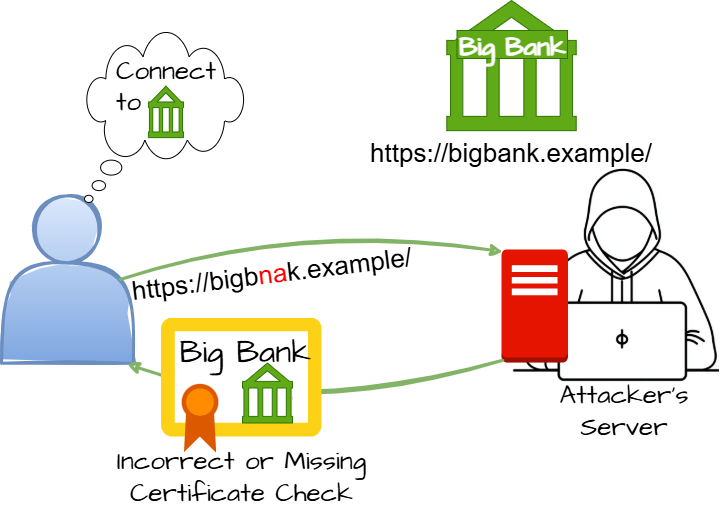 Common Consequences
 This table specifies different individual consequences
associated with the weakness. The Scope identifies the application security area that is
violated, while the Impact describes the negative technical impact that arises if an
adversary succeeds in exploiting this weakness. The Likelihood provides information about
how likely the specific consequence is expected to be seen relative to the other
consequences in the list. For example, there may be high likelihood that a weakness will be
exploited to achieve a certain impact, but a low likelihood that it will be exploited to
achieve a different impact.
This table specifies different individual consequences
associated with the weakness. The Scope identifies the application security area that is
violated, while the Impact describes the negative technical impact that arises if an
adversary succeeds in exploiting this weakness. The Likelihood provides information about
how likely the specific consequence is expected to be seen relative to the other
consequences in the list. For example, there may be high likelihood that a weakness will be
exploited to achieve a certain impact, but a low likelihood that it will be exploited to
achieve a different impact.
Impact Details Bypass Protection Mechanism; Gain Privileges or Assume Identity
Scope: Integrity, Authentication When a certificate is invalid or malicious, it might allow an attacker to spoof a trusted entity by interfering in the communication path between the host and client. The product might connect to a malicious host while believing it is a trusted host, or the product might be deceived into accepting spoofed data that appears to originate from a trusted host.
Potential Mitigations
Relationships
This table shows the weaknesses and high level categories that are related to this
weakness. These relationships are defined as ChildOf, ParentOf, MemberOf and give insight to
similar items that may exist at higher and lower levels of abstraction. In addition,
relationships such as PeerOf and CanAlsoBe are defined to show similar weaknesses that the user
may want to explore.
Relevant to the view "Research Concepts" (View-1000)
Nature Type ID Name ChildOf  Class - a weakness that is described in a very abstract fashion, typically independent of any specific language or technology. More specific than a Pillar Weakness, but more general than a Base Weakness. Class level weaknesses typically describe issues in terms of 1 or 2 of the following dimensions: behavior, property, and resource.
287 Improper Authentication ParentOf  Base - a weakness that is still mostly independent of a resource or technology, but with sufficient details to provide specific methods for detection and prevention. Base level weaknesses typically describe issues in terms of 2 or 3 of the following dimensions: behavior, property, technology, language, and resource.
296 Improper Following of a Certificate's Chain of Trust ParentOf  Variant - a weakness that is linked to a certain type of product, typically involving a specific language or technology. More specific than a Base weakness. Variant level weaknesses typically describe issues in terms of 3 to 5 of the following dimensions: behavior, property, technology, language, and resource.
297 Improper Validation of Certificate with Host Mismatch ParentOf
Variant - a weakness that is linked to a certain type of product, typically involving a specific language or technology. More specific than a Base weakness. Variant level weaknesses typically describe issues in terms of 3 to 5 of the following dimensions: behavior, property, technology, language, and resource.
298 Improper Validation of Certificate Expiration ParentOf
Base - a weakness that is still mostly independent of a resource or technology, but with sufficient details to provide specific methods for detection and prevention. Base level weaknesses typically describe issues in terms of 2 or 3 of the following dimensions: behavior, property, technology, language, and resource.
299 Improper Check for Certificate Revocation ParentOf
Variant - a weakness that is linked to a certain type of product, typically involving a specific language or technology. More specific than a Base weakness. Variant level weaknesses typically describe issues in terms of 3 to 5 of the following dimensions: behavior, property, technology, language, and resource.
599 Missing Validation of OpenSSL Certificate PeerOf
Base - a weakness that is still mostly independent of a resource or technology, but with sufficient details to provide specific methods for detection and prevention. Base level weaknesses typically describe issues in terms of 2 or 3 of the following dimensions: behavior, property, technology, language, and resource.
322 Key Exchange without Entity Authentication
Relevant to the view "Software Development" (View-699)
Nature Type ID Name MemberOf  Category - a CWE entry that contains a set of other entries that share a common characteristic.
1211 Authentication Errors
Relevant to the view "Weaknesses for Simplified Mapping of Published Vulnerabilities" (View-1003)
Nature Type ID Name ChildOf
Class - a weakness that is described in a very abstract fashion, typically independent of any specific language or technology. More specific than a Pillar Weakness, but more general than a Base Weakness. Class level weaknesses typically describe issues in terms of 1 or 2 of the following dimensions: behavior, property, and resource.
287 Improper Authentication
Relevant to the view "Architectural Concepts" (View-1008)
Nature Type ID Name MemberOf
Category - a CWE entry that contains a set of other entries that share a common characteristic.
1014 Identify Actors
Background Details
Modes
Of IntroductionThe different Modes of Introduction provide information
about how and when this
weakness may be introduced. The Phase identifies a point in the life cycle at which
introduction
may occur, while the Note provides a typical scenario related to introduction during the
given
phase.
Phase Note Architecture and Design Implementation REALIZATION: This weakness is caused during implementation of an architectural security tactic. Implementation When the product uses certificate pinning, the developer might not properly validate all relevant components of the certificate before pinning the certificate. This can make it difficult or expensive to test after the pinning is complete.
Applicable PlatformsThis listing shows possible areas for which the given
weakness could appear. These
may be for specific named Languages, Operating Systems, Architectures, Paradigms,
Technologies,
or a class of such platforms. The platform is listed along with how frequently the given
weakness appears for that instance.
Languages Class: Not Language-Specific (Undetermined Prevalence)
Technologies Class: Not Technology-Specific (Undetermined Prevalence)
Class: Web Based (Undetermined Prevalence)
Class: Mobile (Undetermined Prevalence)
Demonstrative Examples Selected Observed
Examples
Weakness Ordinalities Detection
Methods Memberships
This MemberOf Relationships table shows additional CWE Categories and Views that
reference this weakness as a member. This information is often useful in understanding where a
weakness fits within the context of external information sources.
Nature Type ID Name MemberOf Category - a CWE entry that contains a set of other entries that share a common characteristic.731 OWASP Top Ten 2004 Category A10 - Insecure Configuration Management MemberOf Category - a CWE entry that contains a set of other entries that share a common characteristic.1029 OWASP Top Ten 2017 Category A3 - Sensitive Data Exposure MemberOf  View - a subset of CWE entries that provides a way of examining CWE content. The two main view structures are Slices (flat lists) and Graphs (containing relationships between entries).
1200 Weaknesses in the 2019 CWE Top 25 Most Dangerous Software Errors MemberOf Category - a CWE entry that contains a set of other entries that share a common characteristic.1353 OWASP Top Ten 2021 Category A07:2021 - Identification and Authentication Failures MemberOf Category - a CWE entry that contains a set of other entries that share a common characteristic.1382 ICS Operations (& Maintenance): Emerging Energy Technologies MemberOf Category - a CWE entry that contains a set of other entries that share a common characteristic.1396 Comprehensive Categorization: Access Control MemberOf Category - a CWE entry that contains a set of other entries that share a common characteristic.1442 OWASP Top Ten 2025 Category A07:2025 - Authentication Failures
Vulnerability Mapping Notes Taxonomy
Mappings
Related Attack Patterns References Content
History SubmissionsSubmission Date Submitter Organization 2006-07-19
(CWE Draft 3, 2006-07-19)CWE Community Submitted by members of the CWE community to extend early CWE versions  Modifications
Modification Date Modifier Organization 2025-12-11
(CWE 4.19, 2025-12-11)CWE Content Team MITRE updated Applicable_Platforms, Observed_Examples, Relationships, Weakness_Ordinalities 2025-09-09
(CWE 4.18, 2025-09-09)CWE Content Team MITRE updated Common_Consequences, Description, Detection_Factors, Diagram, References 2023-06-29 CWE Content Team MITRE updated Mapping_Notes 2023-04-27 CWE Content Team MITRE updated Relationships 2023-01-31 CWE Content Team MITRE updated Description, Modes_of_Introduction 2022-10-13 CWE Content Team MITRE updated Observed_Examples, References 2022-04-28 CWE Content Team MITRE updated Relationships 2021-10-28 CWE Content Team MITRE updated Observed_Examples, Relationships 2021-07-20 CWE Content Team MITRE updated Demonstrative_Examples, Observed_Examples 2020-08-20 CWE Content Team MITRE updated Related_Attack_Patterns 2020-02-24 CWE Content Team MITRE updated Applicable_Platforms, Demonstrative_Examples, Description, Observed_Examples, Relationships 2019-09-19 CWE Content Team MITRE updated Demonstrative_Examples, Relationships 2019-06-20 CWE Content Team MITRE updated Relationships 2018-03-27 CWE Content Team MITRE updated Background_Details, Modes_of_Introduction, Potential_Mitigations, Relationships 2017-11-08 CWE Content Team MITRE updated Modes_of_Introduction, References, Relationships 2017-01-19 CWE Content Team MITRE updated Relationships 2015-12-07 CWE Content Team MITRE updated Relationships 2014-07-30 CWE Content Team MITRE updated Detection_Factors 2014-06-23 CWE Content Team MITRE updated Observed_Examples 2013-02-21 CWE Content Team MITRE updated Applicable_Platforms, Common_Consequences, Description, Name, Observed_Examples, Potential_Mitigations, References, Relationships, Time_of_Introduction, Type 2012-12-28 CWE Content Team MITRE Converted from category to weakness class. 2012-05-11 CWE Content Team MITRE updated Related_Attack_Patterns 2008-10-14 CWE Content Team MITRE updated Background_Details, Description 2008-09-08 CWE Content Team MITRE updated Relationships, Taxonomy_Mappings 2008-08-15 Veracode Suggested OWASP Top Ten 2004 mapping Previous Entry NamesChange Date Previous Entry Name 2013-02-21 Certificate Issues


