Back to home pageNew Release

Defense
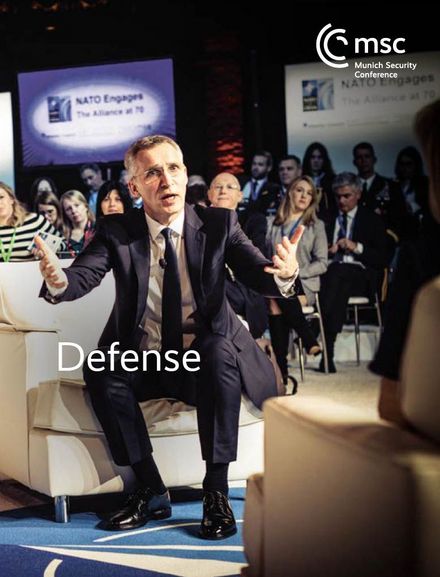
Transatlantic security policy and European defense are among the core topics of the Munich Security Conference. With the Defense Program, the MSC aims to initiate debates on these and other key aspects of global defense and security policy.
About the Defense Program
The global security landscape is changing fast—and not for the better. The risk of peer-to-peer conflict is becoming more acute as great power competition is heating up, crucial arms control and confidence-building regimes are eroding, and regional rivalries are increasingly left unchecked and unresolved. Russia’s full-scale invasion of Ukraine in February 2022 fundamentally changed the European security landscape, marking a “Zeitenwende” for Germany and its European partners, but also for other countries around the globe.
The threat matrix is further complicated by the continued rise of non-state actors, the accelerating militarization of domains such as the Arctic, space, and cyberspace, the use of hybrid and proxy tactics, and the race for new technologies with profound implications for warfare and arms control.
With its Defense Program, the MSC seeks to contribute to and advance the debate around critical aspects of global defense and security policy, including European defense cooperation, the future of NATO, capability development and procurement, as well as the future of warfare, defense innovation, nuclear deterrence, and arms control. To that end, MSC events, publications, and initiatives aim to facilitate exchanges between decision-makers and experts at the highest level.
Publications
Topics from the Defense Program are regularly covered in the annual Munich Security Report (MSR). Additionally, the MSC regularly publishes Munich Security Briefs, MSR Special Editions, and other publications.

- Munich Security Analysis | Don’t Dodge Dilemmas: Three Tests for German Leadership in European Defense (2025)
- Munich Security Debrief | Trump, Trust, and Transatlanticism: Key Takeaways From the Munich Leaders Meeting in Washington (2025)
- Munich Security Analysis | From Soft Talk to Hard Power: Ten To-Dos for the European Defence Union (2024)
- Munich Security Analysis | Wer A sagt, muss auch B sagen: Die Widersprüchlichkeiten der Unterstützung in der deutschen Bevölkerung für die Ukraine (2024)
- Munich Security Opinion | Remedy for Longevity: A European Burden-Seizing Initiative for NATO to Age Well (2024)
- Munich Security Opinion | Ein Quantum Zeitenwende? Zum Paradigmenwechsel für die Nachrichtendienste (2024)
- Special Edition | More European, More Connected, More Capable: Building the European Armed Forces of the Future (2017)
Summits, Roundtables, and other Activities
Defense and security policy issues naturally play an important role at all MSC activities. During the annual flagship conference in Munich, these topics have regularly taken center stage at panel discussions as well as in a growing number of side events.
In addition, the MSC organizes numerous events as part of the Defense Program, which vary in scope and size.
MSC Summits assemble an audience of up to 100 high-profile representatives from government, academia, the military, the private sector and civil society for 24 to 48 hours of open and frank debates with a particular thematic focus. MSC Summits are held on-the-record or under Chatham House rule.
MSC Roundtables bring together an intimate group of up to 35 participants for an interactive debate on a specific security policy challenge. Roundtables are held under Chatham House rule or off-the-record and take place throughout the year, frequently alongside other MSC events, such as the Munich Leaders Meetings and the Munich Security Conference.
MSC Conversations are small, confidential meetings featuring a selected high-level speaker and a group of up to 40 participants, including senior experts, thinkers, and decision-makers. MSC Conversations are typically held under Chatham House rule, but selected events can be open to the public.
Past Events
European Defense Roundtable in Rome, Italy
On September 2, 2026, the fourth edition of the European Defense Roundtable (EDR) series took place in Rome. The “Hard Core Europe” Roundtable series explores options for European states—particularly the European Group of Five (E5)—to respond to current security challenges.
Organized in cooperation with the Istituto Affari Internazionali (IAI) and supported by NATO, the Roundtable brought together around 50 high-level decision-makers, business representatives, and experts from the E5 countries to discuss how a 360-degree approach to European defense can be translated into concrete action.