

SAMBO
Sequential and model-based optimization [for Python]
Say you're a senior baker in a large pharmaceutical, tasked to ship a new medicine
drug for suppressing symptoms of any of the growingly lucrative health conditions of the developed world.
Among simple paper-pushing and the more menial tasks, your drug development pipeline involves figuring
out the correct, for business reasons quite optimal, combination to hundreds of parameters, such as:
ratios of active ingredients,
bulking agents,
centrifugation times,
pH levels,
temperature profiles at each processing step,
choice of solvents and purification steps,
ideal dosage forms,
whether to include any of the other common processes of your establishment,
and so on.
The problem is: because some processes can't be skipped or sped up, every combination you decide to try takes two of your assistant researchers nearly two weeks of laboratory work. But your new flagship drug is expected due next Thursday ...
It is easy to get a thousand prescriptions, but hard to get one single remedy.
— Chinese proverb
Thank god for SAMBO, Rambo of global optimization. It gets in and then it finds minimums of the objective criteria function quickly and efficiently, in least number of evaluations. SAMBO stands for Sequential and Model-Based Optimization. This simple optimization package consists of the following items, each with its own neat, user-friendly, Pythonic interface:
- function
sambo.minimize()to drive constrained and bounded global black-box optimization, design-space exploration and model calibration, modeled after well-known Python packages SciPy and scikit-optimize,1 supporting SOTA optimization algorithms like SHGO,2 SMBO3 and SCE-UA,4 -
class
Optimizerthat provides an ask-and-tell interface, additionally supporting sequential surrogate models produced by estimators like those of scikit-learn, skorch or Keras, with popular algorithms including Gaussian process and tree-based regression built in, -
SamboSearchCV,a faster drop-in replacement forGridSearchCV,RandomizedSearchCVand similar methods of hyperparameter tuning in complex ML pipelines.
See below examples for usage.
- 1 scikit-optimize/scikit-optimize. DOI: 10.5281/zenodo.1157319
- 2 SHGO: Simplicial homology global optimization. DOI: 10.1007/s10898-018-0645-y
- 3 SMBO: Sequential Model-Based Optimization for General Algorithm Configuration. DOI: 10.1007/978-3-642-25566-3 40
- 4 SCE-UA: Effective and efficient global optimization for conceptual rainfall-runoff models. DOI: 10.1029/91WR02985
-
Compatible with Python 3+
Python 3.10+ —Best choice for new and forward-looking projects.
-
Small, clean API
The API reference follows established idiomatic Python doctrine and is easy to wrap one's head around.
-
Out-of-the-box desired behavior
Like Rambo, SAMBO works alone and produces correct results at least 99% of the time.
-
Minimal dependencies
Needs just NumPy/SciPy, optionally uses scikit-learn and Matplotlib.
-
Blazing fast execution
On top of that, fewest objective function evaluations or your money back! Benchmark to prove it.
-
Black-box Bayesian optimization
State-of-the-art optimization techniques painlessly at your disposal.
-
Integral, floating and nominal dimensions
Optimize any kind of input variables including integers, real-valued variables and ordinals/categoricals.
-
Approximate, but converging
Stochastic processes converge to the correct optimum. Error tolerance for you to decide.
-
Beautiful Matplotlib charts
Let you visualize exactly what the algorithms are doing. Reproducible research.
Download
Usage Examples
Use case №1: Find global minimium of an objective/cost function
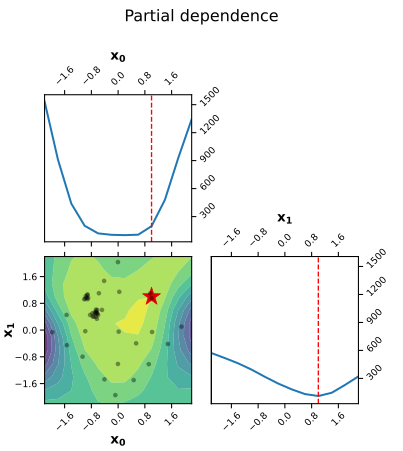
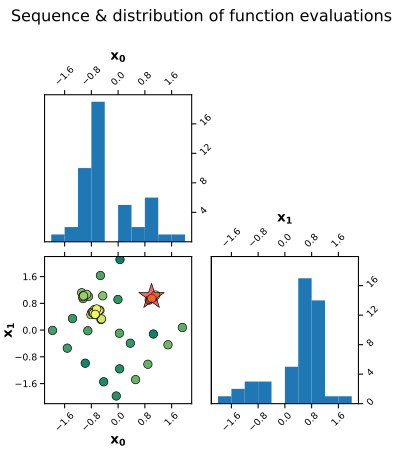
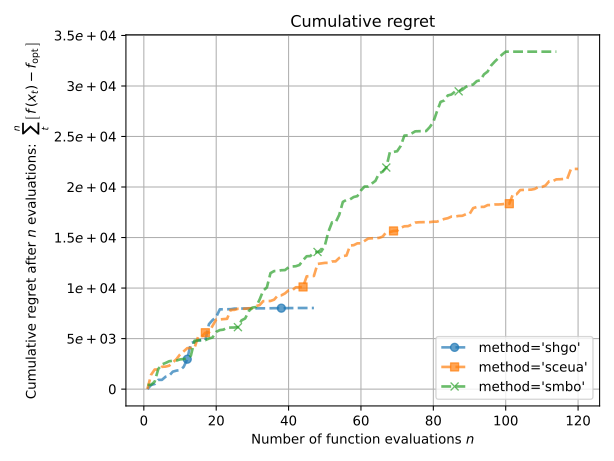
We quickly find the global optimum of an example 2D Rosenbrock's banana function, constrained to a circle with , all in comparatively just a few evaluations.
While this is a simple 2D example, partial-dependence plots and sequence-of-evaluations plots generalize well to several dimensions.
import sambo
from sambo.plot import *
# Extras
import matplotlib.pyplot as plt
from scipy.optimize import rosen

result = sambo.minimize(
    rosen, bounds=[(-2., 2.)] * 2,  # Mind the dots
    constraints=lambda x: sum(x**2) <= 2**len(x),
    max_iter=50, method='shgo')

plot_convergence(result)
plot_objective(result)    # Partial dependence
plot_evaluations(result)  # Sequence of evaluations
plot_regret(result)

plt.show()
<class 'sambo.OptimizeResult'>

 message: Optimization terminated successfully.
 success: True
     fun: 5.205243704996618e-08
       x: [ 9.998e-01  9.996e-01]
    nfev: 68
      xv: [[ 0.000e+00  0.000e+00]
           [ 0.000e+00  0.000e+00]
           ...
           [ 9.998e-01  9.996e-01]
           [ 9.998e-01  9.996e-01]]
    funv: [ 1.000e+00  ...  5.210e-08]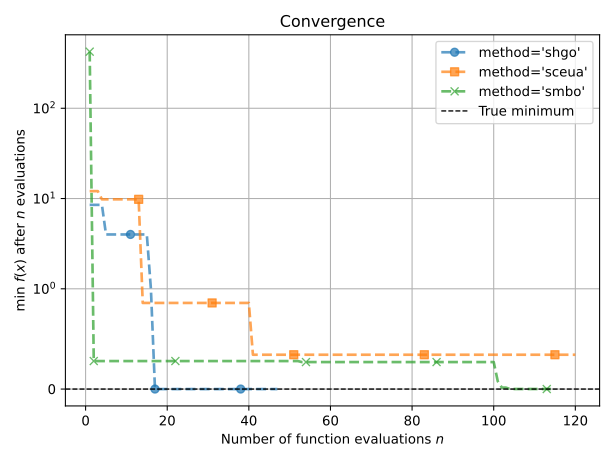
Use case №2: Sequential surrogate model-based "Ask-and-Tell" optimization
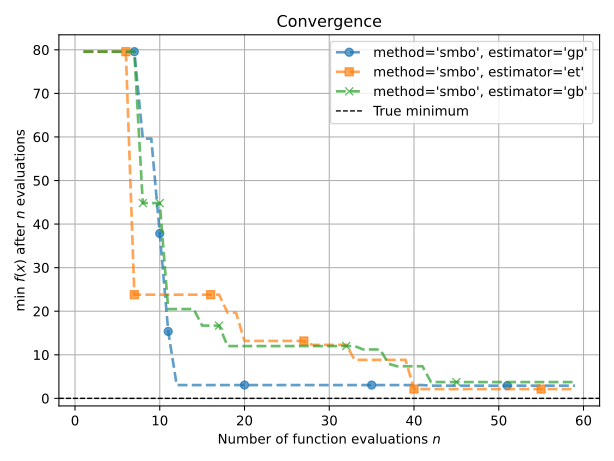
When your optimization objective is an external process, you may not be able to express it as a simple Python function. Instead, you may ask the optimizer process for the next suggested candidate point (solution candidate), execute the trial (e.g. the two-week "baking" process), then report back your findings (objective result ) to the optimizer for further consideration and refitting. We call this an "ask-and-tell" API.
The estimator= can be any object with a scikit-learn fit-predict API,
including neural networks and modern AI.
from sambo import Optimizer

def evaluate(x):
   ...  # Abstract long and laborious process
   return rosen(x)

bounds = [(-2., 2.)] * 4  # 4D
optimizer = Optimizer(
    fun=None,  # Implies Ask-And-Tell interface
    bounds=bounds,
    estimator='gp',  # or bring your own
)

n_iter = 50
for i in range(n_iter):
    suggested_x = optimizer.ask(1)
    y = [evaluate(x) for x in suggested_x]
    optimizer.tell(y)

best_x, best_fvals = optimizer.top_k()
# Continue the optimization ...
result: OptimizeResult = optimizer.run()
Use case №3: Hyperparameter tuning for machine-learning in quasi-logarithmic time
Use sambo.SamboSearchCV as a drop-in replacement for
GridSearchCV (or even HalvingRandomSearchCV) from scikit-learn
to optimize your machine learning pipeline hyperparameters in sub-linear time,
yet with an algorithm considerably better-informed than simple random search!
# Example setup of a scikit-learn pipeline
from sklearn.datasets import load_breast_cancer
from sklearn.tree import DecisionTreeClassifier
from sklearn.model_selection import GridSearchCV

X, y = load_breast_cancer(return_X_y=True)
clf = DecisionTreeClassifier()
param_grid = {
    'max_depth': list(range(1, 30)),
    'min_samples_split': [2, 5, 10, 20, 50, 100],
    'min_samples_leaf': list(range(1, 20)),
    'criterion': ['gini', 'entropy'],
    'max_features': [None, 'sqrt', 'log2'],
}
search = GridSearchCV(clf, param_grid)
# Trying all ~20k combinations takes a long time ...
search.fit(X, y)
print(search.best_params_)
print(search.best_score_)

# Alternatively ...
from sambo import SamboSearchCV
search = SamboSearchCV(clf, param_grid, max_iter=100)
search.fit(X, y)  # Fast, good enough
print(search.best_params_)
print(search.best_score_)
print(search.opt_result_)
{'criterion': 'gini',
 'max_depth': 6,
 'max_features': 'sqrt',
 'min_samples_leaf': 1,
 'min_samples_split': 5}
0.947269582406721

{'criterion': 'entropy',
 'max_depth': 20,
 'max_features': None,
 'min_samples_leaf': 5,
 'min_samples_split': 6}
0.9419940696812453

 message: Reached n_iter_no_change (=10) w/o improvement
 success: True
     fun: -0.9419940696812453
       x: [20 6 5 'entropy' None]
     nit: 26
    nfev: 77
      xv: [[15 86 ... 'gini' None]
           [1 57 ... 'entropy' 'sqrt']
           ...
           [19 5 ... 'gini' None]
           [20 8 ... 'gini' None]]
    funv: [-9.244e-01 -9.034e-01 ... -9.139e-01 -9.191e-01]
   model: [GaussianProcessRegressor()]
Benchmark
It's 2020, and if you're still doing particle swarm, basin-hopping, Monte Carlo or genetic/evolutionary algorithms optimization, you're likely throwing away precious computing cycles, at large! According to published benchmark of most common optimization algorithm implementations on several popular global optimization functions, including some multi-dimensional ones (2–10D), SAMBO out-of-the-box most often converges to correct global optimum, in fewest total objective evaluations, yielding smallest absolute error, with runtime just as fast as that of the best (full stdout output), proving the implementation sound and justified.

Citation
If you find this package useful in your academic research, please consider citing:
@software{SAMBO,
    author = {Kernc},
    title = {SAMBO: Sequential and Model-Based Optimization: Efficient global optimization in Python},
    url = {https://sambo-optimization.github.io},
    doi = {https://doi.org/10.5281/zenodo.14461363},
    year = {2024}
}
What Users are Saying
The proof of [this] program's value is its existence.
A. Perlis
We are all tasked to balance and optimize ourselves.
M. Jemison
[...] When all else fails, read the instructions.
Cahn
You're bound to be unhappy if you optimize everything.
D. Knuth
After scikit-optimize went MIA, the release of this Bayesian optimization software package is just about optimally timed.
B. Kralz