Trending Papers - Hugging Face
new

Get trending papers in your email inbox!

Subscribe

Trending Papers

byAK and the research community

Trending Papers
Submitted by
ruiyaox

Harness^2: Recursive Agent Harnessing for an Open World

Harness² improves agent execution harnesses through recursive task-level refinement and continual harness-level learning, boosting performance across benchmarks without ground-truth verifiers.

google Google · Oct 9, 2026

TradingAgents: Multi-Agents LLM Financial Trading Framework

A multi-agent framework using large language models for stock trading simulates real-world trading firms, improving performance metrics like cumulative returns and Sharpe ratio.

  • 4 authors
· Dec 28, 2024

Kronos: A Foundation Model for the Language of Financial Markets

Kronos, a specialized pre-training framework for financial K-line data, outperforms existing models in forecasting and synthetic data generation through a unique tokenizer and autoregressive pre-training on a large dataset.

  • 7 authors
· Aug 2, 2025
Submitted by
bupalinyu

The Other Half of the Memory Wall: Serving 35B MoEs from SSD with Trained Routing Prediction

Edge0 enables efficient mixture-of-experts inference on consumer hardware by predicting expert routing ahead of time and using recovery adapters to maintain quality with minimal active memory.

Edge0 Edge0 · Sep 16, 2026
Submitted by
Phospheneser

MOSS-Image Technical Report

MOSS-Image is an open diffusion transformer that combines high-fidelity synthesis with intent-aware prompt enhancement to generate text-rich, layout-coherent images, achieving state-of-the-art open-weight results on long-form text and layout benchmarks.

OpenMOSS-Team OpenMOSS · Oct 16, 2026
Submitted by
lgy0404

nanoMuse: An Open-Source Personal Agent for Every Device You Own

Assistants from 2011 answered and waited, and agents from 2023 did a task and stopped. In September 2026 Meta's Muse showed an agent for one person, with accounts, devices, memory and a conversation that lasts, closed, in a vendor's cloud, in one country. Such an agent is expected to act on a person's accounts and devices, remember them across weeks, speak first when it is worth it, and answer for what it did. It is a kind of software, not a model, and until now had no open counterpart. This report defines the personal agent in five questions and three horizons. It reads how Muse is built from Meta's public record and a copy of its production prompt, each statement marked by its source. It then presents nanoMuse, the open-source counterpart under the GPL-3.0, one agent on every device a person owns, with hands on the phone's screen and the computer's. They share one conversation over a relay anyone can run; every action goes through a Sentinel, memory is files the person can read, and the model is their choice. Its size and cost are given as estimates. What is open, memory with provenance, an evaluation suite for the hands and an open model for them, is set out as a roadmap.

zju Zhejiang University · Oct 6, 2026
Submitted by
Lie24

StartLux-Decision: AutoThink Decision Models with Reinforcement Learning for Calibrated Deliberative Decisions

StartLux-Decision introduces efficient and adaptive decision models using single-pass prediction and confidence-guided reasoning, trained via a three-stage pipeline with RLCD² reinforcement learning, and evaluates them on Decision Index and the DecisionPivot benchmark.

startlux-models StartLux · Oct 12, 2026
Submitted by
kumboh

Next-Concept Modeling: Fast, Parallel Coarse-to-Fine Text Generation

Next-Concept Modeling uses hierarchical discrete codes and parallel level-wise generation to accelerate diffusion language models while improving quality and reasoning performance.

StanfordUniversity Stanford University · Oct 9, 2026

Internal Safety Collapse in Frontier Large Language Models

Frontier large language models exhibit Internal Safety Collapse, where they generate harmful content under specific task conditions, revealing inherent vulnerabilities despite alignment efforts.

  • 10 authors
· Mar 4, 2026
Submitted by
akhaliq

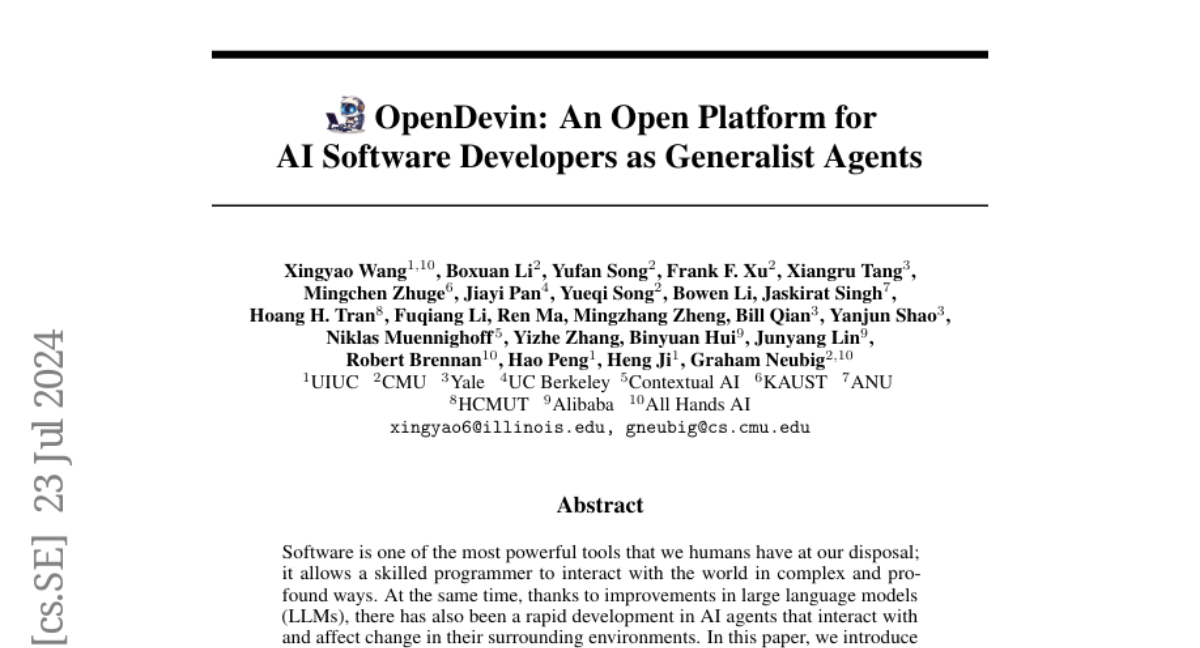
OpenDevin: An Open Platform for AI Software Developers as Generalist Agents

OpenDevin is a platform for developing AI agents that interact with the world by writing code, using command lines, and browsing the web, with support for multiple agents and evaluation benchmarks.

  • 24 authors
· Jul 23, 2024
Submitted by
akhaliq

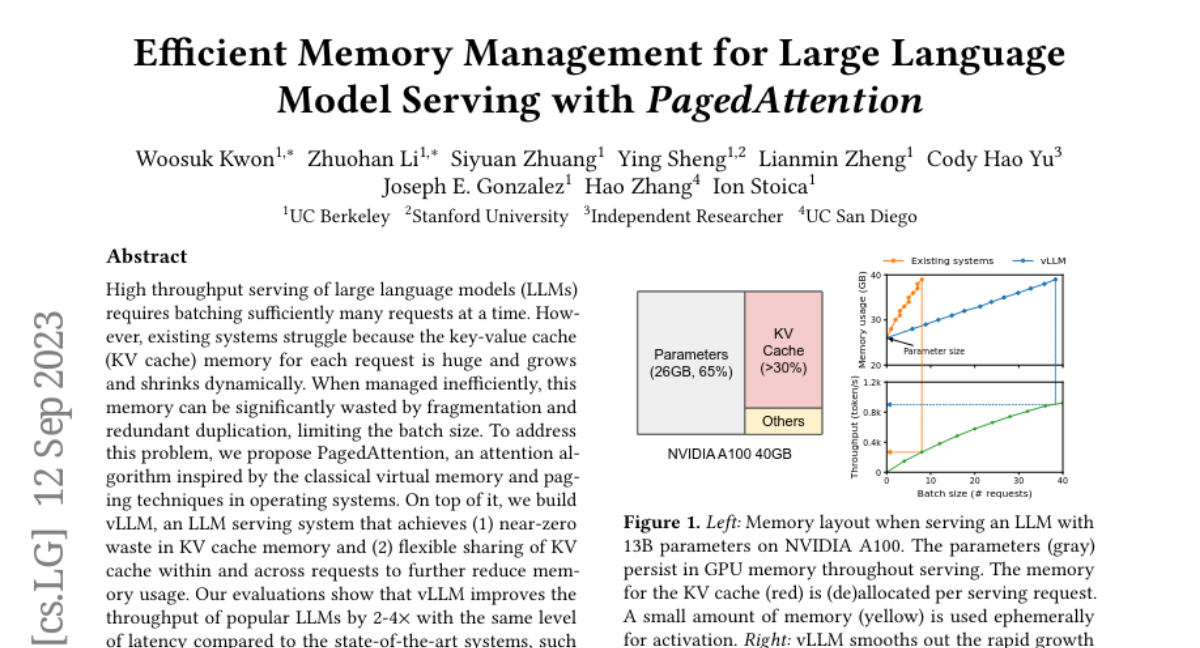
Efficient Memory Management for Large Language Model Serving with PagedAttention

PagedAttention algorithm and vLLM system enhance the throughput of large language models by efficiently managing memory and reducing waste in the key-value cache.

  • 9 authors
· Sep 12, 2023
Submitted by
iTheresaApocalypse

Scaling in Games: Continued Pre-Training For Embodied Agents In Diverse Virtual Worlds

Continued pre-training across data scale, diversity, and model size improves embodied learning in virtual worlds but reveals limits in distant-world generalization, motivating richer training beyond imitation.

Submitted by
FrancisRing

Prism: Dynamic Sparse Attention for Native 2K Joint Video-Audio Generation Model Training

Prism accelerates native joint video-audio generation at 2K by using dynamic sparse attention guided by local visual variance and audio-visual cross-attention to preserve semantic coherence and cross-modal interactions.

Tencent-Hunyuan Tencent Hunyuan · Oct 4, 2026
Submitted by
taesiri

Unlimited OCR Works

Unlimited OCR introduces Reference Sliding Window Attention to eliminate growing memory consumption during long-sequence OCR tasks, enabling efficient transcription of multiple pages in a single forward pass.

baidu BAIDU · Jun 22, 2026
Submitted by
a43992899

YuE2: Unifying Symbolic and Audio Music Generation at Frontier Quality

YuE2 unifies symbolic and audio music generation via symbolic planning, producing readable scores and full-song audio with state-of-the-art quality and agentic editing capabilities.

Submitted by
andito

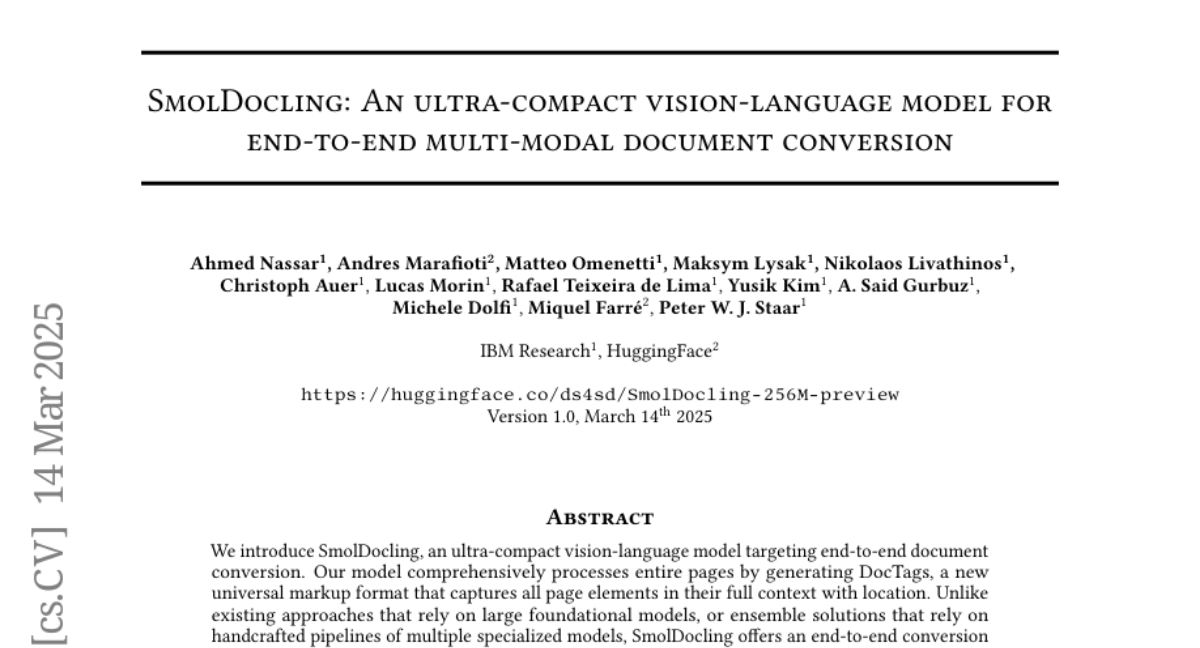
SmolDocling: An ultra-compact vision-language model for end-to-end multi-modal document conversion

SmolDocling is a compact vision-language model that performs end-to-end document conversion with robust performance across various document types using 256M parameters and a new markup format.

ibm-granite IBM Granite · Mar 14, 2025
Submitted by
akhaliq

Very Large-Scale Multi-Agent Simulation in AgentScope

Enhancements to the AgentScope platform improve scalability, efficiency, and ease of use for large-scale multi-agent simulations through distributed mechanisms, flexible environments, and user-friendly tools.

  • 8 authors
· Jul 25, 2024
Submitted by
taesiri

AgentScope 1.0: A Developer-Centric Framework for Building Agentic Applications

AgentScope enhances agentic applications by providing flexible tool-based interactions, unified interfaces, and advanced infrastructure based on the ReAct paradigm, supporting efficient and safe development and deployment.

  • 23 authors
· Aug 22, 2025
Submitted by
taesiri

MinerU2.5: A Decoupled Vision-Language Model for Efficient High-Resolution Document Parsing

MinerU2.5, a 1.2B-parameter document parsing vision-language model, achieves state-of-the-art recognition accuracy with computational efficiency through a coarse-to-fine parsing strategy.

  • 61 authors
· Sep 26, 2025
Submitted by
TK3105

UniAVC: Unified Audio-Video Creation via Progressive Training and Asymmetric Scheduling

UniAVC trains separate audio and video branches on abundant unimodal data before aligning them with scarce paired data, using independent noise schedules and asymmetric supervision to enable joint synthesis, cross-modal generation, and instruction-guided editing.

  • 9 authors
· Oct 17, 2026
Submitted by
liangtm

WeVisOne-VL: Unified Visual Perception from Objects to Pixels

WeVisOne-VL unifies object-level and pixel-level visual perception via structured token prediction, supporting detection, localization, counting, OCR, segmentation, and matting with a lightweight pixel decoder and multi-stage training.

tencent Tencent · Oct 22, 2026
Submitted by
hhhllan

MemT-1.0: Towards Memory-Native Evolution

MemT-1.0 introduces a memory-native architecture that embeds continuous memory into foundation model computation, improving long-context efficiency and agentic task performance.

MemTensor MemTensor · Oct 19, 2026
Submitted by
HELLORPG

Looking Ahead: Modeling Future Evolution in Autoregressive Video Generation

Future Chunk Prediction improves autoregressive video diffusion by enforcing future-chunk supervision, yielding more physically plausible video generation with reduced training cost.

TencentARC ARC Lab, Tencent · Oct 21, 2026
Submitted by
LivXue

Raven: The Harness of Harnesses for Composable Agentic Intelligence

Raven is an open-source multi-agent ecosystem that autonomously builds and evolves modular harnesses, enabling cross-domain collaboration and expanding reliable task coverage through composable agent units.

EverMindAI EverMind · Sep 27, 2026
Submitted by
akhaliq

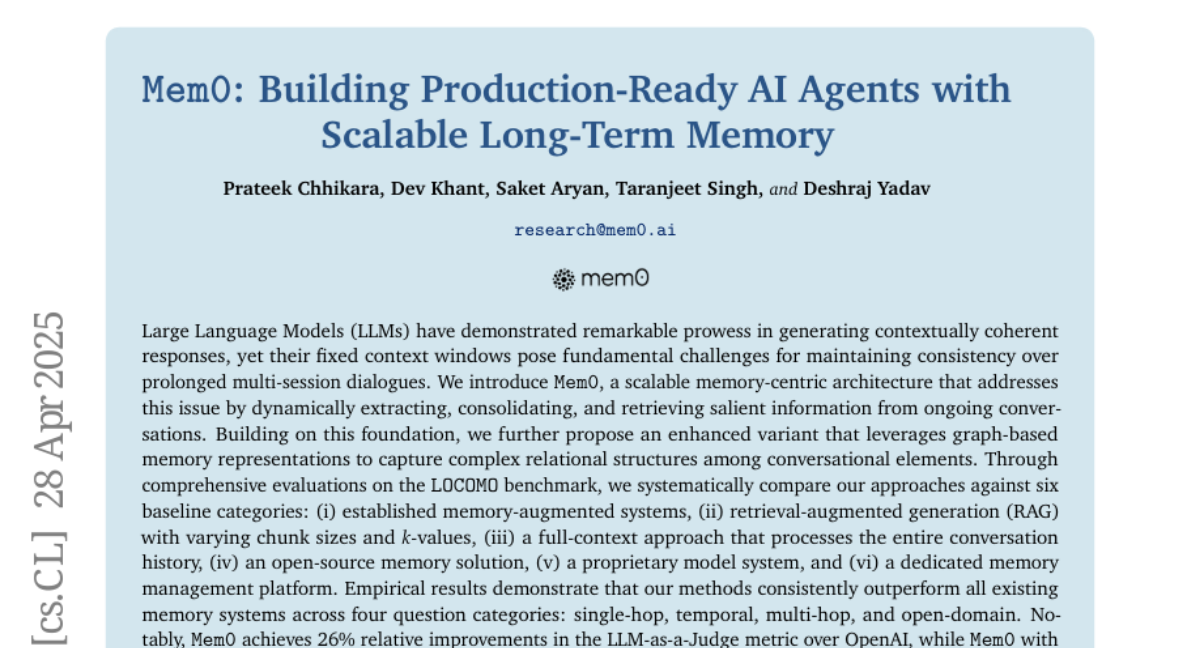
Mem0: Building Production-Ready AI Agents with Scalable Long-Term Memory

Mem0, a memory-centric architecture with graph-based memory, enhances long-term conversational coherence in LLMs by efficiently extracting, consolidating, and retrieving information, outperforming existing memory systems in terms of accuracy and computational efficiency.

  • 5 authors
· Apr 28, 2025
Submitted by
Enderfga

SolarRenderer: Few-Step Generative Reference Rendering

SolarRenderer adapts a frozen video backbone with lightweight LoRAs to render realistic videos from diverse structural inputs in four steps or real-time streaming, using frame-aligned training data.

showlab Show Lab · Oct 20, 2026
Submitted by
RuofengYang

ARIS: Autonomous Research via Adversarial Multi-Agent Collaboration

ARIS is an open-source research harness that uses cross-model adversarial collaboration to ensure reliable long-term research outcomes through coordinated execution, orchestration, and assurance layers.

Submitted by
ChengCui

PaddleOCR-VL-1.6: Expanding the Frontier of Document Parsing with Under-Optimized Region Refinement and Progressive Post-Training

PaddleOCR-VL-1.6 enhances document parsing performance through targeted data optimization and progressive post-training techniques, achieving state-of-the-art results on OmniDocBench v1.6.

PaddlePaddle PaddlePaddle · Jun 2, 2026
Submitted by
demolei

OpenGCUA: Toward a Fully Open Stack for Generalist Computer Use

OpenGCUA introduces an open generalist computer-use agent that integrates visual and programmatic interfaces, harness-to-model decision transfer, and code execution to improve task performance and efficiency across models.

Tongyi-MAI Tongyi-MAI · Oct 15, 2026
Submitted by
Rbin

RAG-Anything: All-in-One RAG Framework

RAG-Anything is a unified framework that enhances multimodal knowledge retrieval by integrating cross-modal relationships and semantic matching, outperforming existing methods on complex benchmarks.

HuggingFace's Transformers: State-of-the-art Natural Language Processing

Transformers library provides state-of-the-art Transformer architectures and pretrained models for natural language processing tasks with a unified API and emphasis on extensibility and robust deployment.

huggingface Hugging Face · Oct 9, 2019
Submitted by
Yuyang-z

SANA-Video: Efficient Video Generation with Block Linear Diffusion Transformer

SANA-Video, a small diffusion model, efficiently generates high-resolution, high-quality videos with strong text-video alignment using linear attention and a constant-memory KV cache, achieving competitive performance at a lower cost and faster speed.

nvidia NVIDIA · Sep 29, 2025
Submitted by
bryanzhou008

OpenVLHarness: Real World Visual Agentic Tool-Use with Multimodal Memory

OpenVLHarness improves multimodal reasoning by integrating persistent memory, heterogeneous tool interfaces, and iterative evidence composition across 22 benchmarks.

apple Apple · Oct 19, 2026
Submitted by
Karl28

RSIPO: Recursive Self-Improving Policy Optimization for Agentic Reinforcement Learning via Skill-Policy Co-Evolution

RSIPO is a self-evolving agentic reinforcement learning framework that co-evolves agentic skills and policies while calibrating teacher supervision reliability via empirical Bayes shrinkage.

Submitted by
Lruca

What Generation Knows: Unlocking Fine-Grained Understanding in Unified Multimodal Models

GAFU leverages native generation-side representations to improve fine-grained visual understanding in unified multimodal models by compressing them into compact tokens for task-conditioned retrieval.

  • 9 authors
· Oct 14, 2026
Submitted by
J3rr1

F2G-Pose: Geometry-Aware Foundation Feature Lifting for Direct RGB-D Category-Level Object Pose Estimation

F2G-Pose is a real-time feed-forward framework that predicts category-level object pose, metric size, and completed shape from a single RGB-D image using dense visual features, DGCNN tokenization, and a Mixture-of-Experts Transformer.

Submitted by
caizhongang

Has GPT-6-Astra Achieved Embodied Intelligence?

GPT-6-Astra achieves high performance across diverse robotic tasks via in-context learning, yet real-world deployment reveals gaps in demonstration cost, execution time, and practical embodied intelligence.

sensenova SenseNova · Oct 15, 2026
Submitted by
yshenaw

Self-Evolving Agent Harness

A framework for self-evolving agent harnesses uses feedback-driven revisions and evolutionary optimization with theoretical generalization guarantees while keeping model weights fixed.

zgcagi ZGCAGI · Oct 13, 2026
Submitted by
Zonghao2025

Securing the AI Agent: A Unified Framework for Multi-Layer Agent Red Teaming

AI-Infra-Guard is an open-source framework that addresses AI infrastructure security through layered detection paradigms spanning infrastructure, protocol, agent behavior, and model layers.

tencent Tencent · Jun 30, 2026
Submitted by
Linzhan

UniMate: One Unified Model to Animate Diverse Skeletons

UniMate is a unified diffusion transformer that generates articulated motion for arbitrary skeletons from text and rigged 3D assets without per-skeleton retraining, using topology-aware attention and a large curated motion dataset.

princetonu Princeton University · Sep 4, 2026
Submitted by
jasonrqh

COLLEAGUE.SKILL: Automated AI Skill Generation via Expert Knowledge Distillation

Person-grounded AI skills are automatically distilled from heterogeneous traces into inspectable, correctable packages that capture both capabilities and behavioral patterns.

ShanghaiAiLab shanghai ailab · May 29, 2026
Submitted by
QiushiSun

PrismaCoder: Pushing the Boundaries of Open Multimodal Code Intelligence through Decomposed Rubric Synthesis

PrismaForge uses a rubric-based pipeline to synthesize and filter high-quality multimodal code data, enabling open models that rival proprietary systems on visual coding tasks.

Submitted by
Lie24

DecisionPivot: A Diagnostic Benchmark for Decision Models in LLM Systems

DecisionPivot is a diagnostic benchmark that evaluates decision models across controlled variations, revealing gaps between aggregate accuracy, contrast-group performance, calibration, and reasoning effort.

startlux-models StartLux · Oct 20, 2026

Native and Compact Structured Latents for 3D Generation

A new sparse voxel representation called O-Voxel enables high-quality 3D generative modeling with efficient inference and robust topology handling.

microsoft Microsoft · Dec 16, 2025
Submitted by
nielsr

Ultralytics YOLO26: Unified Real-Time End-to-End Vision Models

YOLO26 addresses real-time vision challenges through a unified model family with NMS-free inference, improved training strategies, and multi-task capabilities spanning detection, segmentation, and pose estimation.

Ultralytics Ultralytics · Jun 2, 2026

PyTorch Distributed: Experiences on Accelerating Data Parallel Training

The PyTorch distributed data parallel module optimizes large-scale model training using techniques like gradient bucketing, computation-communication overlap, and selective synchronization to achieve near-linear scalability.

  • 11 authors
· Jun 28, 2020
Submitted by
jiaruz2

Hybrid Reasoning Agents

Hybrid Reasoning Agents combine latent internal reasoning with text-based external interaction via a unified architecture and specialized post-training, improving agent performance while reducing inference cost and token usage.

StanfordUniversity Stanford University · Oct 13, 2026
Submitted by
mocoV3

REMORY: Learning Residual Memory for Context Compaction

REMORY enhances long-horizon agent memory by adding learnable soft tokens to textual summaries, improving decision accuracy with minimal context usage.

PDFMathTranslate: Scientific Document Translation Preserving Layouts

PDFMathTranslate enables layout-preserving scientific document translation using large language models and precise layout detection, offering improved precision, flexibility, and efficiency.

  • 4 authors
· Jul 2, 2025
Submitted by
supra3d

SUPRA-TEX: 3D Generation with Super-Aligned Texture

SUPRA-Tex decouples visible-material estimation, surface alignment, and 3D completion to generate relightable 3D materials that preserve reference image details and complete unobserved surfaces.

  • 8 authors
· Oct 15, 2026