

LocalStack Resource Library
Explore the LocalStack Resource Library to unlock the full potential of local cloud development. From quick-start tutorials and deep-dive technical guides to best practices and webinars, we've gathered all the insights you need to build, test, and scale your cloud applications seamlessly.
Browse by Category
An agent will write you a CDK stack, a Terraform module, or a stack of IAM policies in seconds.
Whether any of it works is a separate question, and the usual way to find out is to deploy to a real AWS account and watch what breaks.
In an agentic workflow, that means giving AI access to a public cloud account, racking up costs on the AWS bill, and waiting for provisioning to complete every time you push new code to the environment.

An overview of how LocalStack relates to AWS, useful for AWS-aligned buyers, account teams, and partners weighing how the two fit together. It covers:
- How applications run against LocalStack with the same code and infrastructure files used in AWS
- How local development affects the path to production and usage of core AWS services
- How it applies to cloud migrations
- Where security and governance checks can happen before workloads reach the cloud
- How it relates to testing AI-generated code before deployment
An overview of how LocalStack applies to financial services, where regulatory constraints rule out using a shared cloud development account. It covers:
- How development and testing can happen inside your own network perimeter, without sending data to the cloud
- How licensing and cost work compared to public-cloud dev/test spend
- The effect on the serverless development loop
- How existing AWS tooling, SDKs, CLI, Terraform, CDK, and CloudFormation work with LocalStack
A practitioner's overview of how LocalStack fits into day-to-day development and where it changes the workflow. It covers:
- Why developers can build and test against AWS without waiting on shared or remote accounts
- How the local feedback loop compares to round-tripping through the cloud
- What "AWS parity" looks like in practice, and where it cuts out extra work
- How teams keep behavior consistent across local development and CI
A short overview of the case for local cloud development. It covers:
- Three problems that grow as cloud development scales: security and compliance risk, unpredictable cost, and slower developer workflows
- How running an AWS environment locally relates to all three
- Where local development sits in the workflow, from a developer's laptop through CI/CD
- The outcomes: time to market, non-production cloud spend, and application reliability
A deep dive into the trade-off every enterprise engineering org is quietly making between velocity and risk, and a framework for getting both back. It covers:
- Why the true cost of public-cloud development and testing is higher than most teams budget for, across security, spend, and developer productivity
- The data: breach costs, cloud-waste percentages, budget overruns, and the looming impact of AI-generated code volume
- How centralizing cloud access to control cost and risk quietly throttles developer velocity
- The role local cloud development plays in decoupling day-to-day iteration from public-cloud friction
- What "high-fidelity emulation" actually means for security, compliance, and cost predictability
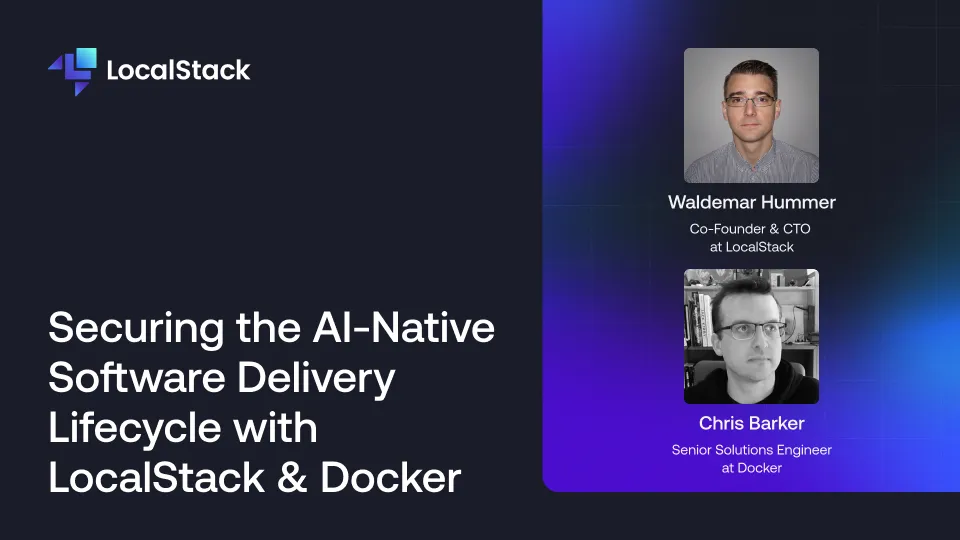
The rise of agentic AI in the software delivery lifecycle creates a dilemma with high-stakes implications.
As agents create new applications at an unprecedented rate, how do you integrate security without slowing down delivery?

You've been there: Lambda triggers, SQS messages fly, Step Functions execute, and somewhere in the middle, something breaks. You have no idea what triggered what, what payload was passed, or where it all went wrong.
That's the black box problem of AWS development.
Once your architecture grows beyond a single service, visibility disappears fast. You're left stitching together scattered logs and redeploying just to see what's going on.
App Inspector is LocalStack's built-in observability layer that opens up that black box. It gives you a real-time, unified view of every service interaction happening inside your local cloud: what triggered what, with what payload, in what order.
In this talk, we'll walk through what App Inspector is, how it fits into your LocalStack workflow, and how to use it to catch bugs locally before they ever reach staging or production.

You’ve been there: Your Unit tests pass both locally and in CI. You deploy with confidence. You thought.. Then staging in the real cloud reveals the truth—bugs that only show up with actual RDS parameter settings, real SQS and SNS throughput limits, or Lambda and API Gateway behaviour your local mocks never captured.
The solution is Testcontainers.
Testcontainers is a testing library that provides easy and lightweight APIs for bootstrapping integration tests with real services wrapped in Docker containers. Using Testcontainers, you can write tests talking to the same type of services you use in production without mocks or in-memory services. Spin them up, run migrations, execute your Node.js service against them, assert results, auto-cleanup.
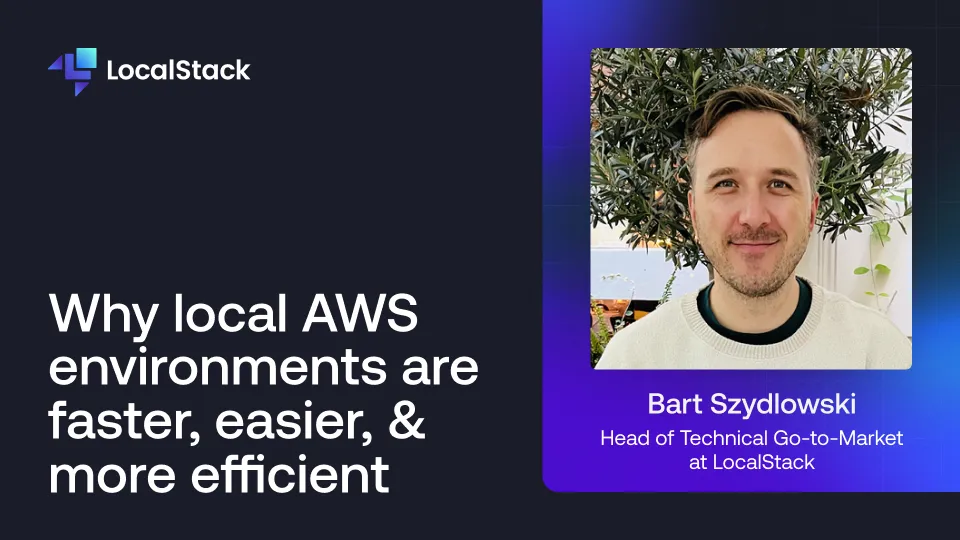
So many of the challenges that slow down software development stem from the fact that early-stage dev & test cycles are performed in cloud environments.
Local cloud development removes these challenges.
By simulating AWS application behavior in a local container, the local cloud enables developers and agents to validate the security, quality, and reliability of their applications faster and more effectively than they can on the cloud.
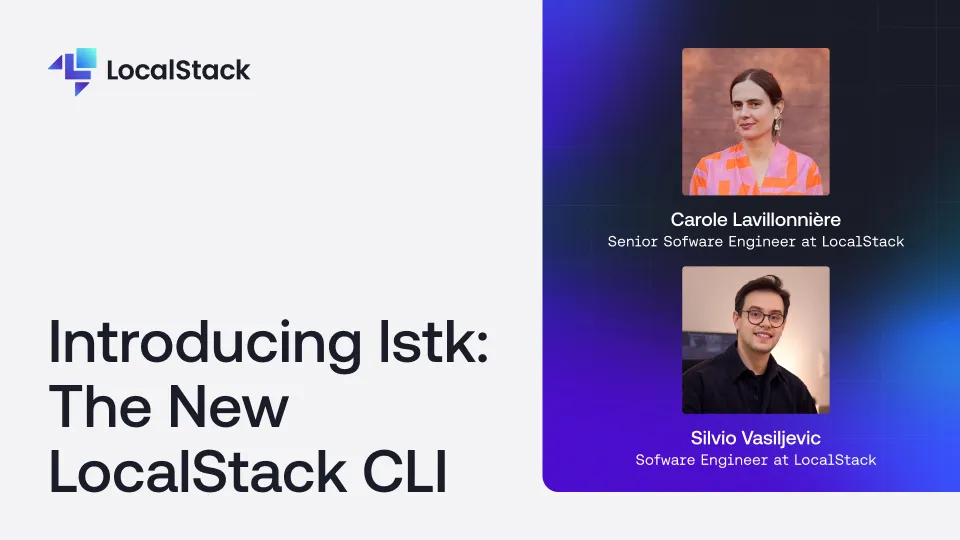
Silvio and Carole introduce lstk, LocalStack's next-generation CLI built from scratch in Go. They explain why the team rebuilt the CLI, walk through its key features — zero-config startup, seamless browser-based authentication, and a rich interactive TUI that surfaces real-time progress and actionable errors — and demo how lstk gets you from install to a running emulator in seconds. They also dive into the architecture behind lstk and how it is designed to support multiple emulators, flexible runtimes, and deep integrations with CI pipelines and IDEs.
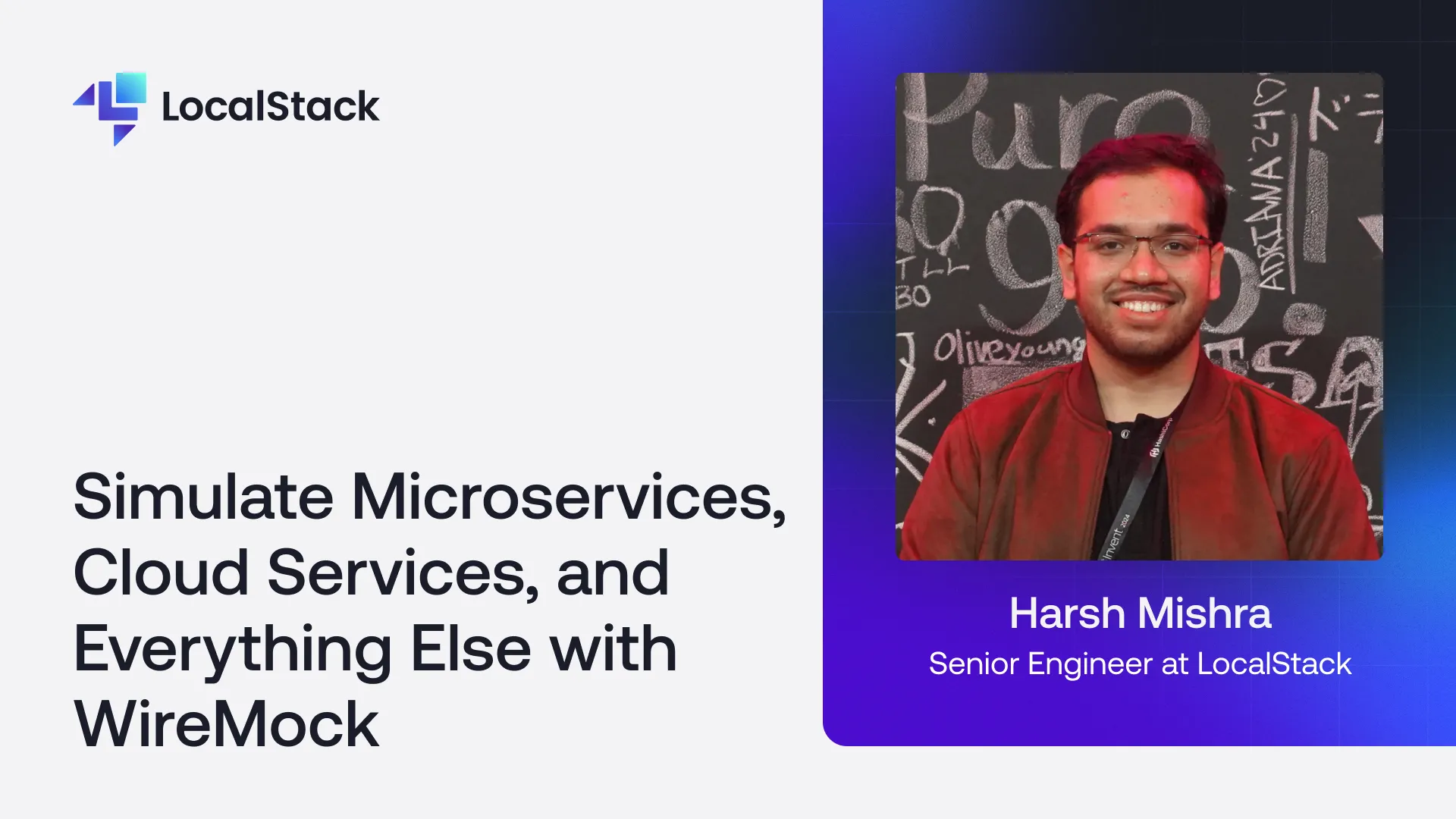
Cloud-first development kills your inner dev loop. There's a better way.TypeDB on AWS is powerful — Lambda functions querying complex relationship hierarchies, recursive schema functions resolving transitive memberships, all without application logic. But iterating on schemas and queries in the cloud is slow and expensive.Harsh Mishra introduces the TypeDB extension for LocalStack: run a fully functional TypeDB server inside your local AWS environment and connect your app exactly as you would in production. Faster iteration, zero unnecessary spend.
Launch yourself in the world of local cloud development
