

Raven is a linear-time sequence model built on top of Flash Linear Attention. It introduces a routing memory mechanism that selectively writes to a fixed set of persistent memory slots using a learned sparse router — achieving sub-quadratic complexity while maintaining strong associative recall.
This fork adds RWKV-7 sequence mixers to Raven so the original Raven routing-memory mixer can be compared against RWKV variants inside the same RavenForCausalLM model API.
Implemented in this repo:
sequence_mixer="rwkv7": original dense RWKV-7 TimeMix adapted from HRM-Text, using the LT2 CUDA backend when available.sequence_mixer="routed_rwkv7": Raven-style top-k router gating dense RWKV channel groups.sequence_mixer="slot_rwkv7": explicit Raven-level routed RWKV memory slots with fullnum_slots x D x Dper-head state.sequence_mixer="low_rank_slot_rwkv7": explicit routed RWKV slots with lower-costnum_slots x rank x Dper-head state.low_rank_slot_rwkv7_backend="triton_fused": train-ready Triton forward plus reverse-scan backward for the low-rank slot RWKV path.examples/compare_mixers.py,examples/run_compare_matrix.py, andexamples/compare_hrm_text_losses.py: speed and held-out loss comparison scripts.
Local HRM-Text held-out loss comparison on RTX 4090, trained from scratch on /home/xiaol/X/hrm_text_subset_1B for 500 steps with hidden=256, layers=2, batch=4, seq=128, slots=64, topk=16, rank=8:
| mixer | params M | initial val | final val | best val | final train | tok/s | peak GB |
|---|---|---|---|---|---|---|---|
raven |
35.39 | 11.1281 | 2.9195 | 2.9195 | 2.5000 | 49,627 | 0.448 |
low_rank_slot_rwkv7 |
35.56 | 11.0938 | 2.6273 | 2.6273 | 1.9531 | 52,854 | 0.991 |
In this local train-ready comparison, low-rank slot RWKV reaches lower validation loss and slightly higher throughput than Raven, while using more VRAM because the fused backward caches low-rank slot states. Full commands and implementation details are in the RWKV-7 sequence mixers section.
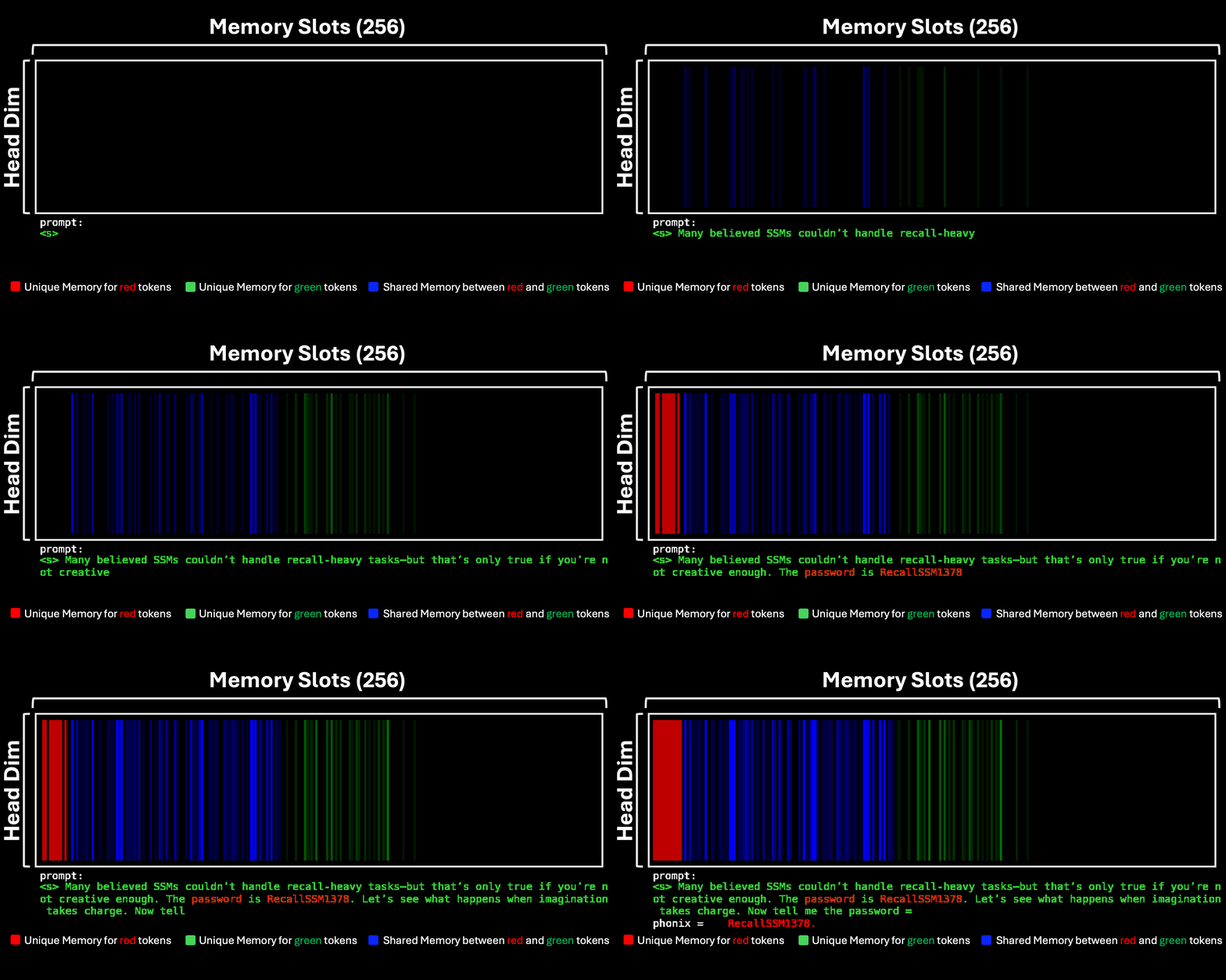
Sparse Memory Routing in Raven. Unlike SSMs that update the entire state densely, or SWA that enforces strict FIFO overwriting, Raven uses an input-dependent router. At each step, only a specific subset of memory slots (highlighted) is selected to undergo decay and receive new information. Unselected slots remain completely untouched, preventing interference and preserving long-range recall.

Raven replaces the SSM block with an RSM (Routing State Model) layer. Unlike GLA/Mamba2 which write to all memory slots uniformly, Raven learns a per-token sparse router R that selects which slots to update.

Each Raven layer maintains a matrix memory state H ∈ R^(slots × d_v). At each timestep the router selects the top-k most relevant slots and performs a gated update:
route_scores = TopK( sigmoid(r_proj(x)) )
decay         = exp( route_scores * f )     # sparse forgetting gate
H             = H * decay + (1 - decay) * k ⊗ v
o             = q · H                       # read
The table below places Raven in the broader landscape of linear models:

Key design choices:
- Sparse top-k routing — each token writes to a small subset of memory slots
- Gumbel noise during training for exploration (optional)
- Mamba2 or GLA decay for the forgetting gate
- Chunked Triton kernels for training, fused recurrent kernels for generation

Table 2: In-context recall benchmarks and NIAH accuracy vs. context length. Accuracy (%) on SWDE/FDA/SQuAD and single NIAH-1/2/3 across context lengths. Bold = best, underline = second best.
~400M parameter models
| Model | Params | Mem (M) | SWDE | FDA | SQuAD | N1-1K | N1-2K | N1-4K | N1-8K | N1-16K | N1-32K | N2-1K | N2-2K | N2-4K | N2-8K | N2-16K | N2-32K | N3-1K | N3-2K | N3-4K | N3-8K | N3-16K | N3-32K |
|---|---|---|---|---|---|---|---|---|---|---|---|---|---|---|---|---|---|---|---|---|---|---|---|
| Transformer | |||||||||||||||||||||||
| w. RoPE | 340 | ∞ / 0 | 42.3 | 34.5 | 22.1 | 100 | 100 | 0 | 0 | 0 | 0 | 100 | 100 | 0 | 0 | 0 | 0 | 71.6 | 47.6 | 0 | 0 | 0 | 0 |
| w. Gate (FoX) | 376 | ∞ / 0 | 52.5 | 64.3 | 30.1 | 100 | 100 | 32.2 | 8.0 | 4.2 | 0 | 100 | 100 | 100 | 24.0 | 11.6 | 3.2 | 95.4 | 85.6 | 64.2 | 11.6 | 7.2 | 0 |
| SSM | |||||||||||||||||||||||
| GLA | 475 | 12.5 / 0.4 | 29.0 | 11.4 | 30.3 | 74.6 | 25.1 | 8.2 | 2.2 | 0 | 0 | 91.2 | 37.2 | 21.4 | 3.6 | 0 | 0 | 84.2 | 57.1 | 20.8 | 10.2 | 2.3 | 0 |
| GSA | 399 | 12.5 / 0 | 23.8 | 14.5 | 24.9 | 99.2 | 97.1 | 90.0 | 67.4 | 29.6 | 11.0 | 96.6 | 98.8 | 28.0 | 5.1 | 1.0 | 0 | 60.0 | 30.1 | 13.5 | 1.0 | 0 | 0 |
| GDN | 475 | 12.5 / 0.4 | 29.5 | 8.3 | 31.3 | 99.2 | 100 | 99.8 | 92.0 | 41.8 | 22.1 | 99.2 | 92.0 | 43.6 | 17.8 | 6.2 | 4.0 | 92.6 | 80.6 | 37.8 | 5.2 | 6.8 | 2.5 |
| Mamba-2 | 382 | 12.5 / 0.4 | 25.7 | 14.9 | 31.9 | 99.2 | 95.6 | 52.2 | 12.8 | 5.4 | 2.8 | 99.8 | 98.0 | 68.2 | 15.4 | 4.4 | 3.8 | 53.4 | 53.6 | 17.4 | 1.8 | 2.2 | 3.2 |
| SWA | 374 | 12.5 / 0 | 10.0 | 14.4 | 29.7 | 29.8 | 11.0 | 6.2 | 3.4 | 1.2 | 0 | 36.2 | 14.4 | 10.2 | 3.8 | 3.2 | 0 | 26.2 | 9.2 | 7.4 | 1.4 | 1.8 | 0 |
| Raven | 424 | 12.5 / 0 | 34.1 | 22.7 | 35.4 | 99.8 | 100 | 99.8 | 99.8 | 99.4 | 91.4 | 98.8 | 98.0 | 98.8 | 81.6 | 23.0 | 8.8 | 76.8 | 43.6 | 13.4 | 1.0 | 0 | 0 |
Table 3: Language modeling and zero-shot evaluation results. Perplexity on Lambada (LMB.) and zero-shot accuracy across standard benchmarks. Bold = best, underline = second best.
~400M parameter models
| Model | Params | LMB. ppl↓ | LMB. acc↑ | PIQA↑ | Hella.↑ | Wino.↑ | ARC-e↑ | ARC-c↑ | Avg.↑ |
|---|---|---|---|---|---|---|---|---|---|
| Transformer | |||||||||
| w. RoPE | 340 | 42.0 | 31.0 | 64.4 | 30.2 | 51.0 | 44.3 | 18.7 | 39.9 |
| w. Gate (FoX) | 376 | 48.1 | 30.6 | 64.9 | 30.7 | 51.1 | 44.7 | 18.9 | 40.1 |
| SSM | |||||||||
| GLA | 400 | 42.1 | 30.7 | 64.4 | 30.1 | 52.7 | 43.8 | 19.6 | 40.2 |
| GSA | 399 | 44.1 | 30.3 | 64.9 | 30.7 | 51.5 | 45.6 | 20.5 | 40.5 |
| GDN | 475 | 40.1 | 31.6 | 65.6 | 31.4 | 50.2 | 45.7 | 19.3 | 40.6 |
| Mamba-2 | 382 | 43.0 | 29.9 | 65.0 | 31.5 | 51.2 | 47.5 | 20.5 | 40.1 |
| SWA | 374 | 40.7 | 30.5 | 64.5 | 30.4 | 51.6 | 44.9 | 18.6 | 40.0 |
| Raven | 424 | 41.0 | 32.7 | 64.1 | 30.3 | 51.7 | 43.9 | 18.4 | 40.2 |
Table 4: Hybrid-Raven vs. other hybrid architectures on retrieval tasks. ✓ = no convolutional memory needed.
~400M parameter models
| Model | No Conv. | SWDE | FDA | SQuAD | N1-1K | N1-2K | N1-4K | N1-8K | N1-16K | N1-32K | N2-1K | N2-2K | N2-4K | N2-8K | N2-16K | N2-32K | N3-1K | N3-2K | N3-4K | N3-8K | N3-16K | N3-32K |
|---|---|---|---|---|---|---|---|---|---|---|---|---|---|---|---|---|---|---|---|---|---|---|
| GDN | ✗ | 54.6 | 67.2 | 34.5 | 100 | 100 | 100 | 100 | 93.2 | 70.5 | 100 | 100 | 100 | 8.0 | 0 | 0 | 93.2 | 70.2 | 50.0 | 0 | 0 | 0 |
| Mamba-2 | ✗ | 56.3 | 68.8 | 36.0 | 100 | 100 | 16.4 | 0 | 0 | 0 | 100 | 100 | 85.8 | 0 | 0 | 0 | 76.9 | 80.6 | 60.8 | 0 | 0 | 0 |
| SWA-RoPE | ✓ | 51.0 | 68.1 | 34.1 | 100 | 100 | 100 | 100 | 98.2 | 60.4 | 100 | 100 | 100 | 98.2 | 3.1 | 0 | 93.4 | 78.2 | 12.8 | 60.0 | 4.4 | 0 |
| Raven | ✓ | 51.4 | 64.2 | 31.4 | 100 | 100 | 100 | 100 | 98.4 | 78.6 | 100 | 100 | 100 | 100 | 95.4 | 65.4 | 90.0 | 67.0 | 73.8 | 60.0 | 10.2 | 14.4 |
| Component | Details |
|---|---|
| Layer type | RavenAttention (replaces standard attention) |
| Memory | Fixed-size slot matrix per head (num_slots slots) |
| Router | Linear or MLP projection → top-k sigmoid/softmax |
| Decay | Mamba2 (A_log + dt_bias) or GLA (logsigmoid) |
| Feature map | Swish, ReLU, or T2R |
| Computation | Chunked (training) / Fused recurrent (inference) |
| Hybrid layers | Optional standard attention layers at specified indices |
Install the FLA dependency first, following the official FLA guide:
pip install flash-linear-attentionThen clone this repo:
git clone https://github.com/AvivBick/RoutingMemory
cd RoutingMemory
pip install -e .
Requirements: PyTorch ≥ 2.5, Triton ≥ 3.0, einops, transformers ≥ 4.45.0
from raven.layers import RavenAttention

attn = RavenAttention(
    hidden_size=1024,
    num_heads=4,
    num_slots=256,
    topk=32,
    decay_type='Mamba2',    # or 'GLA'
    feature_map='swish',
    router_type='lin',      # or 'mlp'
    router_score='sigmoid', # or 'softmax'
).cuda()

x = torch.randn(1, 2048, 1024).cuda()
y, _, _ = attn(x) # (batch, seq_len, hidden_size)from raven.models import RavenConfig, RavenForCausalLM
from transformers import AutoModelForCausalLM
config = RavenConfig(
hidden_size=1024,
num_hidden_layers=24,
num_heads=4,
num_slots=256,
topk=32,
decay_type='Mamba2',
feature_map='swish',
vocab_size=32000,
)
model = AutoModelForCausalLM.from_config(config).cuda()This fork can also replace the default routing-memory layer with RWKV-7 mixers adapted from HRM-Text. The implementation keeps Raven's embedding, normalization, MLP, LM head, and Hugging Face model API, while swapping RavenAttention for an RWKV-7 mixer inside each non-attention block.
config = RavenConfig(
    hidden_size=1024,
    num_hidden_layers=24,
    sequence_mixer="rwkv7",  # or "routed_rwkv7" / "slot_rwkv7" / "low_rank_slot_rwkv7"
    rwkv7_head_size=64,
    rwkv7_backend="cuda",
    rwkv7_chunk_len=16,
    low_rank_slot_rwkv7_rank=8,
    low_rank_slot_rwkv7_backend="triton_fused",
    vocab_size=32000,
)
model = RavenForCausalLM(config)
Implemented options:
sequence_mixer |
Memory/routing granularity | State size per head | Kernel path | Training status |
|---|---|---|---|---|
"rwkv7" |
Dense RWKV-7 state, no router | D x D |
LT2 CUDA when available | Trainable baseline |
"routed_rwkv7" |
Raven-style top-k router mapped to per-head channel groups | D x D |
LT2 CUDA when available | Trainable router adapter |
"slot_rwkv7" |
Explicit per-head recurrent slot states, closest to Raven memory slots | num_slots x D x D |
PyTorch CUDA recurrence | Correct but slow |
"low_rank_slot_rwkv7" |
Explicit routed slots with low-rank per-slot state | num_slots x rank x D |
Triton forward/backward with triton_fused |
Ready-to-train comparison path |
Use sequence_mixer="slot_rwkv7" when you want RWKV to have Raven-level routed memory slots. It creates num_slots independent RWKV state matrices per head and applies the router inside the recurrent update. This is semantically closer to Raven, but slower until a dedicated slot-aware CUDA kernel is written.
Use sequence_mixer="low_rank_slot_rwkv7" to keep explicit routed slots but reduce each slot state from head_dim x head_dim to rank x head_dim; configure the rank with low_rank_slot_rwkv7_rank. Forward/eval can use the Triton kernel via low_rank_slot_rwkv7_backend="auto" or "triton". For training, use "triton_fused" for a Triton reverse-scan backward, or "triton_autograd" to keep the older Triton-forward/PyTorch-recompute backward path for debugging.
To compare Raven vs. RWKV-7 with the same model shape:
PYTHONPATH=/home/xiaol/X/HRM-Text:$PYTHONPATH \
LT2_RWKV7_CUDA_DIR=/home/xiaol/X/LT2_upstream/apps/LT2/cuda/rwkv7 \
python examples/compare_mixers.py \
  --device cuda \
  --dtype bf16 \
  --rwkv-backend cuda \
  --hidden-size 512 \
  --num-layers 4 \
  --seq-len 512 \
  --batch-size 2 \
  --steps 10
Use --backward to compare training-step cost instead of inference-only forward cost. The LT2 CUDA path currently requires BF16, rwkv7_head_size=64, and rwkv7_chunk_len=16.
For held-out loss comparisons on the already-prepared HRM-Text token subset, use:
PYTHONPATH=/home/xiaol/X/HRM-Text:/home/xiaol/X/raven:$PYTHONPATH \
LT2_RWKV7_CUDA_DIR=/home/xiaol/X/LT2_upstream/apps/LT2/cuda/rwkv7 \
/home/xiaol/X/HRM-Text/.venv/bin/python examples/compare_hrm_text_losses.py \
  --dataset-path /home/xiaol/X/hrm_text_subset_1B \
  --out-dir outputs/hrm_text_loss_compare_raven_vs_low_rank_slot_rwkv7_s500 \
  --steps 500 \
  --eval-every 100 \
  --eval-batches 20 \
  --batch-size 4 \
  --seq-len 128 \
  --hidden-size 256 \
  --num-layers 2 \
  --num-heads 4 \
  --num-slots 64 \
  --topk 16 \
  --low-rank-slot-rwkv-rank 8 \
  --low-rank-slot-rwkv-backend triton_fused \
  --lr 3e-4 \
  --warmup-steps 50 \
  --dtype bf16 \
  --device cuda
Local HRM-Text causal-LM loss result on RTX 4090, using the command above:
| mixer | params M | initial val | final val | best val | final train | tok/s | peak GB |
|---|---|---|---|---|---|---|---|
raven |
35.39 | 11.1281 | 2.9195 | 2.9195 | 2.5000 | 49,627 | 0.448 |
low_rank_slot_rwkv7 |
35.56 | 11.0938 | 2.6273 | 2.6273 | 1.9531 | 52,854 | 0.991 |
Validation checkpoints:
In this short local run, the train-ready low-rank slot RWKV path reaches lower held-out loss and slightly higher throughput than the Raven mixer, with higher VRAM use from cached low-rank slot states during fused backward. Full results are saved in outputs/hrm_text_loss_compare_raven_vs_low_rank_slot_rwkv7_s500/.
Raven uses the flame training framework. Add a config from configs/raven_340M_*.json to flame/configs/, then:
CUDA_VISIBLE_DEVICES=0,1,2,3 NGPU=4 bash train.sh \
    --job.config_file flame/models/fla.toml \
    --job.dump_folder exp/raven-340M \
    --model.config configs/raven_340M_1.json \
    --optimizer.name AdamW \
    --optimizer.lr 3e-4 \
    --lr_scheduler.warmup_steps 1024 \
    --lr_scheduler.decay_type cosine \
    --training.batch_size 16 \
    --training.seq_len 2048 \
    --training.gradient_accumulation_steps 4 \
    --training.steps 30720 \
    --training.dataset /path/to/SlimPajama-627B \
    --training.streaming \
    --training.compile \
    --checkpoint.interval 3072
The configs/ directory contains 12 ablation configurations varying the router design (linear vs. MLP, sigmoid vs. softmax, with/without Gumbel noise and bias).
raven/
├── layers/
│   └── raven.py                # RavenAttention layer
└── models/
    └── raven/
        ├── configuration_raven.py
        └── modeling_raven.py

configs/
└── raven_340M_*.json           # 12 ablation configs (340M scale)

assets/img/                     # figures used in this README
This repo builds on [fla-org/flash-linear-attention] and depends on it for hardware-efficient Triton kernels. In particular, Raven currently reuses FLA’s GSA chunked and fused recurrent kernels rather than vendoring separate Raven ops in this repository.


@article{afzalbick2026raven,
  title={Raven: High-Recall Sequence Modeling with Sparse Memory Routing},
  author={Arshia Afzal, Aviv Bick, Eric P. Xing, Volkan Cevher, Albert Gu},
  year={2026},
  publisher={MDPI}
}