
Your AI Bill,
Itemized
Supported tools, 40 and counting











The menu bar app
One glance up.
One click down.

You used to find out at the end of the month. Now the number sits next to your clock all day, above every window, and one click opens the whole bill.
Always on
The day's spend sits next to your clock. No dashboard to open, no tab to find.
Limits before they bite
Plan usage metered live for every agent, with time remaining on each window.
Every agent, one ledger
Per agent totals from today to lifetime, local or combined across your machines.
Where it went
Spend split by activity: coding, debugging, feature work, with turns and 1-shot rates.
Native Swift. Reads local session files only. Nothing leaves your Mac. On Linux, the same number lives in your GNOME top bar.
The desktop app
Follow the money.
Model to project.


The bill stops being one number and becomes a map: which model, which project, which session, and whether the work it paid for survived.
Model to project, traced
Cost flow shows which model spent into which repo, for any range you pick.
Graded, not guessed
An efficiency score built from one-shot rate, cache hits, and retry tax.
Month to date, and where it lands
A projected month total, with your pace measured against last month.
Sessions and pull requests
Spend attributed to the branches and PRs the work actually produced.
Free and open source. macOS, Windows, and Linux.
New · The capacity dock
See every limit
before you hit it.
A floating dock rests on the edge of your screen with a live ring for every AI plan you are signed in to. Claude, Codex, Kimi and more, each showing how much you have burned and when it resets.

Live usage rings
Weekly or 5-hour usage per provider, shading from green to red as each limit fills.
Docks to any edge
Snap it to a screen edge or let it float. It necks into the notch like it was always there.
Only what you use
Shows the providers you are actually connected to, and nothing you are not.
Part of the native macOS menu bar app. Local only, nothing leaves your Mac.
The terminal
One command.
Nothing added to your stack.
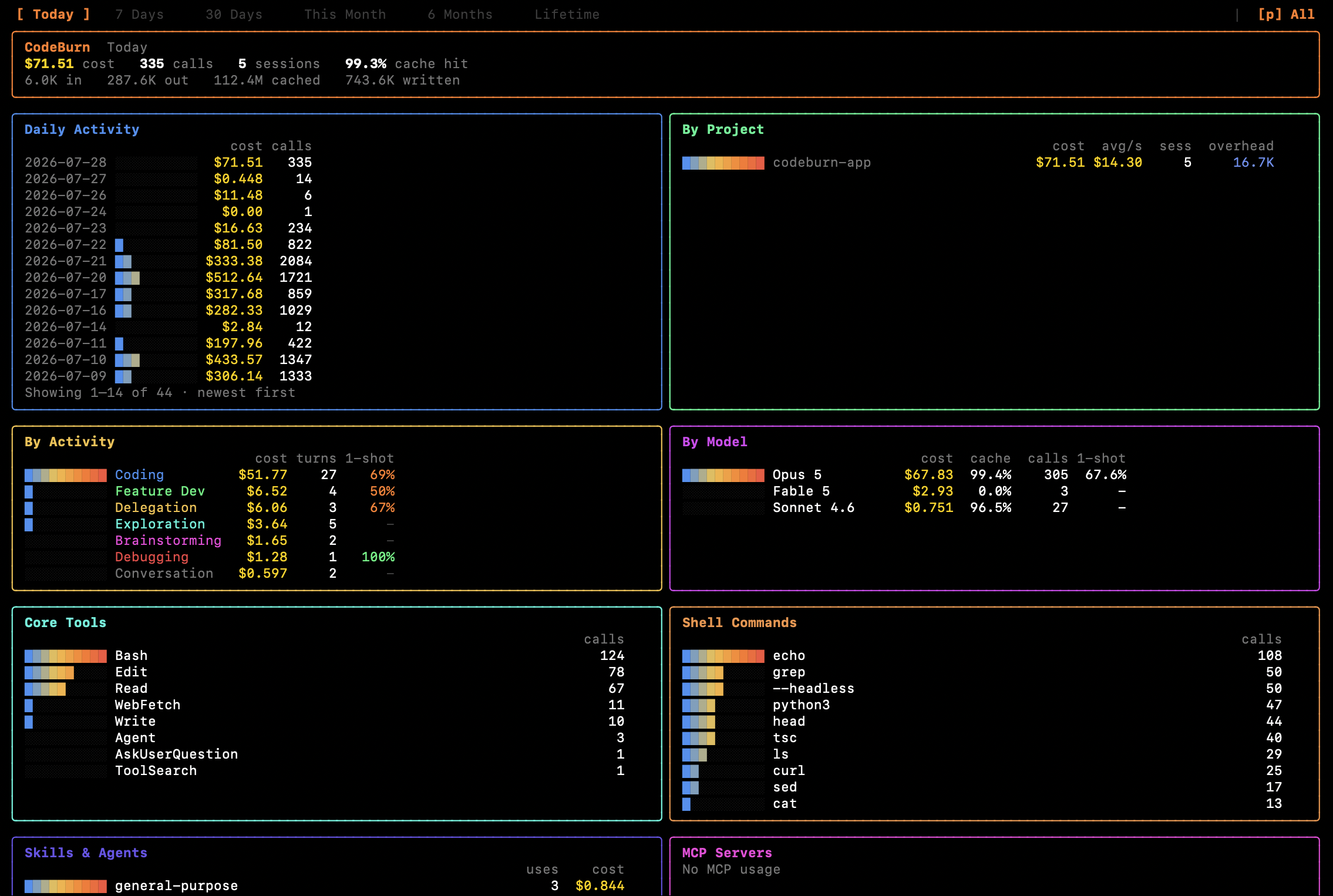
Run npx codeburn and the whole picture opens where you already are. It only reads local logs: no account, no config, no changes to how your tools run.
Today to lifetime
Switch the whole view between today, a week, a month, six months, or everything you have ever run.
Every breakdown on one screen
Project, model, activity, core tools, shell commands, skills and agents, all at once.
Cache hit and 1-shot, per row
Cache hit rate, turns, and one-shot percentage sit next to every cost, not in a separate report.
MCP servers and subagents
Uses and cost for the MCP servers, skills, and delegated agents your runs pulled in.
Also on Homebrew. The same totals the menu bar and the app read.
The community has spoken
From GitHub to Hacker News, developers are talking about CodeBurn.
THIS TOOL SHOWS YOU EXACTLY WHERE YOUR CLAUDE CODE TOKENS ARE GOING. This guy was spending $200+ a day on Claude Code with zero visibility into what was eating the tokens. So he built a terminal dashboard that reads your session transcripts and classifies every single turn.
“This is actually pretty useful. Most people have no idea how much they're spending on AI tools until it adds up, so having it visible in the menubar makes a lot of sense. Really solid idea though, especially being open source.”
“Wait this is so sick! Definitely adding this when I get home”
“big thanks! needed this so badly.”
“Thank you - very interesting. I will try it out.”
“Beautiful”
“We definitely need to install this before our Polymarket scripts bankrupt us on API calls”
“CodeBurn Is The Latest Usage Tracker Blowing up On Github. 435 likes, 16K+ views.”
“You may want to bookmark this!! Do you know the true dollar cost of every Claude Code session?”
“Thanks for the quick turnaround and for getting the invariants right. The reconciliation guarantee is what makes this safe to consume.”
THIS TOOL SHOWS YOU EXACTLY WHERE YOUR CLAUDE CODE TOKENS ARE GOING. This guy was spending $200+ a day on Claude Code with zero visibility into what was eating the tokens. So he built a terminal dashboard that reads your session transcripts and classifies every single turn.
“This is actually pretty useful. Most people have no idea how much they're spending on AI tools until it adds up, so having it visible in the menubar makes a lot of sense. Really solid idea though, especially being open source.”
“Wait this is so sick! Definitely adding this when I get home”
“big thanks! needed this so badly.”
“Thank you - very interesting. I will try it out.”
“Beautiful”
“We definitely need to install this before our Polymarket scripts bankrupt us on API calls”
“CodeBurn Is The Latest Usage Tracker Blowing up On Github. 435 likes, 16K+ views.”
“You may want to bookmark this!! Do you know the true dollar cost of every Claude Code session?”
“Thanks for the quick turnaround and for getting the invariants right. The reconciliation guarantee is what makes this safe to consume.”
A handy little tool I discovered, specifically designed to keep tabs on the token bills for Claude Code and Codex. When you usually use AI to write code, where the tokens are spent, which model burns through money the fastest.
“Very nice. Feels like one of those tools that becomes obvious the moment you see your spend broken down this clearly. Looks like the project has great velocity now.”
“I'd love something like this Claude Desktop. Looks great.”
“Been using this a lot since I discovered it a few weeks ago. Thanks for building and sharing!”
“Looks like it may be useful, thank you”
“Looks cool! Is it able to track stats for models that I use through a non-opencode subscription? Like if I use gpt-5.3-codex through a chatgpt subscription in opencode, will I be able to see some usage stats for it?”
“This is a game changer for anyone trying to scale their agentic workflows without going broke. Visualizing where the tokens actually go makes it much easier to optimize your development budget.”
“CodeBurn, an open-source dashboard built by the AgentSeal team that answers the one question every developer using Claude Code or Cursor is frustrated about: where the hell did all my tokens go?”
“ah nice, you are doing some amazing work. Just to let you know — Visa has forked CodeBurn internally and suggested employees try it.”
“Thanks for shipping this so quickly. Two choices are nicer than what I proposed. NSStatusItem.variableLength is a cleaner answer, and Int((cost * rate).rounded()) rounds correctly where my version would silently truncate.”
A handy little tool I discovered, specifically designed to keep tabs on the token bills for Claude Code and Codex. When you usually use AI to write code, where the tokens are spent, which model burns through money the fastest.
“Very nice. Feels like one of those tools that becomes obvious the moment you see your spend broken down this clearly. Looks like the project has great velocity now.”
“I'd love something like this Claude Desktop. Looks great.”
“Been using this a lot since I discovered it a few weeks ago. Thanks for building and sharing!”
“Looks like it may be useful, thank you”
“Looks cool! Is it able to track stats for models that I use through a non-opencode subscription? Like if I use gpt-5.3-codex through a chatgpt subscription in opencode, will I be able to see some usage stats for it?”
“This is a game changer for anyone trying to scale their agentic workflows without going broke. Visualizing where the tokens actually go makes it much easier to optimize your development budget.”
“CodeBurn, an open-source dashboard built by the AgentSeal team that answers the one question every developer using Claude Code or Cursor is frustrated about: where the hell did all my tokens go?”
“ah nice, you are doing some amazing work. Just to let you know — Visa has forked CodeBurn internally and suggested employees try it.”
“Thanks for shipping this so quickly. Two choices are nicer than what I proposed. NSStatusItem.variableLength is a cleaner answer, and Int((cost * rate).rounded()) rounds correctly where my version would silently truncate.”
Someone was spending $200+ a day on Claude Code with no idea where the tokens were going. So they built a terminal dashboard that classifies every session turn into 13 categories. More than half the money was going to conversation, not code. One line install: npx codeburn.
“Great to see someone actually evaluating, sharing data and insights over the hundreds of "this sucks" posts with zero context. Thanks!”
“Thanks for the context. Quality post.”
“That is cool. Will try it out soon.”
“Interesting! I like it!”
“wait this is actually useful. was literally wondering yesterday why my claude bill was so high when i wasn't coding that much. gonna try this today”
“Visibility is key.”
“Very useful”
“Great tool. Installed via npx, zero friction, immediately useful on a 15-project setup running 170+ sessions/month across Opus and Sonnet. Starred.”
“Confirmed working! Before fix: 0 Gemini sessions detected. After fix: 54 sessions captured, full breakdown intact. Thanks for the fast turnaround on the fix!”
Someone was spending $200+ a day on Claude Code with no idea where the tokens were going. So they built a terminal dashboard that classifies every session turn into 13 categories. More than half the money was going to conversation, not code. One line install: npx codeburn.
“Great to see someone actually evaluating, sharing data and insights over the hundreds of "this sucks" posts with zero context. Thanks!”
“Thanks for the context. Quality post.”
“That is cool. Will try it out soon.”
“Interesting! I like it!”
“wait this is actually useful. was literally wondering yesterday why my claude bill was so high when i wasn't coding that much. gonna try this today”
“Visibility is key.”
“Very useful”
“Great tool. Installed via npx, zero friction, immediately useful on a 15-project setup running 170+ sessions/month across Opus and Sonnet. Starred.”
“Confirmed working! Before fix: 0 Gemini sessions detected. After fix: 54 sessions captured, full breakdown intact. Thanks for the fast turnaround on the fix!”
“Genuinely thank you so much for this. I was able to find where my claude has been opening thousands of terminal sessions and eating up my tokens without me even sending a single message. Super duper helpful”
“Immediate install and use. It's brilliant, thank you OP!”
“I need this in my life”
“Nice design! Good job!”
“Thanks for making this, will try this out with my team!”
“Codex, Claude Code, Cursor... quietly hiding the real cost of your usage. That's why CodeBurn exists. It tracks tokens, cost, and performance across 18+ AI coding tools, so you can compare models, optimize usage, and see where your budget leaks.”
“beautiful”
“Install codeburn, then run codeburn optimize. That command scans your coding agent sessions for specific waste. Repeated file reads, low read-to-edit ratios, uncapped bash output, unused MCP servers. And returns token-level savings estimates per fix.”
“Four out of six in a single release cycle is genuinely impressive. Per-project drill-down and cost-per-session are exactly what I needed most. Great project.”
“And thanks for the quick fixes!!”
“Genuinely thank you so much for this. I was able to find where my claude has been opening thousands of terminal sessions and eating up my tokens without me even sending a single message. Super duper helpful”
“Immediate install and use. It's brilliant, thank you OP!”
“I need this in my life”
“Nice design! Good job!”
“Thanks for making this, will try this out with my team!”
“Codex, Claude Code, Cursor... quietly hiding the real cost of your usage. That's why CodeBurn exists. It tracks tokens, cost, and performance across 18+ AI coding tools, so you can compare models, optimize usage, and see where your budget leaks.”
“beautiful”
“Install codeburn, then run codeburn optimize. That command scans your coding agent sessions for specific waste. Repeated file reads, low read-to-edit ratios, uncapped bash output, unused MCP servers. And returns token-level savings estimates per fix.”
“Four out of six in a single release cycle is genuinely impressive. Per-project drill-down and cost-per-session are exactly what I needed most. Great project.”
“And thanks for the quick fixes!!”
Frequently asked questions
What is CodeBurn?
CodeBurn is a free, open-source, local-first tool that tracks AI coding token usage and cost across 40 tools and agents, including Claude Code, Cursor, Codex, Gemini and Grok, broken down by model, project, and task. It ships as a desktop app for macOS, Windows and Linux, a macOS menu bar app, a CLI, a local web dashboard, and a GNOME extension.
How do I track my Claude Code, Cursor, or Codex cost?
Run npx codeburn and CodeBurn reads the session data already on your machine. See the dedicated guides for Claude Code cost, Cursor usage, and Codex cost.
Does CodeBurn only find waste, or fix it?
Both. codeburn optimize grades your setup A to F and flags duplicate reads, context bloat, and ghost agents. It can then apply the fixes for you, with an undo for each one. See Optimize.
Is CodeBurn a ccusage alternative?
Yes. CodeBurn covers 40 tools (not just Claude Code), adds a desktop app, a menu bar app and a web dashboard, and prices cache reads and writes correctly. See CodeBurn vs ccusage.
Is it free, and does my data leave my machine?
CodeBurn is 100% free and open source, and fully local. It reads session files on disk and never uploads anything, no account, no API keys. The desktop app has optional, anonymous telemetry you opt into at first launch, and you can read exactly what it collects.
Which AI coding tools does CodeBurn support?
CodeBurn auto-detects 40 AI coding tools. See the full list of supported tools.