
First-Class Automation Testing Company











Why Choose Us for Test Automation?





 6 years in automation testing services A comprehensive test automation toolkit featuring Apache JMeter, Selenium, REST-assured, Ranorex and more Development of tailored test automation frameworks Expertise in a variety of industries, including e-commerce, financial, healthcare, travel and accommodation
Automated Testing Services We Offer


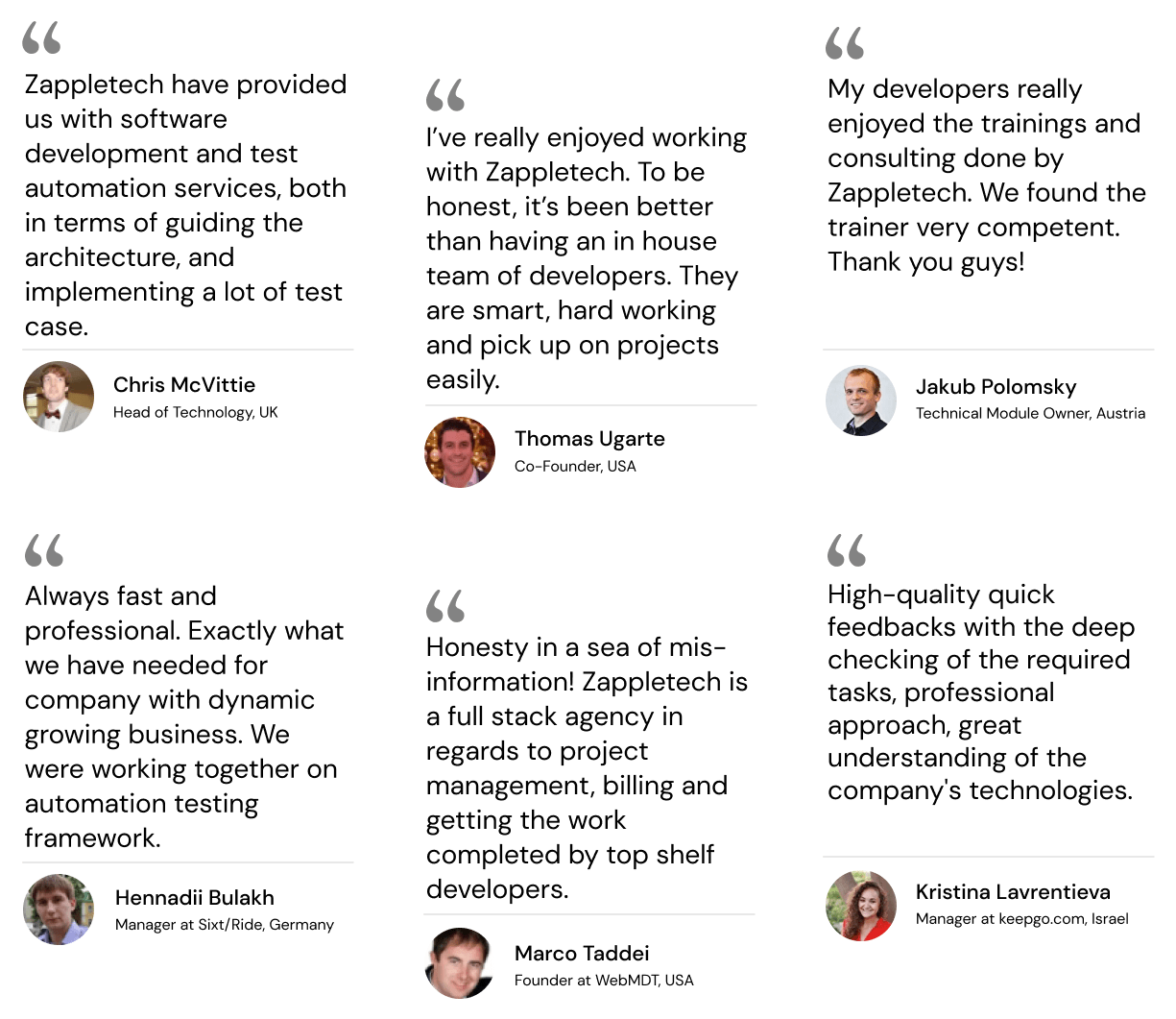
What Our Customers Say




The Benefits of Automation Testing


Why Choose Zapple.Tech as an Automation Testing Company?


Our QA & Testing Team


Industries We Work With


Our Expertise

Cooperation Types
What Tools We Use


















How We Deliver the Best QA Automation Services in the Industry


Start Cooperation Now!
Frequently Asked Questions:
How to choose a right tool/framework?
- Understand the project stack;
- Documentation, manuals, and community accessibility;
- Understanding of the tools’ capabilities;
- Truncated solutions.
What should be the most important thing?
The efficiency of automated testing is achieved with coverage of the most critical areas of the application:
- High risk – essential test cases;
- Repeatedly executed text cases (regression test suite);
- Tedious test cases or difficult to perform manually;
- Time-consuming test cases.
How can we speed up our tests?
One of the key features of automation tests is the reduction of time spent on testing. For big projects with thousands of automation tests created, batch runs can take days to complete. This is because all data depends on each other in large companies. It decreases productivity and makes the tests impossible to run simultaneously.
It usually happens in the case of wrong architecture. With such scenarios, usual tests are ineffective. You need another method called parallelization. Instead of running tests sequentially, parallel testing allows the execution of multiple tests at the same time across different environments.
Which is more effective, automated or manual testing?
They have their pros and cons. One isn’t necessarily any better than the other. A human engages in manual testing, painstakingly checking to ensure the application performs as expected. Automated testing occurs after the initial development of the application is completed. These prolonged tests can run independently and are poorly suited for manual testing.
They can also run in parallel on various types of operating systems and browsers. These two types of testing are similar but have slightly different purposes. Automated testing can speed up the process, reduce human resources required, make a more structured approach to testing, and automate repeated activities.
Is it necessary to include automated tests in my CI/CD process?
The short answer “yes.” If you integrate automation tests to your CI/CD
process, you will gain the following benefits:
- Full continuous delivery process;
- Numerous test report delivery channels;
- Broken code never deployed to the server.
What exactly do automated tests entail?
- The frontend and the backend;
- Stress, load, and performance testing;
- Testing of functionality and cross-platform/device compatibility;
- APIs, as well as web, mobile, and desktop apps.
Should bespoke programming be replaced with a record/play tool?
If you are going to have a few dozen tests, and you aren’t concerned about maintaining your test suite, and you do not need to speed up your tests through multi threading, the record/play solutions should be sufficient.
In the event that your test suite contains hundreds or thousands of tests, they should run quickly so that releases aren’t delayed. They should be reliable and easy to maintain, so you should certainly use custom solutions based on well-known test automated frameworks.
Automated testing is prohibitively expensive. Is it truly necessary?
While, at first, the cost of automated testing may seem difficult to justify, it pays for itself in the end. Since they take out the human component, that man power can be shifted to more important issues, like customer needs, functionality, and improvements. You will also require fewer code revisions, and the ones that do occur will be cheaper.
The tests are also reusable, so once the source code changes, you can just run the tests again. While manual testing is expensive and takes a lot of time, you can engage in automated testing as much as you want with no additional cost.
I don't have any automated testing setup. What should be my first steps?
Your steps should be:
- Choose tool that covers your needs;
- Set up test suite architecture;
- Develop tests;
- Integrate your test suite in CI/CD process;
- Cover test cases that are time-consuming.
Is it possible to cover every potential feature?
In most cases, no. Some scenarios may require so much effort that it makes no sense to automate them. However, 93% code of coverage is typically achievable.