

OpenRig — Talk to one agent. Build with a whole team.

A persistent team of coding agents

Build your own agent population.

Talk to one agent.
Build with a whole team.

Bring your ideas and feedback to a lead agent. It delegates to specialists, tracks their work and brings answers back to you. OpenRig lets Claude Code, Codex and Pi work together as a persistent team on projects that take weeks or months.

Bring your ideas and feedback to a lead agent. It delegates to specialists, tracks their work and brings answers back to you. OpenRig lets Claude Code, Codex and Pi work together as a persistent team on projects that take weeks or months.

Claude Code · Codex · Pi · Self-hosted

One conversation. A whole team behind it.

Coordinate work that takes weeks.

Split a large project across agents that specialize in different parts of it. Each keeps responsibility for its work, coordinates with teammates and can use its own temporary subagents for smaller jobs. The team can tackle more than one agent could keep in view.

How this works →
Reach the right expertise

Ask the specialist.

When a project has months of decisions behind it, another agent may already know what you need. Use rig send to ask that specialist directly and bring the answer into your work, without creating a new task for a simple question.

How this works →

Keep track of the work

Give work an owner.

An assignment needs to stay visible after the conversation moves on. With rig queue, an agent can assign work to a named teammate, who reads and claims it. The task stays assigned to that teammate, with its progress on record for later follow-up.

How this works →

OpenRig TUI

See what your whole team is doing.

See how your agents are organized, what they’re working on and where they need your attention. The OpenRig TUI brings the team’s work into one place, so you can look around without checking every agent’s terminal.

Click into the demo and try it.Open a pod, select an agent or switch to a rig’s terminals.

Interactive example. The OpenRig TUI uses fictional data; agent terminals are staged. Nothing runs.

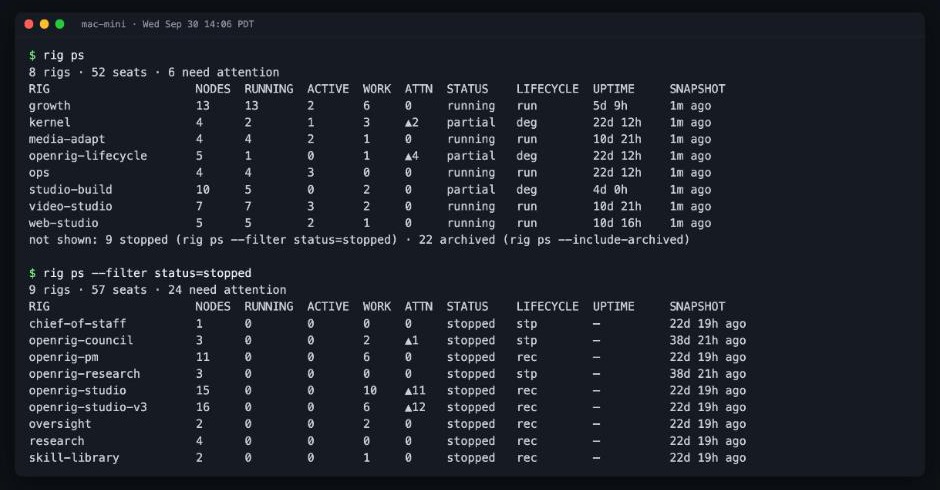
Most of my agents aren't working right now.

Terminal roster on one Mac mini showing running and stopped agent seats.
One Mac mini · September 30, 2026 · 109 seats defined, 41 running, 13 active.View full-size roster ↗

I spin up agents as I need them and just leave them on. They build up context, and later I route work to whoever already knows that part of the project.

From the notebook

From the blog

Read the blog →
Notes / 2026-10-20

What I put in an agent's starting map

A small view of what exists, with routes into the detail, gives a new agent enough to start without filling its context window. Here is what I include, what I leave behind a link, and where the agent goes when the map runs out.

Notes / 2026-10-17

Ship a contributor team with your open-source project

An open-source project can share a contributor team together with the context it needs to become useful. Workshop is an early example of what that could look like.

Notes / 2026-10-16

Context engineering as world building

How I organize context so agents can find what they need, and I can still understand and repair the system as it grows.