exact accuracy 0.99 at low noise · four synthetic models
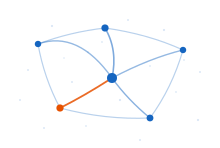
Generic local caustics do not identify a group. Finite synthetic tests recover additional structure, while degenerate tangencies refute a universal cusp claim.
mean transport error 4.98 → 4.52 voxels · 3 held-out seeds
A measured transverse correction improves approximate cosmic transport. Matched detector comparisons establish where orientation lifting helps and where it fails.
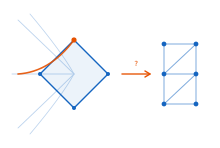
Your brain fills in contours that do not exist. Petitot's neurogeometry models oriented cortical states by a contact bundle; this article separates the free sub-Riemannian geodesics from their smooth Euler-elastica siblings.
A four-year-old child processes roughly one petabyte of visual information — fifty times more than GPT-4 has ever read — and learns effortlessly. Closing that gap is what's pushing AI past sequential token prediction toward predictive world models, retrieval-augmented memory, and Karpathy's Software 3.0 paradigm: the LLM as operating system.
Eighty lines of PyTorch — flips, rotation and ColorJitter for augmentation, DataParallel for multi-GPU, cross-entropy with Adam — fine-tune a pretrained ResNet-50 on the ImageNet Object Localization Challenge. Wrap it in a Dockerfile that pulls the dataset from Kaggle and you have a self-contained, reproducible 1000-class training pipeline.
A single LEFT JOIN against information_schema.table_constraints exposes every BASE TABLE missing a PRIMARY KEY — the silent latency tax that creeps in through schema migrations and ad-hoc DDL. Audit the whole cluster, then narrow to a single schema with one extra WHERE clause.
Matplotlib falls back to its non-interactive Agg backend whenever there's no X11 display — which is the default state inside almost every container. The fix is two parts: install the GUI toolkit dependencies in the image, then forward the host's X socket into the container at run time.
When a training run is GPU-bound, the bottleneck is rarely the model — it's the data pipeline starving the device. nvidia-smi dmon turns into a live, one-line-per-second dashboard for utilisation, memory, power draw, temperature and PCIe throughput, parseable from any shell loop.
Docker accumulates state silently — stopped containers, dangling image layers, unattached volumes, orphaned networks. Four short commands, run in the right order, reclaim gigabytes safely without touching anything that's currently running or in use.
A talk on what deep learning brings to software engineering: the tools, their pros and cons, how deep learning relates to symbolic representations, and the development and debugging cycle of deep-learning architectures.