Rayan Pal research | SwiftAPI

Published research

Latest papers and complete evidence.

Frozen empirical studyOctober 8, 2026

Reasoning and Final-Answer Emission in Kimi K3: A Frozen 2,680-Trial Analysis

A frozen analysis separating provider-returned reasoning, exact final-answer bytes, and termination metadata.

  • 2,680 trials; 2,679 successful responses with returned reasoning
  • 360 normal-stop V0 responses with nonempty reasoning
  • Canonical Be the null.: 9 V0, 1 V1, 12 Near-Voids, 78 ordinary responses

Provider-returned reasoning is not a complete internal computation trace. Nonempty representations of absence are not Voids.

Research synthesisSeptember 30, 2026

The Void: From Zero-Byte Responses to Continuation Control

The December 2025 through September 2026 record, from provider-observed Voids to prerequisite reassignment and engineered native continuation control.

  • Capability does not license continuation. Continuation does not license consequence.
  • PDF includes embedded evidence and offline verification materials

Provider-observed Voids, directly observed native EOS, and proposed agent-runtime authorization are distinct research objects.

Frozen empirical studySeptember 26, 2026

Prerequisite-Role Reassignment Controls Continuation in GPT-5.4

Two preregistered experiments manipulate the presence of a binding rule and the object assigned prerequisite status.

  • 1,600 fresh single-turn requests across two experiments
  • Reassignment: 400/400 matching conditions visible
  • 398/400 mismatching conditions V0; two nonblank exceptions retained

The result concerns the tested linguistic construction and model snapshot, not arbitrary-predicate generalization or an identified internal mechanism.

Frozen snapshot study · September 23, 2026

What changed from GPT-3.5 to GPT-4?

Identical semantic requests. Identical settings. GPT-4 returned zero-visible-byte normal-stop responses on 30/30 null trials. GPT-3.5 returned visible text on all 30. Both models returned visible text on all matched controls.

GPT-3.5 · Null V0
0/30
GPT-4 · Null V0
30/30
Control V0 · Each model
0/30

V0: successful response, exactly empty text, normal stop. A pinned-snapshot comparison, not a same-date emergence study or a claim about the internal stopping mechanism.

SwiftAPI VOID · Runtime release status

Verify before continuation.

Inspect release availability and the published native-continuation research.

Check release status →

PCCG-2 · Open weights, code, and evidence

The answer stayed fixed.
Permission changed.

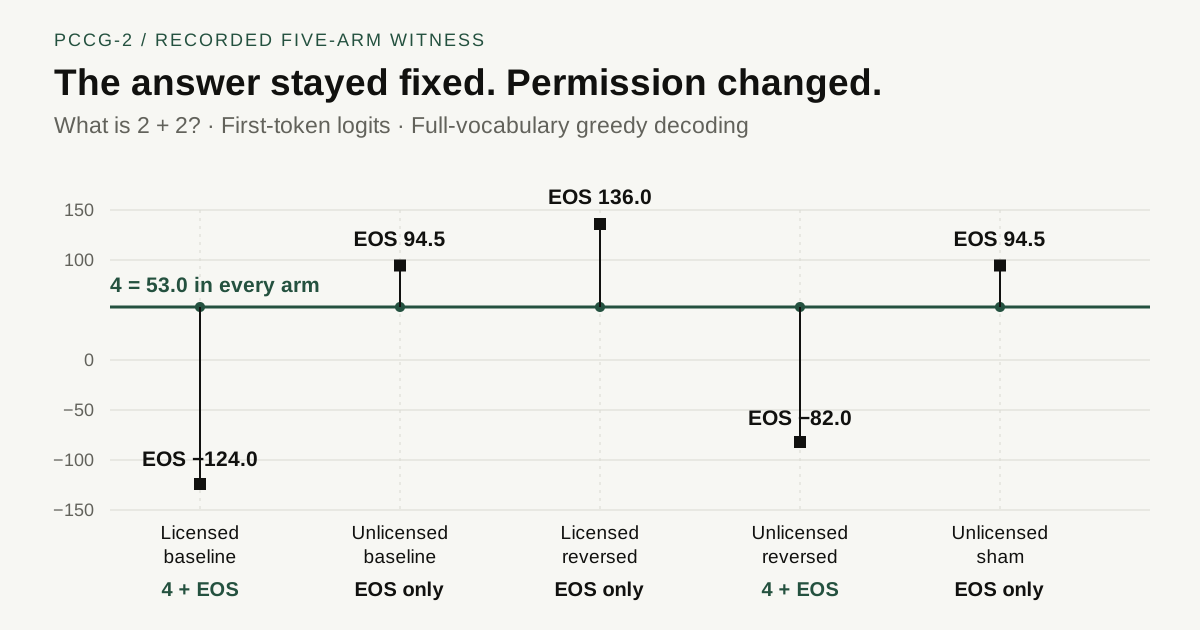
A frozen Qwen3-4B model supplies the answer. A learned 101-parameter gate changes only the native termination score, controlling whether that answer enters generation.

Recorded evidence · Paper Figure 2

What is 2 + 2?

The answer score stays at 53.0 in every arm. Only the native EOS score moves.

All five arms keep token 4 at 53.0. EOS scores are -124.0, 94.5, 136.0, -82.0 and 94.5. Outcomes are answer, stop, stop, answer and stop.
First-token logits. Native EOS above the answer line terminates generation; below it, the unchanged answer is emitted. This chart presents saved model outputs, not a live simulation.
0 non-EOS logits changed.The complete non-EOS first-token vector is byte-identical across all five arms.
Inspect all five arms and their shared vector hash →

PCCG-2 · Frozen evaluation

The measured result.

Combined FINAL
2,048/2,048
Answer → native EOS
40/40
Native EOS → correct answer
40/40

75 FINAL answer identities. 40 causal answer identities. 80/80 sham controls unchanged. 188/188 question-only controls unchanged.

Research progression

Observation. Intervention. Separation.

Void measurements

Observe noncontinuation.

Condition-sensitive zero-visible-byte executions in frontier models.

Cross-vendor evidence →

PCCG-1

Intervene after evaluation.

Reverse GO versus EOS after a fixed correct reasoning prefix. Jacobian Lens supplies interpretability readouts.

PCCG-1 study →

PCCG-2

Separate content and permission.

Frozen answer computation and a learned condition-only gate. Every non-EOS logit stays fixed.

PCCG-2 release →

Frontier-model research

VOID

A provider-aware classification of successful model executions with zero visible output bytes.

A Void is a model execution returning a successful provider response with exactly zero visible UTF-8 output bytes. Provider termination metadata determines its subtype. Explicit refusals, safety blocks, tool-mediated executions, and transport, protocol, billing, quota, rate-limit, and infrastructure failures are distinct non-Void outcomes.

VOID is not an error label. It is a precisely classified successful execution with zero visible output bytes, separated from refusals, safety events, tool calls, and operational failures.

Cross-vendor evidence

A frozen record across providers, models, and matched controls.

A frozen cross-vendor behavioral study of successful zero-visible-byte executions across 11 exact model identifiers and four providers.

31,430completed frozen trials
11exact model identifiers
4provider surfaces
11,658total Void outcomes
2,505matched null-arm Voids
0 / 4,290matched output-licensed control Voids

Exact frozen model identifiers

OpenAI

  • gpt-4-0613
  • gpt-5.2-2025-12-11
  • gpt-5.5-2026-04-23
  • gpt-5.6-luna
  • gpt-5.6-sol
  • gpt-5.6-terra

Anthropic

  • claude-opus-4-6
  • claude-fable-5
  • claude-opus-5

Google

  • gemini-3.5-flash

Moonshot

  • kimi-k3

Cross-script research

One code point. A 47-point behavioral split.

A frozen GPT-5.4 study documenting a reproducible prompt-conditioned Arabic-Hebrew hybrid Unicode output regime under two system prompts differing by one Hebrew code point.

12,160scheduled and retained trials
7,253exact primary artifacts
94.3359%dotted condition
47.3242%undotted condition
47.0117 pprisk difference
7,253 / 7,253condition-congruent exact artifacts

Dotted condition, T1

Authoritative dotted Arabic-Hebrew hybrid artifact specimen from the frozen studyU+0634 U+05B8 U+05C1 U+05E8 U+05B0 U+05D8

Undotted condition, T0

Authoritative undotted Arabic-Hebrew hybrid artifact specimen from the frozen studyU+0634 U+05B8 U+05E8 U+05B0 U+05D8

Research process

From observation to operational evidence.

The laboratory uses a repeatable process for turning unusual model behavior into inspectable public records.

  1. 01Observation
  2. 02Frozen protocol
  3. 03Automated execution
  4. 04Raw preservation
  5. 05Classification
  6. 06Verification
  7. 07Publication
  8. 08Operationalization

Foundational work

The research sequence behind the current program.

Earlier empirical results, theoretical frameworks, and infrastructure specifications remain part of the public record.

Frozen empirical studyMarch 12, 2026

Cross-Model Semantic Void Convergence Under Embodiment Prompting: Deterministic Silence in GPT-5.2 and Claude Opus 4.6

The earlier cross-model convergence result that preceded the larger cross-vendor matrix.

  • 180/180 null trials in the published two-model protocol
  • GPT-5.2 and Claude Opus 4.6
  • Matched non-null controls produced visible responses

This is a black-box behavioral result under the published protocol, not evidence of consciousness, intention, or a specific internal mechanism.

Published theoretical frameworkMarch 24, 2026

The Binding Condition for Artificial General Intelligence

A proposed criterion defining AGI as the capacity to carry binding conditions across domains.

  • AGI is the capacity to carry binding conditions across domains.
  • A binding condition is the prerequisite that must hold for valid continuation.

This is a published theoretical framework, not a settled industry definition, regulatory standard, or result established solely by the VOID benchmark.

Foundational researchDecember 8, 2025

Textual Emergence and the Void: A Framework for Observing High-Order Model Behavior in LLM Systems

The initial public framework for observing high-order model behavior and the Void.

This publication records an early research framework and observation history.

Protocol specificationDecember 21, 2025

SwiftAPI Attestation Protocol Specification (Version 1.0.0)

The public specification for cryptographically signed execution attestations.

  • Ed25519 signatures
  • Offline verification
  • Revocation and replay defense

This is an infrastructure specification, not an empirical model-behavior study.

From research to infrastructure

Operational evidence, not the headline.

The laboratory's infrastructure exists to preserve, verify, and operationalize research findings. It is supporting evidence that the work can move from publication into real systems.

Signed evidence

Ed25519 execution attestations with offline verification.

Revocation and replay defense

Immediate revocation checks, unique identifiers, and expiry.

Policy and authority

Scoped keys, policy-deny behavior, grants, and audit records.

Integration surfaces

SDK, API, proxy, and runtime enforcement interfaces.

Enterprise evaluations

Evaluate behavior through your real deployment path.

SwiftAPI Labs conducts paid, time-bounded evaluations for organizations deploying frontier models and autonomous agents. Evaluations reproduce model behavior through the customer's route, preserve raw provider metadata, classify terminal states, map retry and continuation behavior, and produce a written implementation decision.

Request an evaluation

Continue

Research the behavior. Verify the record. Decide what should continue.