CWE - CWE-134: Use of Externally-Controlled Format String (4.20)
Home > CWE List > CWE-134: Use of Externally-Controlled Format String (4.20)  
ID

  • Home
  • CWE-134: Use of Externally-Controlled Format String

    Weakness ID: 134
    Vulnerability Mapping: ALLOWED This CWE ID may be used to map to real-world vulnerabilities
    Abstraction: Base Base - a weakness that is still mostly independent of a resource or technology, but with sufficient details to provide specific methods for detection and prevention. Base level weaknesses typically describe issues in terms of 2 or 3 of the following dimensions: behavior, property, technology, language, and resource.
    View customized information:
    For users who are interested in more notional aspects of a weakness. Example: educators, technical writers, and project/program managers. For users who are concerned with the practical application and details about the nature of a weakness and how to prevent it from happening. Example: tool developers, security researchers, pen-testers, incident response analysts. For users who are mapping an issue to CWE/CAPEC IDs, i.e., finding the most appropriate CWE for a specific issue (e.g., a CVE record). Example: tool developers, security researchers. For users who wish to see all available information for the CWE/CAPEC entry. For users who want to customize what details are displayed.
    ×

    Edit Custom Filter


    + Description
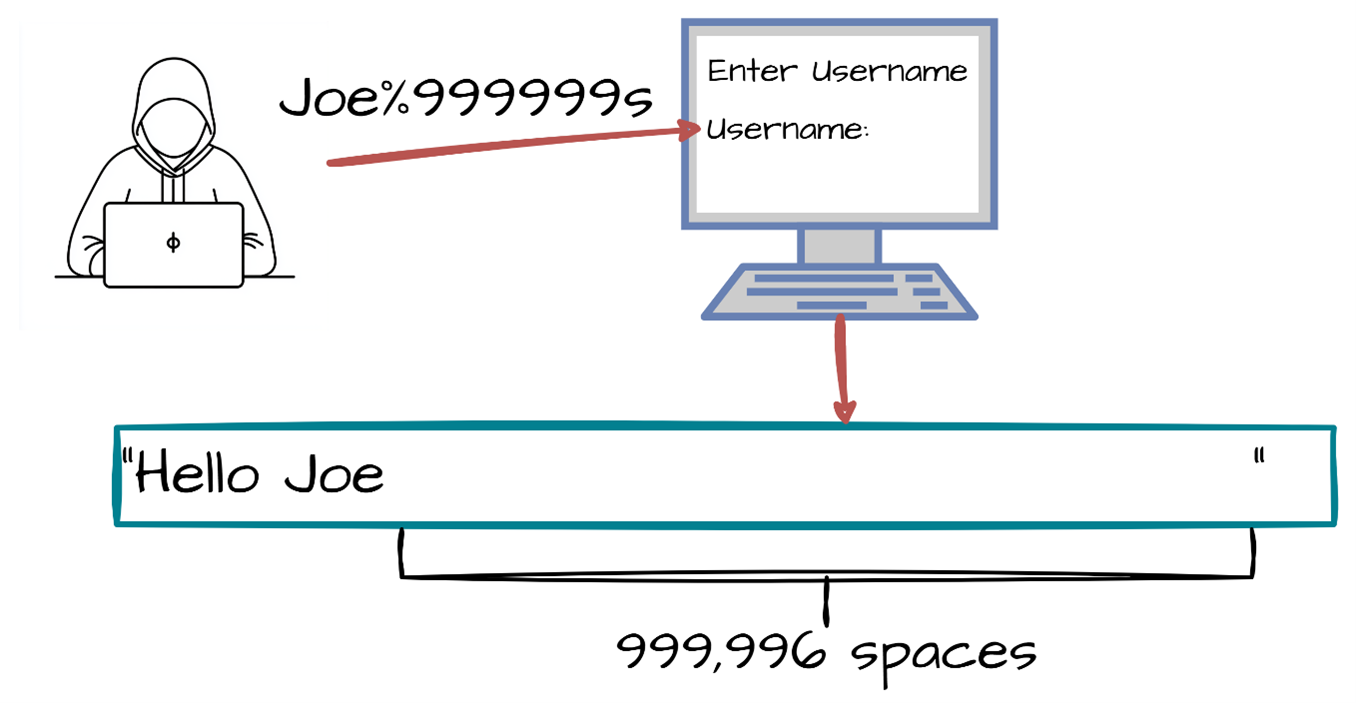
    The product uses a function that accepts a format string as an argument, but the format string originates from an external source. Diagram for CWE-134
    + Common Consequences
    Section HelpThis table specifies different individual consequences associated with the weakness. The Scope identifies the application security area that is violated, while the Impact describes the negative technical impact that arises if an adversary succeeds in exploiting this weakness. The Likelihood provides information about how likely the specific consequence is expected to be seen relative to the other consequences in the list. For example, there may be high likelihood that a weakness will be exploited to achieve a certain impact, but a low likelihood that it will be exploited to achieve a different impact.
    Impact Details

    Read Memory

    Scope: Confidentiality

    Format string problems allow for information disclosure which can severely simplify exploitation of the program.

    Modify Memory; Execute Unauthorized Code or Commands

    Scope: Integrity, Confidentiality, Availability

    Format string problems can result in the execution of arbitrary code, buffer overflows, denial of service, or incorrect data representation.
    + Potential Mitigations
    Phase(s) Mitigation

    Requirements

    Choose a language that is not subject to this flaw.

    Implementation

    Ensure that all format string functions are passed a static string which cannot be controlled by the user, and that the proper number of arguments are always sent to that function as well. If at all possible, use functions that do not support the %n operator in format strings. [REF-116] [REF-117]

    Build and Compilation

    Run compilers and linkers with high warning levels, since they may detect incorrect usage.
    + Relationships
    Section Help This table shows the weaknesses and high level categories that are related to this weakness. These relationships are defined as ChildOf, ParentOf, MemberOf and give insight to similar items that may exist at higher and lower levels of abstraction. In addition, relationships such as PeerOf and CanAlsoBe are defined to show similar weaknesses that the user may want to explore.
    + Relevant to the view "Research Concepts" (View-1000)
    Nature Type ID Name
    ChildOf Class Class - a weakness that is described in a very abstract fashion, typically independent of any specific language or technology. More specific than a Pillar Weakness, but more general than a Base Weakness. Class level weaknesses typically describe issues in terms of 1 or 2 of the following dimensions: behavior, property, and resource. 668 Exposure of Resource to Wrong Sphere
    CanPrecede Base Base - a weakness that is still mostly independent of a resource or technology, but with sufficient details to provide specific methods for detection and prevention. Base level weaknesses typically describe issues in terms of 2 or 3 of the following dimensions: behavior, property, technology, language, and resource. 123 Write-what-where Condition
    + Relevant to the view "Software Development" (View-699)
    Nature Type ID Name
    MemberOf Category Category - a CWE entry that contains a set of other entries that share a common characteristic. 133 String Errors
    + Relevant to the view "Weaknesses for Simplified Mapping of Published Vulnerabilities" (View-1003)
    Nature Type ID Name
    ChildOf Class Class - a weakness that is described in a very abstract fashion, typically independent of any specific language or technology. More specific than a Pillar Weakness, but more general than a Base Weakness. Class level weaknesses typically describe issues in terms of 1 or 2 of the following dimensions: behavior, property, and resource. 668 Exposure of Resource to Wrong Sphere
    + Relevant to the view "Seven Pernicious Kingdoms" (View-700)
    Nature Type ID Name
    ChildOf Class Class - a weakness that is described in a very abstract fashion, typically independent of any specific language or technology. More specific than a Pillar Weakness, but more general than a Base Weakness. Class level weaknesses typically describe issues in terms of 1 or 2 of the following dimensions: behavior, property, and resource. 20 Improper Input Validation
    + Modes Of Introduction
    Section HelpThe different Modes of Introduction provide information about how and when this weakness may be introduced. The Phase identifies a point in the life cycle at which introduction may occur, while the Note provides a typical scenario related to introduction during the given phase.
    Phase Note
    Implementation The programmer rarely intends for a format string to be externally-controlled at all. This weakness is frequently introduced in code that constructs log messages, where a constant format string is omitted.
    Implementation In cases such as localization and internationalization, the language-specific message repositories could be an avenue for exploitation, but the format string issue would be resultant, since attacker control of those repositories would also allow modification of message length, format, and content.
    + Applicable Platforms
    Section HelpThis listing shows possible areas for which the given weakness could appear. These may be for specific named Languages, Operating Systems, Architectures, Paradigms, Technologies, or a class of such platforms. The platform is listed along with how frequently the given weakness appears for that instance.
    Languages

    Class: Not Language-Specific (Undetermined Prevalence)

    C (Often Prevalent)

    C++ (Often Prevalent)

    Perl (Rarely Prevalent)

    + Likelihood Of Exploit
    High
    + Demonstrative Examples

    Example 1


    The following program prints a string provided as an argument.

    (bad code)
    Example Language: C 
    #include <stdio.h>

    void printWrapper(char *string) {

    printf(string);
    }

    int main(int argc, char **argv) {

    char buf[5012];
    memcpy(buf, argv[1], 5012);
    printWrapper(argv[1]);
    return (0);
    }

    The example is exploitable, because of the call to printf() in the printWrapper() function. Note: The stack buffer was added to make exploitation more simple.


    Example 2


    The following code copies a command line argument into a buffer using snprintf().

    (bad code)
    Example Language: C 
    int main(int argc, char **argv){
    char buf[128];
    ...
    snprintf(buf,128,argv[1]);
    }

    This code allows an attacker to view the contents of the stack and write to the stack using a command line argument containing a sequence of formatting directives. The attacker can read from the stack by providing more formatting directives, such as %x, than the function takes as arguments to be formatted. (In this example, the function takes no arguments to be formatted.) By using the %n formatting directive, the attacker can write to the stack, causing snprintf() to write the number of bytes output thus far to the specified argument (rather than reading a value from the argument, which is the intended behavior). A sophisticated version of this attack will use four staggered writes to completely control the value of a pointer on the stack.


    Example 3


    Certain implementations make more advanced attacks even easier by providing format directives that control the location in memory to read from or write to. An example of these directives is shown in the following code, written for glibc:

    (bad code)
    Example Language: C 
    printf("%d %d %1$d %1$d\n", 5, 9);

    This code produces the following output: 5 9 5 5 It is also possible to use half-writes (%hn) to accurately control arbitrary DWORDS in memory, which greatly reduces the complexity needed to execute an attack that would otherwise require four staggered writes, such as the one mentioned in a separate example.


    + Selected Observed Examples

    Note: this is a curated list of examples for users to understand the variety of ways in which this weakness can be introduced. It is not a complete list of all CVEs that are related to this CWE entry.

    Reference Description
    format string in Perl program
    format string in bad call to syslog function
    format string in bad call to syslog function
    format strings in NNTP server responses
    Format string vulnerability exploited by triggering errors or warnings, as demonstrated via format string specifiers in a .bmp filename.
    Chain: untrusted search path enabling resultant format string by loading malicious internationalization messages
    + Weakness Ordinalities
    Ordinality Description
    Primary
    (where the weakness exists independent of other weaknesses)
    + Detection Methods
    Method Details

    Automated Static Analysis

    This weakness can often be detected using automated static analysis tools. Many modern tools use data flow analysis or constraint-based techniques to minimize the number of false positives.

    Black Box

    Since format strings often occur in rarely-occurring erroneous conditions (e.g. for error message logging), they can be difficult to detect using black box methods. It is highly likely that many latent issues exist in executables that do not have associated source code (or equivalent source.

    Effectiveness: Limited

    Automated Static Analysis - Binary or Bytecode

    According to SOAR [REF-1479], the following detection techniques may be useful:

    Highly cost effective:
    • Bytecode Weakness Analysis - including disassembler + source code weakness analysis
    • Binary Weakness Analysis - including disassembler + source code weakness analysis
    Cost effective for partial coverage:
    • Binary / Bytecode simple extractor - strings, ELF readers, etc.

    Effectiveness: High

    Manual Static Analysis - Binary or Bytecode

    According to SOAR [REF-1479], the following detection techniques may be useful:

    Cost effective for partial coverage:
    • Binary / Bytecode disassembler - then use manual analysis for vulnerabilities & anomalies

    Effectiveness: SOAR Partial

    Dynamic Analysis with Automated Results Interpretation

    According to SOAR [REF-1479], the following detection techniques may be useful:

    Cost effective for partial coverage:
    • Web Application Scanner
    • Web Services Scanner
    • Database Scanners

    Effectiveness: SOAR Partial

    Dynamic Analysis with Manual Results Interpretation

    According to SOAR [REF-1479], the following detection techniques may be useful:

    Cost effective for partial coverage:
    • Fuzz Tester
    • Framework-based Fuzzer

    Effectiveness: SOAR Partial

    Manual Static Analysis - Source Code

    According to SOAR [REF-1479], the following detection techniques may be useful:

    Highly cost effective:
    • Manual Source Code Review (not inspections)
    Cost effective for partial coverage:
    • Focused Manual Spotcheck - Focused manual analysis of source

    Effectiveness: High

    Automated Static Analysis - Source Code

    According to SOAR [REF-1479], the following detection techniques may be useful:

    Highly cost effective:
    • Source code Weakness Analyzer
    • Context-configured Source Code Weakness Analyzer
    Cost effective for partial coverage:
    • Warning Flags

    Effectiveness: High

    Architecture or Design Review

    According to SOAR [REF-1479], the following detection techniques may be useful:

    Highly cost effective:
    • Formal Methods / Correct-By-Construction
    Cost effective for partial coverage:
    • Inspection (IEEE 1028 standard) (can apply to requirements, design, source code, etc.)

    Effectiveness: High

    + Functional Areas
    • Logging
    • Error Handling
    • String Processing
    • Memory Management
    + Affected Resources
    • Memory
    + Memberships
    Section HelpThis MemberOf Relationships table shows additional CWE Categories and Views that reference this weakness as a member. This information is often useful in understanding where a weakness fits within the context of external information sources.
    Nature Type ID Name
    MemberOf ViewView - a subset of CWE entries that provides a way of examining CWE content. The two main view structures are Slices (flat lists) and Graphs (containing relationships between entries). 635 Weaknesses Originally Used by NVD from 2008 to 2016
    MemberOf CategoryCategory - a CWE entry that contains a set of other entries that share a common characteristic. 726 OWASP Top Ten 2004 Category A5 - Buffer Overflows
    MemberOf CategoryCategory - a CWE entry that contains a set of other entries that share a common characteristic. 743 CERT C Secure Coding Standard (2008) Chapter 10 - Input Output (FIO)
    MemberOf CategoryCategory - a CWE entry that contains a set of other entries that share a common characteristic. 808 2010 Top 25 - Weaknesses On the Cusp
    MemberOf CategoryCategory - a CWE entry that contains a set of other entries that share a common characteristic. 845 The CERT Oracle Secure Coding Standard for Java (2011) Chapter 2 - Input Validation and Data Sanitization (IDS)
    MemberOf CategoryCategory - a CWE entry that contains a set of other entries that share a common characteristic. 865 2011 Top 25 - Risky Resource Management
    MemberOf CategoryCategory - a CWE entry that contains a set of other entries that share a common characteristic. 877 CERT C++ Secure Coding Section 09 - Input Output (FIO)
    MemberOf ViewView - a subset of CWE entries that provides a way of examining CWE content. The two main view structures are Slices (flat lists) and Graphs (containing relationships between entries). 884 CWE Cross-section
    MemberOf CategoryCategory - a CWE entry that contains a set of other entries that share a common characteristic. 990 SFP Secondary Cluster: Tainted Input to Command
    MemberOf CategoryCategory - a CWE entry that contains a set of other entries that share a common characteristic. 1131 CISQ Quality Measures (2016) - Security
    MemberOf CategoryCategory - a CWE entry that contains a set of other entries that share a common characteristic. 1134 SEI CERT Oracle Secure Coding Standard for Java - Guidelines 00. Input Validation and Data Sanitization (IDS)
    MemberOf CategoryCategory - a CWE entry that contains a set of other entries that share a common characteristic. 1163 SEI CERT C Coding Standard - Guidelines 09. Input Output (FIO)
    MemberOf CategoryCategory - a CWE entry that contains a set of other entries that share a common characteristic. 1179 SEI CERT Perl Coding Standard - Guidelines 01. Input Validation and Data Sanitization (IDS)
    MemberOf CategoryCategory - a CWE entry that contains a set of other entries that share a common characteristic. 1308 CISQ Quality Measures - Security
    MemberOf ViewView - a subset of CWE entries that provides a way of examining CWE content. The two main view structures are Slices (flat lists) and Graphs (containing relationships between entries). 1340 CISQ Data Protection Measures
    MemberOf CategoryCategory - a CWE entry that contains a set of other entries that share a common characteristic. 1399 Comprehensive Categorization: Memory Safety
    + Vulnerability Mapping Notes
    Usage ALLOWED
    (this CWE ID may be used to map to real-world vulnerabilities)
    Reason Acceptable-Use

    Rationale

    This CWE entry is at the Base level of abstraction, which is a preferred level of abstraction for mapping to the root causes of vulnerabilities.

    Comments

    Carefully read both the name and description to ensure that this mapping is an appropriate fit. Do not try to 'force' a mapping to a lower-level Base/Variant simply to comply with this preferred level of abstraction.
    + Notes

    Applicable Platform

    This weakness is possible in any programming language that support format strings.

    Research Gap

    Format string issues are under-studied for languages other than C. Memory or disk consumption, control flow or variable alteration, and data corruption may result from format string exploitation in applications written in other languages such as Perl, PHP, Python, etc.

    Other

    In some circumstances, such as internationalization, the set of format strings is externally controlled by design. If the source of these format strings is trusted (e.g. only contained in library files that are only modifiable by the system administrator), then the external control might not itself pose a vulnerability.

    While Format String vulnerabilities typically fall under the Buffer Overflow category, technically they are not overflowed buffers. The Format String vulnerability is fairly new (circa 1999) and stems from the fact that there is no realistic way for a function that takes a variable number of arguments to determine just how many arguments were passed in. The most common functions that take a variable number of arguments, including C-runtime functions, are the printf() family of calls. The Format String problem appears in a number of ways. A *printf() call without a format specifier is dangerous and can be exploited. For example, printf(input); is exploitable, while printf(y, input); is not exploitable in that context. The result of the first call, used incorrectly, allows for an attacker to be able to peek at stack memory since the input string will be used as the format specifier. The attacker can stuff the input string with format specifiers and begin reading stack values, since the remaining parameters will be pulled from the stack. Worst case, this improper use may give away enough control to allow an arbitrary value (or values in the case of an exploit program) to be written into the memory of the running program.

    Frequently targeted entities are file names, process names, identifiers.

    Format string problems are a classic C/C++ issue that are now rare due to the ease of discovery. One main reason format string vulnerabilities can be exploited is due to the %n operator. The %n operator will write the number of characters, which have been printed by the format string therefore far, to the memory pointed to by its argument. Through skilled creation of a format string, a malicious user may use values on the stack to create a write-what-where condition. Once this is achieved, they can execute arbitrary code. Other operators can be used as well; for example, a %9999s operator could also trigger a buffer overflow, or when used in file-formatting functions like fprintf, it can generate a much larger output than intended.

    + Taxonomy Mappings
    Mapped Taxonomy Name Node ID Fit Mapped Node Name
    PLOVER Format string vulnerability
    7 Pernicious Kingdoms Format String
    CLASP Format string problem
    CERT C Secure Coding FIO30-C Exact Exclude user input from format strings
    CERT C Secure Coding FIO47-C CWE More Specific Use valid format strings
    OWASP Top Ten 2004 A1 CWE More Specific Unvalidated Input
    WASC 6 Format String
    The CERT Oracle Secure Coding Standard for Java (2011) IDS06-J Exclude user input from format strings
    SEI CERT Perl Coding Standard IDS30-PL Exact Exclude user input from format strings
    Software Fault Patterns SFP24 Tainted input to command
    OMG ASCSM ASCSM-CWE-134
    + References
    [REF-116] Steve Christey. "Format String Vulnerabilities in Perl Programs".
    <https://seclists.org/fulldisclosure/2005/Dec/91>. (URL validated: 2023-04-07)
    [REF-117] Hal Burch and Robert C. Seacord. "Programming Language Format String Vulnerabilities".
    <https://drdobbs.com/security/programming-language-format-string-vulne/197002914>. (URL validated: 2023-04-07)
    [REF-118] Tim Newsham. "Format String Attacks". Guardent. 2000-09-09.
    <https://seclists.org/bugtraq/2000/Sep/214>. (URL validated: 2025-07-29)
    [REF-7] Michael Howard and David LeBlanc. "Writing Secure Code". Chapter 5, "Format String Bugs" Page 147. 2nd Edition. Microsoft Press. 2002-12-04.
    <https://www.microsoftpressstore.com/store/writing-secure-code-9780735617223>.
    [REF-44] Michael Howard, David LeBlanc and John Viega. "24 Deadly Sins of Software Security". "Sin 6: Format String Problems." Page 109. McGraw-Hill. 2010.
    [REF-62] Mark Dowd, John McDonald and Justin Schuh. "The Art of Software Security Assessment". Chapter 8, "C Format Strings", Page 422. 1st Edition. Addison Wesley. 2006.
    [REF-962] Object Management Group (OMG). "Automated Source Code Security Measure (ASCSM)". ASCSM-CWE-134. 2016-01.
    <http://www.omg.org/spec/ASCSM/1.0/>.
    [REF-1479] Gregory Larsen, E. Kenneth Hong Fong, David A. Wheeler and Rama S. Moorthy. "State-of-the-Art Resources (SOAR) for Software Vulnerability Detection, Test, and Evaluation". 2014-07.
    <https://www.ida.org/-/media/feature/publications/s/st/stateoftheart-resources-soar-for-software-vulnerability-detection-test-and-evaluation/p-5061.ashx>. (URL validated: 2025-09-05)
    + Content History
    + Submissions
    Submission Date Submitter Organization
    2006-07-19
    (CWE Draft 3, 2006-07-19)
    PLOVER
    + Modifications
    Modification Date Modifier Organization
    2025-12-11
    (CWE 4.19, 2025-12-11)
    CWE Content Team MITRE
    updated Applicable_Platforms
    2025-09-09
    (CWE 4.18, 2025-09-09)
    CWE Content Team MITRE
    updated Detection_Factors, Functional_Areas, References
    2025-04-03
    (CWE 4.17, 2025-04-03)
    CWE Content Team MITRE
    updated Common_Consequences, Demonstrative_Examples, Description, Diagram, Other_Notes
    2023-06-29
    (CWE 4.12, 2023-06-29)
    CWE Content Team MITRE
    updated Mapping_Notes
    2023-04-27
    (CWE 4.11, 2023-04-27)
    CWE Content Team MITRE
    updated References, Relationships
    2023-01-31
    (CWE 4.10, 2023-01-31)
    CWE Content Team MITRE
    updated Description
    2021-03-15
    (CWE 4.4, 2021-03-15)
    CWE Content Team MITRE
    updated Potential_Mitigations, Relationships
    2020-12-10
    (CWE 4.3, 2020-12-10)
    CWE Content Team MITRE
    updated Common_Consequences, Relationships
    2020-08-20
    (CWE 4.2, 2020-08-20)
    CWE Content Team MITRE
    updated Relationships
    2020-02-24
    (CWE 4.0, 2020-02-24)
    CWE Content Team MITRE
    updated Detection_Factors, Relationships
    2019-09-19
    (CWE 3.4, 2019-09-19)
    CWE Content Team MITRE
    updated Relationships
    2019-06-20
    (CWE 3.3, 2019-06-20)
    CWE Content Team MITRE
    updated Relationships
    2019-01-03
    (CWE 3.2, 2019-01-03)
    CWE Content Team MITRE
    updated References, Relationships, Taxonomy_Mappings
    2018-03-27
    (CWE 3.1, 2018-03-27)
    CWE Content Team MITRE
    updated References
    2017-11-08
    (CWE 3.0, 2017-11-08)
    CWE Content Team MITRE
    updated Applicable_Platforms, Causal_Nature, Functional_Areas, Likelihood_of_Exploit, Other_Notes, References, Relationships, Taxonomy_Mappings, White_Box_Definitions
    2015-12-07
    (CWE 2.9, 2015-12-07)
    CWE Content Team MITRE
    updated Description, Modes_of_Introduction, Name, Relationships
    2014-07-30
    (CWE 2.8, 2014-07-31)
    CWE Content Team MITRE
    updated Demonstrative_Examples, Detection_Factors, Relationships, Taxonomy_Mappings
    2012-05-11
    (CWE 2.2, 2012-05-15)
    CWE Content Team MITRE
    updated Observed_Examples, References, Related_Attack_Patterns, Relationships, Taxonomy_Mappings
    2011-09-13
    (CWE 2.1, 2011-09-13)
    CWE Content Team MITRE
    updated Potential_Mitigations, References, Relationships, Taxonomy_Mappings
    2011-06-27
    (CWE 2.0, 2011-06-27)
    CWE Content Team MITRE
    updated Modes_of_Introduction, Relationships
    2011-06-01
    (CWE 1.13, 2011-06-01)
    CWE Content Team MITRE
    updated Common_Consequences, Relationships, Taxonomy_Mappings
    2010-02-16
    (CWE 1.8, 2010-02-16)
    CWE Content Team MITRE
    updated Detection_Factors, References, Relationships, Taxonomy_Mappings
    2009-07-27
    (CWE 1.5, 2009-07-27)
    CWE Content Team MITRE
    updated White_Box_Definitions
    2009-07-17
    (CWE 1.5, 2009-07-27)
    KDM Analytics
    Improved the White_Box_Definition
    2009-05-27
    (CWE 1.4, 2009-05-27)
    CWE Content Team MITRE
    updated Demonstrative_Examples
    2009-03-10
    (CWE 1.3, 2009-03-10)
    CWE Content Team MITRE
    updated Relationships
    2008-11-24
    (CWE 1.1, 2008-11-25)
    CWE Content Team MITRE
    updated Relationships, Taxonomy_Mappings
    2008-09-08
    (CWE 1.0, 2008-09-09)
    CWE Content Team MITRE
    updated Applicable_Platforms, Common_Consequences, Detection_Factors, Modes_of_Introduction, Relationships, Other_Notes, Research_Gaps, Taxonomy_Mappings, Weakness_Ordinalities
    2008-08-01
    (CWE 1.0, 2008-09-09)
    KDM Analytics
    added/updated white box definitions
    + Previous Entry Names
    Change Date Previous Entry Name
    2015-12-07 Uncontrolled Format String
    Page Last Updated: April 30, 2026