

About Me
I was born in Athens, Greece, in 1985. I received a Diploma in Chemical Engineering in 2007 and an MSc with honours in Applied Mathematics in 2009 from NTU Athens. In December 2012, I defended my PhD thesis titled "Modelling and Control of Biological and Physiological Systems" at NTU Athens. In have held post-doctoral positions at IMT Lucca, Italy, ESAT, KU Leuven, Belgium and KIOS CoE, University of Cyprus. I will soon join the School Of Electronics, Electrical Engineering & Computer Science at Queen's University Belfast as a lecturer.
Contact Details
Pantelis Sopasakis
Queen's University Belfast
School of EEECS
i-AMS Centre
Email: to be updated
Publications
Optimisation
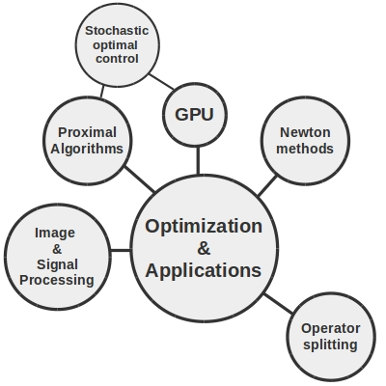
- P. Sopasakis, K. Menounou and P Patrinos, SuperSCS: fast and accurate large-scale conic optimization, IEEE European Control Conference (ECC), 2019 (software).
- P. Sopasakis, M. Schuurmans and P. Patrinos, Risk-averse risk-constrained optimal control, IEEE European Control Conference (ECC), 2019 (software, documentation).
- P. Sopasakis, A. Themelis, J. Suykens and P. Patrinos, A Primal-dual line search method and applications in image processing, European Signal Processing Conference 2017 (arxiv, bibtex)
- L. Stella, A. Themelis, P. Sopasakis and P. Patrinos, A simple and efficient algorithm for nonlinear model predictive control, IEEE CDC, 2017.
- A.K. Sampathirao, P. Sopasakis, A. Bemporad and P. Patrinos, Proximal limited-memory quasi-Newton methods for scenario-based stochastic optimal control, IFAC 2017 (arxiv, bibtex).
- A.K. Sampathirao, P. Sopasakis, A. Bemporad and P. Patrinos, GPU-accelerated stochastic predictive control of drinking water networks, IEEE Trans. Control Systems Technology 26(2):551-562, 2018 (arxiv, bibtex).
- A.K. Sampathirao, P. Sopasakis, A. Bemporad and P. Patrinos, Fast parallelizable scenario-based stochastic optimization, 4th European Conference on Computational Optimization, Leuven, Belgium, Sept. 2016 (slides, bibtex).
- A. K. Sampathirao, P. Sopasakis, A. Bemporad and P. Patrinos (2015), Distributed solution of stochastic optimal control problems on GPUs, 54 IEEE Conf. Decision and Control, Osaka, Japan, Dec 2015 (pdf, slides, errata, bibtex).
- P. Patrinos, P. Sopasakis and H. Sarimveis, A global piecewise smooth Newton method for fast large-scale model predictive control, Automatica 47(9), pp. 2016-2022. (bibtex)
- P. Sopasakis, N.Freris and P. Patrinos, Accelerated reconstruction of a compressively sampled data stream, 24th European Signal Processing conference, Budapest, Hungary, 2016 (pdf, slides, bibtex).
CONTROL THEORY
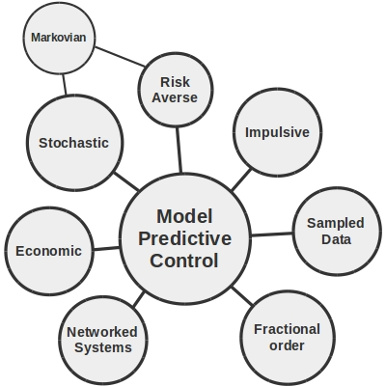
- P. Sopasakis, D. Herceg, A. Bemporad and P. Patrinos, Risk-averse model predictive control, Automatica, vol 100, pp. 281-288, 2019. (arxiv, pdf bibtex)
- M. Tsiakkas, P. Sopasakis, F. Boem, C. Panayiotou and M. Polycarpou, Active Fault Diagnosis via Reachable Set Separation using Interval Methods, IEEE European Control Conference (ECC), 2019.
- S. Ntouskas, H. Sarimveis, P. Sopasakis, Model predictive control for offset-free reference tracking of fractional order systems, Control Engineering Practice, 2018.
- P. Sopasakis and H. Sarimveis, Stabilising Model predictive control for discrete-time fractional-order systems, Automatica 75, 2017, pp. 24-31 (arxiv, bibtex).
- P. Sopasakis, D. Herceg, P. Patrinos and A. Bemporad, Stochastic economic model predictive control for Markovian switching systems, IFAC World Congress 2017 (arxiv, bibtex).
- P. Patrinos, P. Sopasakis, H. Sarimveis, A. Bemporad (2014), Stochastic Model Predictive Control for Constrained Discrete-time Markovian Switching Systems, Automatica 50(10), 2504-2514, (doi, bibtex).
- P. Sopasakis, P. Patrinos, H. Sarimveis and A. Bemporad (2014), Model predictive control for linear impulsive systems, IEEE Transactions on Automatic Control 60(8), pp. 2277-2282, 2015 (bibtex)
- P. Sopasakis, P. Patrinos, H. Sarimveis and A. Bemporad (2012), Model predictive control for linear impulsive systems, 51st Conference on Decision and Control, Maui, Hawaii. (bibtex)
- P. Sopasakis, P. Patrinos and H. Sarimveis (2014), MPC for sampled-data linear systems: Guaranteeing constraint satisfaction in continuous time, IEEE Transactions on Automatic Control 59(4), pp. 1088-1093, 2014 (bibtex)
- P. Sopasakis, P. Patrinos and H. Sarimveis (2014), Robust model predictive control for optimal continuous drug administration, Computer Methods and Programs in Biomedicine 116(3), pp. 193-204 (bibtex).
- P. Sopasakis, S. Ntouskas and H. Sarimveis (2015), Robust model predictive control for discrete-time fractional-order systems, Mediteranean Conference on Control and Automation (MED 2015, IEEE), Torremolinos, Spain, June 16-19, 2015 (pdf, slides, bibtex).
- A.K. Sampathirao, P. Sopasakis and A. Bemporad (Oct. 2014), Decentralised hierarchical multi-rate control of large-scale drinking water networks 9th Int. Conf. Critical Information Infrastructures Security, Limassol, Cyprus, Oct. 13-15 2014 (pdf, bibtex)
- P. Sopasakis, D. Bernardini and A. Bemporad (Dec. 2013), Constrained model predictive control based on reduced-order models, 52nd IEEE Conference on Decision and Control, Florence, Italy. (slides, bibtex)
- P. Patrinos, P. Sopasakis and H. Sarimveis (2011), Stochastic model predictive control for constrained networked control systems with random time delays, 18th IFAC World Congress, Milano, Italy. (pdf, bibtex)
BioMedical
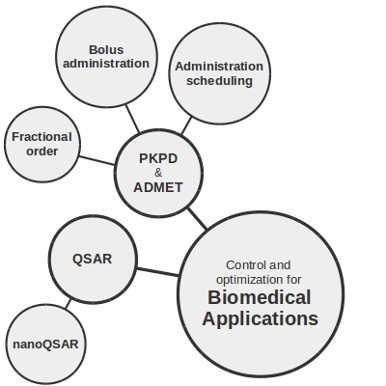
- P. Sopasakis, H. Sarimveis, P. Macheras, A. Dokoumetzidis, Fractional calculus in pharmacokinetics, Journal of pharmacokinetics and pharmacodynamics 45 (1), 107-125, 2018.
- D. Herceg, S. Ntouskas, P. Sopasakis, A. Dokoumetzidis, P. Macheras, H. Sarimveis and P. Patrinos (2017), Modeling and administration scheduling of fractional-order pharmacokinetic systems, IFAC World Congress 2017 (arxiv, bibtex).
- P. Sopasakis, P. Patrinos, H. Sarimveis (2014), Robust model predictive control for optimal continuous drug administration, Computer Methods and Programs in Biomedicine 116(3), pp. 193-204 (bibtex).
- P. Sopasakis and H. Sarimveis (Aug. 2014), Controlled Drug Administration by a Fractional PID, 19th IFAC World Congress, Cape Town, South Africa (pdf, slides, bibtex)
- P. Sopasakis and H. Sarimveis (2012), An integer programming approach for optimal drug dose computation, Computer Methods and Programs in Biomedicine, 108 (3). pp. 1022-1035. (bibtex)
- N. Jeliazkova, C. Chomenides, P. Doganis, B. Fadeel, R. Glafstrom, B. Hardy, J. Hastings, M. Hegi, V. Jeliazkov, N. Kochev, P. Kohonen, C. Munteanu, H. Sarimveis, B. Smeets, P. Sopasakis, G. Tsiliki, D. Vorgimmler and E. Willighagen (2015), The eNanoMapper database for nanomaterial safety information, Beil. Jour. Nanotechnology (pdf, bibtex)
- B. Hardy, P. Sopasakis et al. (2010), Collaborative development of predictive toxicology applications, Journal of Cheminformatics, 2(7). (bibtex)
- I. Tetko, P. Sopasakis, P. Kunwar, S. Brandmaier, S. Novotarskyi, L. Charochkina, V. Prokopenko and W. Peijenburg (2013), Prioritization of Polybrominated Diphenyl Ethers (PBDEs) using the QSPR-Thesaurus Web Tool, ATLA, 40, pp. 1-9. (bibtex)
Applications
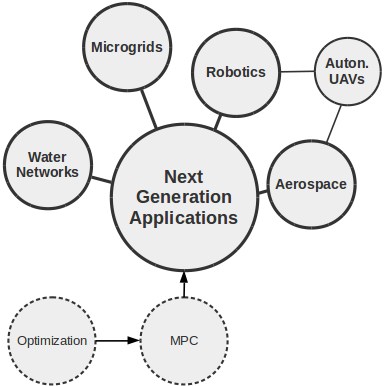
- E Small, P Sopasakis, E Fresk, P Patrinos and G Nikolakopoulos, Aerial navigation in obstructed environments with embedded nonlinear model predictive control, IEEE European Control Conference (ECC), 2019 (pdf, demo)
- A.S. Sathya, P. Sopasakis, R. Van Parys, A. Themelis, G. Pipeleers and P. Patrinos, Embedded nonlinear model predictive control for obstacle avoidance using PANOC, European Control Conference (ECC), Limassol, Cyprus, June 2018 (demo, pdf).
- P. Sopasakis, A.K. Sampathirao, A. Bemporad and P. Patrinos, Uncertainty-aware demand management of water distribution networks in deregulated energy markets, Environmental Modelling & Software, 2018. (github).
- A.K. Sampathirao, J.M. Grosso, P. Sopasakis, C. Ocampo-Martinez, A. Bemporad and V. Puig (2014), Water demand forecasting for the optimal operation of large-scale drinking water networks: The Barcelona Case Study, 19th IFAC World Congress, Cape Town, South Africa (pdf, slides, bibtex)
- C. A. Hans, P. Sopasakis, A. Bemporad, J. Raisch and C. Reincke-Collon, Scenario-based model predictive operation control of islanded microgrids, 54 IEEE Conf. Decision and Control, Osaka, Japan, Dec 2015 (pdf, bibtex).
- D. Herceg, G. Georgoulas, P. Sopasakis, M. Castano, P. Patrinos, A. Bemporad, J. Niemi and G. Nikolakopoulos, Data-driven modelling, learning and stochastic predictive control for the steel industry, IEEE MED 2017, 2017 (bibtex).
- P. Sopasakis, D. Bernardini, H. Strauch, S. Bennani and A. Bemporad, Sloshing-aware attitude control of impulsively actuated spacecraft, (tutorial paper), European Control Conference (IFAC), Linz, Austria, July 15-17, 2015 (pdf, slides, bibtex).
- P. Sopasakis, D. Bernardini, H. Strauch, S. Bennani and A. Bemporad, A Hybrid Model Predictive Control Approach to Attitude Control with Minimum-Impulse-Bit Thrusters, European Control Conference (IFAC), Linz, Austria, July 15-17, 2015 (pdf, slides, bibtex).
KIOS Summer School 2018
In September 2018, I gave a lecture entitled Identification of nonlinear systems by kernel methods (part 1, part 2) at KIOS Graduate Summer School 2018 on Intelligent Systems and Control.
The lecture was a 90' introduction to system identification with special focus on kernel-based methods and was followed by a competition on kaggle where the participants used input-output data to identify a discrete-time nonlinear system.
P&O EAGLE, KU Leuven
I taught the control theory and autonomous navigation module (lectures and lab exercises) of the course P&O Eagle at ESAT, KU Leuven. P&O Eagle is a drone with computer vision and navigation capabilities.
- Course slides
- Quaternion-based modelling
- Addendum: quaternions
- C programming guide
- MATLAB programming guide
- Video lectures
Here is a video presentation made by students...
Control Systems, IMT Lucca
In the winter semester of 2016 I gave the PhD course advanced topics in control systems in IMT Lucca. The course focused on economic model predictive control, control of linear and nonlinear Markovian switching systems, risk measures and risk-averse optimal control.
Highlights

SuperSCS: Fast and accurate conic solver
SuperSCS is a fast solver for large-scale conic problems of the form
\begin{eqnarray*} && \mathrm{Minimize}\ c' x \\ &&Ax + s = b\\ &&s\in\mathcal{K}, \end{eqnarray*}
where \(A\in\mathbb{R}^{m\times n}\) is a (sparse) matrix, and \(\mathcal{K}\) is a closed, convex, proper cone. SuperSCS is based on the algorithmic scheme SuperMann applied to a Douglas-Rachford splitting on the self-dual homogeneous embedding of the original problem.
SuperSCS achieves higher accuracy and faster convergence compared to SCS as you can see for example here.

Risk-averse Model Predictive Control
Risk-averse model predictive control (MPC) offers a control framework that allows one to account for ambiguity in the knowledge of the underlying probability distribution and unifies stochastic and worst-case MPC.
Risk-averse MPC can be employed in presence of ambiguity on the knowledge of the actual probability distribution of the system disturbances.
We have studied risk-averse MPC problems for constrained nonlinear Markovian switching systems using generic cost functions, and derive Lyapunov-type risk-averse stability conditions by leveraging the properties of risk-averse dynamic programming operators.
We propose a controller design procedure to design risk-averse stabilizing terminal conditions for constrained nonlinear Markovian switching systems.
Additionally, we cast the resulting risk-averse optimal control problem in a favourable form which can be solved efficiently and thus deems risk-averse MPC suitable for embedded applications.
NEW: Checkout our new MATLAB toolbox that allows the formulation and solution of general risk-averse problems with risk constraints.

RapidNet
RapidNet is an open-source software written in CUDA-C++ involving open-source libraries (cuBLAS and rapidjson) which allows the easy design of stochastic model predictive controllers for drinking water networks taking into account the volatility associated with water demands and price uncertainty in a deregulated bid-based energy market.
Some of the features of RapidNet are:
- Efficient operating management of drinking water networks
- Uncertainty on demands and electricity prices
- Mitigation of the volatility in electricity cost
- Very fast Stochastic Model Predictive Control
- Parallelization on NVIDIA Graphics Processing Units (GPU)

Embedded Nonlinear MPC
This is an ANSI C embedded control framework for nonlinear model predictive control which implements a very fast nonconvex optimization solver with convergence guarantees that significantly outperforms SQP/SCP approaches. It is particularly suitable for robotic applications.
In this video, the embedded nonlinear predictive controller is used to drive an autonomous ground vehicle...
and on a micro aerial vehicle...

Fast Online Compressive Sensing
Compressed sensing is a signal processing methodology for the reconstruction of sparsely sampled signals and it offers a new paradigm for sampling signals based on their innovation, that is, the minimum number of coefficients sufficient to accurately represent it in an appropriately selected basis. Compressed sensing leads to a lower sampling rate compared to theories using some fixed basis and has many applications in image processing, medical imaging and MRI, photography, holography, facial recognition, radio astronomy, radar technology and more.
The traditional compressed sensing approach is naturally offline, in that it amounts to sparsely sampling and reconstructing a given dataset. Recently, an online algorithm for performing compressed sensing on streaming data was proposed (Freris et al., 2013): the scheme uses recursive sampling of the input stream and recursive decompression to accurately estimate stream entries from the acquired noisy measurements.
In this work we developed a recursive compressed sensing algorithm which makes use of a Forward-Backward Newton (FBN) method to efficient solve the involved LASSO problems in real time. Our simulations showed significant speed-up compared to all well-established algorithms for such problems such as (F)ISTA, ADMM and the L1LS algorithm by Kim et al. Exploiting the fact that in recursive LASSO the optimizer at time k can be used to produce a good estimate at time k+1, and using the fact the FBN converges to the solution locally quadratically, at every sampling time we only need to perform a few Newton iterations.

Jaqpot Quattro
JAQPOT Quattro is a comprehensive open-source web application for linking molecular structure with biological properties and effects of chemical compounds and nanomaterials to living organisms. JAQPOT Quattro uses machine learning algorithms to extract knowledge out of structured databased.

Stochastic control of large-scale water networks
Drinking water networks are large-scale systems whose operation is characterised by complex uncertainty patterns. Pressures across the network need to be kept in certain limits, tanks must not overflow and water demand requirements must be met, while unexpectedly high demands and electricity prices may signal the alarm in the control centre of the network. Water demand and energy price are fluctuating uncertain parameters that deem the control of these systems rather challenging and dictate computationally intense operations for the determination of how valves and pumps need to be operated for a smooth, economic and safe operation of the whole infrastructure.
We have proposed as optimisation-based control scheme which accounts for the aforementioned uncertainty. The resulting optimisation problems involve more than 1 million decision variables and has to be solved in real time. Modern high-end CPUs require up to several minutes for their solution; We employed an accelerated proximal gradient (APG) algorithm which can be vastly parallelised and solved on a GPU to afford computation times down to a few tens of a second! These developments pave the way for the use of optimisation-based control algorithms (such as stochastic model predictive control) in large-scale water networks which - as simulations show - can lead to a significant reduction of energy consumption, higher quality of service and a smoother operation of the network.
SuperSCS
We proudly present SuperSCS: a super-(linearly) fast solver for conic optimization problems. Optimization software often cast convex problems into conic ones and delegate their solution to solvers in the backend. Based on the implementation of the popular solver SCS, we implemented a new algorithm which leads to manifold speed-ups.
Software, OptimizationOptimization on GPUs
This is a CUDA-implementation of an dual accelerated proximal gradient algorithm for scenario-based model predictive control problems. The structure of the optimization problem is employed to accelerate computations; very high speedups (ranging from x10 up to x100) are observed compared to the corresponding GPU implementation.
GPU, Numerical OptimizationFast Comppressive Sensing
A remarkably fast algorithm for recursive compressive sensing which is about one order of magnitutde faster compared to state-of-the-art algorithms (L1LS, ISTA, FISTA).
Numerical OptimizationControl of Water Networks
Drinking water networks are large-scale systems whose operation is characterised by complex uncertainty patterns. Pressures across the network need to be kept in certain limits, tanks must not overflow and water demand requirements must be met, while unexpectedly high demands and electricity prices may signal the alarm in the control centre of the network. Scenario-based stochastic model predictive control is an advanced control methodology which can address the problem of controlling such systems very efficiently leading to a considerable reduction in operating costs and a higher quality of service.
Stochastic MPC, Control, DWNJaqpot Quattro
JAQPOT Quattro is a predictive toxicology platform on the web which combines machine learning, cheminformatics, linked data and web technologies with the OpenTox and eNanomapper APIs to deliver a generic and interoperable solution for drug discovery.
Software, ChemiformaticsEmbedded Nonlinear MPC
This is an ANSI C embedded control framework for nonlinear model predictive control which implements a very fast nonconvex optimization solver with convergence guarantees that significantly outperforms SQP/SCP approaches. It is particularly suitable for robotic applications.
Software, Optimization, ControlNEWS
Special issue on Visual Perception for Micro Aerial Robots
In am a guest editor for the special issue on Visual Perception for Micro Aerial Robots in Journal of Intelligent and Robotic Systems, Springer.
Together with Prof. George Nikolakopoulos, LTU and Prof. Andreas Nuechter, Uni. Würzburg, we seek to attract high quality manuscripts on a series of topics related to vision and guidance, navigation and control (GNC) for unmanned aerial vehicles (UAVs) and especially aerial robots.
The purpose of this special issue is to address theoretical and application-oriented problems in the general area of visual perception for micro-aerial robots and to identify and provide key perception solutions that meet the real-time constraints posed by aerial vehicles, following recent advances in computer vision and robotics.
Topics of interest include (but are not limited to):
- Vision-based control and visual servoing
- Visual navigation, mapping, and SLAM
- Cooperative perception using multiple platforms
- Vision-assisted floating-base manipulation
- Deep Learning for visual perception
- Object recognition, tracking, semantic and 3D vision techniques
- Fusion of vision with other sensing systems, e.g., laser scanner
- Advanced visual sensors and mechanisms (event-based, solid state sensors, LiDAR, RGB-D, time-of-flight cameras, etc.)
- Aerial robot applications on key enabling perception technologies
- Model predictive control for vision-based autonomous navigation
- Reinforcement learning for visual perception.
Manuscripts should describe original and previously unpublished results which are not currently considered for publication in any other journal.
All manuscripts shall be submitted electronically, and will undergo a peer-review process.
For further details, please, consult the Journal website or contact me or the Guest Editors.
Check out the announcement on WikiCFP.